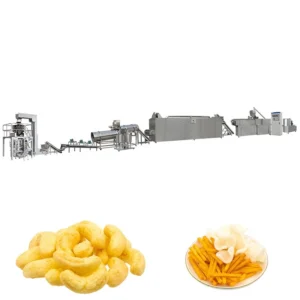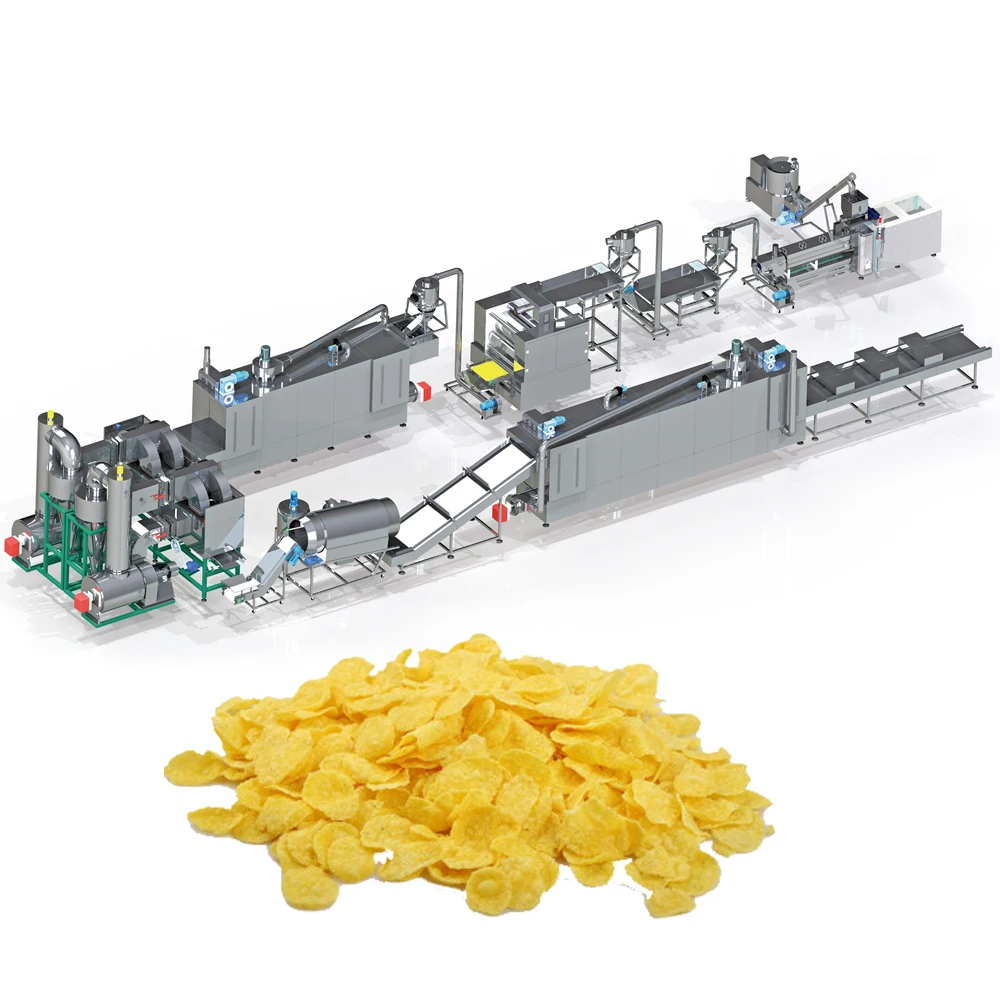
Twin-Screw Co-Rotating Extrusion — Sectional screw modules and matched die geometry give process engineers direct control over starch gelatinisation, expansion ratio and final corn flake density across grain blends.
Technical Specifications
| Parameter | Value |
|---|---|
| Model | MT-65 / MT-70 / MT-75 / MT-85 |
| Product Type | Corn Flakes and Breakfast Cereal Extrusion Production Line |
| Screw Type | Co-rotating twin-screw, sectional modules |
| Extruder Functions | Forward/backward transport, mixing, de-gassing, cooking, forming |
| Gearbox Lubrication | Oil-forced automatic lubrication system |
| Cutting System | Non-stop cutting |
| Self-Cleaning | Yes (twin-screw self-cleaning function) |
| Contact Materials | Food-grade stainless steel |
| Installed Power (MT-65) | 84 kW |
| Real Power (MT-65) | 59 kW |
| Output Capacity (MT-65) | 120–150 kg/h (basis not stated in source — confirm raw material type and moisture content) |
| Dimension (MT-65) | 12000 × 1200 × 2200 mm |
| Installed Power (MT-70) | 132 kW |
| Real Power (MT-70) | 92 kW |
| Output Capacity (MT-70) | 200–250 kg/h (basis not stated in source — confirm raw material type and moisture content) |
| Dimension (MT-70) | 23000 × 1500 × 2200 mm |
| Installed Power (MT-75) | 186 kW |
| Real Power (MT-75) | 140 kW |
| Output Capacity (MT-75) | 300–400 kg/h (basis not stated in source — confirm raw material type and moisture content) |
| Dimension (MT-75) | 24000 × 1500 × 2800 mm |
| Installed Power (MT-85) | 239 kW |
| Real Power (MT-85) | 167 kW |
| Output Capacity (MT-85) | 400–500 kg/h (basis not stated in source — confirm raw material type and moisture content) |
| Dimension (MT-85) | 28000 × 1500 × 2800 mm |
| Mixer Power | 4 kW |
| Mixer Tank Size | φ600 × 500 mm |
| Corn Flakes Press Power | 16.12 kW |
| Corn Flakes Press Roller Size | 510 × 310 × 1050 mm |
| Oven Heating | Gas, both-side baking |
| Oven Power | 3.75 kW |
| Sugar Spraying System Power | 28.75 kW |
| Sugar Spraying Roller Size | Ø600 × 2700 mm |
| Control System | Available with PLC or MCC control (verify configuration) |
| Voltage & Frequency | Configurable to buyer’s facility (confirm before order) |
| Standards | CE |
| Warranty | 1 year, lifetime maintenance |
| Lead Time | 5–30 days after advance payment |
Application Suitability
| Application | Material or Output |
|---|---|
| Corn flakes production | Corn grits and corn flour at controlled moisture |
| Oat and multi-grain breakfast flakes | Oat blends, rice flour, wheat flour combinations |
| Fortified breakfast cereals | Grain flour with added vitamin and mineral premix |
| Puffed and extruded snack shapes | Corn, rice and wheat flour bases |
| Core-filled snack formats | Grain shell with sugar or nut-based filling |
What the Nominal Capacity Figure Does Not Tell You About Flake Density
Capacity ratings only matter when tied to your specific grain blend and moisture content.
I spent a week on a breakfast cereal line where the extruder was sized correctly on paper, but the corn flakes came out dense and sank in the bowl. The problem was not the motor or the barrel diameter — it was the screw configuration, which had been copied from a standard corn grits setup while the customer was running a corn-oat blend. Starch gelatinisation behaved completely differently, and the expansion profile collapsed right at the die face. That is a pattern I keep seeing: buyers receive an extruder rated at a nominal throughput, only to discover the flake density, bowl-life and surface texture fall outside what their market requires. The corn flakes extrusion line extrusion technology only delivers when screw geometry, barrel temperature zones and die design are matched to your actual raw material before the machine leaves the factory. [NEED_CITE: starch gelatinisation behaviour across grain types in extrusion]
Barrel Zone Profile and Starch Gelatinisation Control
The co-rotating twin-screw design processes material through distinct functional zones along the barrel length. Mixing, de-gassing, cooking and forming happen in a single continuous pass, and the sectional screw modules allow the process engineer to rearrange conveying, kneading and shear elements for each grain formulation. When the corn flakes extrusion line extrusion technology is tuned correctly, the barrel temperature profile drives a predictable gelatinisation curve — under-gelatinised starch produces brittle flakes that shatter during pressing, while over-gelatinised dough sticks to the press rollers.
Die Geometry and Expansion Ratio at the Cut Face
Die aperture size and land length determine how much the extrudate expands as it exits the barrel. For corn flakes, the target is a controlled, moderate expansion that the downstream press can flatten into a uniform sheet. The non-stop cutting system slices the extrudate into consistent pellets before they reach the press roller, and any mismatch between die geometry and cutting speed shows up immediately as irregular pellet weight. The oil-forced automatic gearbox lubrication keeps the extruder running without scheduled stops, which matters when you need uninterrupted thermal equilibrium across the barrel zones to hold die-face expansion steady. [NEED_CITE: die land length and expansion ratio in twin-screw extrusion]
Reading the Specification Sheet Against Your Process Requirements
The MT-85 delivers higher installed power (239 kW) and a larger footprint (28000 × 1500 × 2800 mm) compared to the MT-65 (84 kW, 12000 × 1200 × 2200 mm), but the meaningful comparison is how each model handles your material’s residence time and shear requirements. Co-rotating twin screws with sectional modules give operators flexibility to change screw element sequencing without replacing the entire shaft. The self-cleaning function reduces residue build-up between product changeovers, which is relevant when a line shifts from plain corn flakes to a sugar-coated or fortified formulation. Real power draw figures (59 kW for MT-65, 167 kW for MT-85) indicate actual energy consumption during operation, not just the motor nameplate rating, and this distinction affects utility planning for the facility.
The Hidden Cost of a Mismatched Press and Oven Stage
A twin-screw extruder producing well-gelatinised pellets means nothing if the downstream press and oven cannot keep up. I have seen lines where the extruder ran fine but the press roller had no cooling system, so pellets stuck to the surface and flake thickness varied across the bed. The corn flakes press on this line includes an adjustable roller distance for flake thickness control and an integrated cooling system to prevent adhesion. Similarly, the gas-fired high-temperature oven uses both-side baking to remove moisture evenly — a single-side heat source leaves the bottom of the flake bed softer and more prone to breakage during packing. When throughput is unbalanced between stations, the extruder idles or the oven starves, and the line never reaches its intended steady-state output. [NEED_CITE: throughput balancing in sequential food processing lines]
Why Process Engineers Choose This Extrusion Platform
The complete line runs from mixing through extrusion, pressing, baking and coating under one supplier, so throughput between each station is matched rather than assembled from separate vendors with unknown interface points. Screw configuration and die design are specified to the buyer’s raw material and target flake density, not pulled from a generic build library. The in-house testing workshop allows trial runs on your actual grain blend before shipment, so screw element sequencing and barrel zone temperatures are validated on real material. Twin-screw expertise spans corn flakes, oat-based flakes, multi-grain cereals and fortified breakfast formats, with each formulation receiving its own screw and die configuration record. The sugar spraying system with Ø600 × 2700 mm roller provides coating capacity matched to the extruder output, preventing the bottleneck that appears when seasoning capacity falls behind upstream throughput.
Documentation & Verification
- Line layout and capacity calculation based on your grain blend and target flake weight
- Screw and die configuration record matched to your raw material test results
- Trial run report on your actual corn grits or oat blend before shipment
- Electrical schematic with voltage and frequency confirmed to your facility
- Machine specification sheet showing installed versus real power draw
- CE declaration of conformity with electronic edition certificates
Installation, Commissioning & Support
- Foundation and floor space planning matched to line dimensions (up to 28000 mm length for MT-85)
- Dedicated electrical circuit sized to real power draw (up to 167 kW for MT-85)
- On-site assembly and barrel alignment for twin-screw modules by commissioning engineers
- First-run parameter setting for screw speed, barrel zone temperatures and die face cutting
- Operator training covering screw configuration changes, press roller gap adjustment and self-cleaning procedures
- Wear parts list with screw elements, die plates and press roller consumables identified
Before You Request a Quotation
To configure the corn flakes extrusion line extrusion technology around your production target, provide your raw material specification (corn grits, oat blend, multi-grain formula and moisture content), your target flake density and bowl-life requirement, and your facility voltage, frequency and control language preference. If you have existing upstream mixing or downstream packing equipment, share the interface details so the line layout accounts for those connection points.
Frequently Asked Questions
Q: How is screw configuration selected for different grain blends?
A: Sectional screw modules are rearranged to change the ratio of conveying, kneading and shear elements along the barrel. For high-starch corn grits, the configuration emphasises gradual gelatinisation, while oat blends with higher fibre content need more aggressive mixing zones. The final arrangement is validated through a trial run on your actual material in the testing workshop before the machine ships.
Q: How is output capacity confirmed against my raw material?
A: Nominal capacity figures assume standard conditions that may not match your grain blend or moisture content. The testing workshop runs your actual material through the extruder to measure real throughput, and the specification sheet is updated with those results. This means the capacity figure you receive reflects your formulation, not a generic baseline.
Q: What controls final flake thickness and density?
A: Die aperture size at the extruder determines pellet diameter, the press roller gap sets flake thickness, and the oven temperature profile develops the final crispness and density. These three parameters are adjusted together during the trial run to hit your target bowl-life specification. The corn flakes press includes adjustable roller distance and an integrated cooling system to hold consistent thickness across production runs.
Q: How is starch gelatinisation monitored during production?
A: Barrel zone temperatures, screw speed and moisture content at the mixer stage together determine gelatinisation degree. Process engineers track extrudate appearance and expansion behaviour at the die face as real-time indicators. Adjustments to individual barrel heating zones or screw element sequencing correct any drift before it affects downstream flake quality.
Q: How is throughput balanced across the full line?
A: Each station — mixer, extruder, press, oven, sugar spraying drum — is sized so that none becomes a bottleneck at the line’s intended running speed. The sugar spraying system with 28.75 kW total power and the gas-fired oven with both-side baking are matched to the extruder model selected. Line layout documentation shows calculated throughput at every stage to confirm balance before equipment is built.