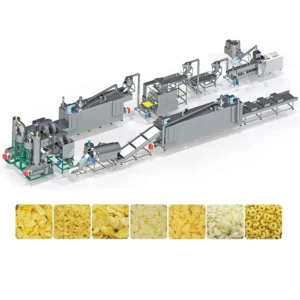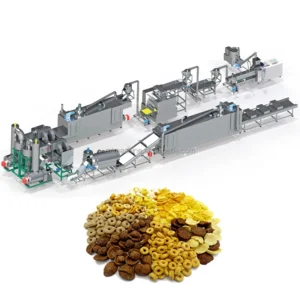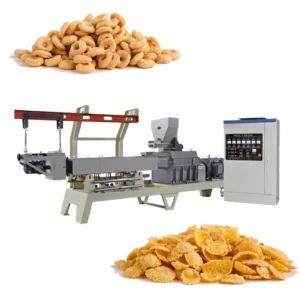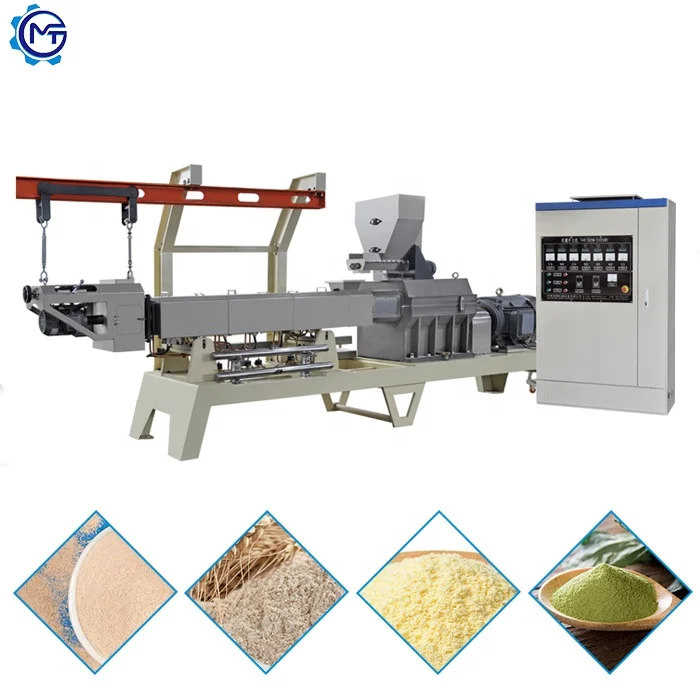
Screw Configuration Matched to Formulation — Every MT70, MT85, and MT75 extruder ships with screw elements and die geometry selected against the buyer’s actual grain blend, not copied from a generic build sheet.
Technical Specifications
| Parameter | Value |
|---|---|
| Model | MT70 / MT85 / MT75 |
| Product Type | Corn Flakes Breakfast Cereal Extrusion Line |
| Screw Type | Twin Screw |
| Installed Power | MT70 — 160 kW; MT85 — 190 kW; MT75 — 210 kW |
| Power Consumption | MT70 — 120 kW; MT85 — 140 kW; MT75 — 150 kW |
| Output Capacity | MT70 — 150–200 kg/h (basis to be confirmed); MT85 — 300–400 kg/h (basis to be confirmed); MT75 — 300–500 kg/h (basis to be confirmed) |
| Overall Dimensions | MT70 — 41 × 1.5 × 2.2 m; MT85 — 43 × 1.5 × 3.2 m; MT75 — 45 × 1.5 × 3.5 m |
| Control System | PLC with MCC integration across the line |
| Heating Source (Dryer) | Gas or Electric |
| Flaking Roller Drive | Double motors with hydraulic system |
| Temperature Control (Flaking) | Infrared sensor for uniform pipe temperature |
| Roasting Oven | Hot air circulation, dual circulating fans, cyclone dust removal |
| Coating System | Double tumble sugar melting, elevator, coating drum, spraying nozzle |
| Screw Material | Special wear-resistant alloy |
| Voltage & Frequency | Configurable (e.g. 415 V / 50 Hz, 440 V / 60 Hz, 220 V / 60 Hz) |
| Assembly State | Complete turnkey line |
| Standards | CE, ISO |
Application Suitability
| Application | Material or Output |
|---|---|
| Natural corn flakes production | Corn grits, maize flour |
| Sugar-coated corn flakes | Corn base with sugar syrup coating |
| Shaped breakfast cereal snacks | Rice, wheat, oat, barley blends formed into rings, loops, stars, balls, tubes |
| Fortified breakfast cereals | Cereal powders blended with vitamin and mineral premix |
| Multi-grain flake production | Mixed grain formulations including corn, rice and oat |
What Nominal Capacity Figures Leave Out About Corn Flake Lines
A quoted throughput only matters when verified against your specific grain blend, moisture level, and target flake density.
I spent a week in a Colombian plant where the corn flakes line ran perfectly during the factory trial on standard corn grits, then collapsed the moment the buyer switched to a local sorghum-and-corn mix. The flakes came out thick, dense, more like crackers than cereal. The extrusion screw configuration that worked on pure corn could not handle the different starch gelatinisation behaviour of sorghum. The buyer lost days of production before the screw elements were swapped and die clearances reset [NEED_CITE: starch gelatinisation behaviour differences between corn and sorghum in extrusion]. That is exactly the gap between a generic capacity number and a corn flakes extrusion line manufacturer who tests on your raw material before the machines leave the factory.
How Barrel Temperature Profile Shapes Flake Expansion
The twin-screw extruder in this line controls starch gelatinisation through a multi-zone barrel temperature profile combined with specific screw element sequencing. Feeding zones use lower shear to hydrate the grain particles, while the metering and high-shear zones that follow push the material through the temperature window where starch granules rupture and gelatinise. This is the stage that determines whether the extrudate will expand properly at the die face or collapse into a dense rope. Getting the corn flakes extrusion line manufacturer to document the exact screw configuration and barrel temperatures for your formulation is the difference between consistent flake texture and constant line adjustments.
Die Design and Moisture Control for Target Flake Density
The die opening geometry, combined with the moisture content at the die face, sets the initial expansion ratio of the extrudate rope before it enters the flaking rollers. A wider die with higher moisture produces a thicker, softer rope suited to natural corn flakes, while a narrower die at lower moisture gives a denser extrudate for sugar-coated variants that must survive the coating drum without breaking apart. The hydraulic double-roller flaking station then compresses this rope into the target sheet thickness, with infrared temperature monitoring keeping the roller surface even across its full width [NEED_CITE: relationship between die geometry and flake density in cereal extrusion].
Reading the Specs That Actually Matter
The installed power across the MT70, MT85, and MT75 models — 160 kW, 190 kW, and 210 kW respectively — reflects the mechanical and thermal energy required for twin-screw extrusion of cereal doughs at different throughputs. Higher installed power supports longer barrel sections with more heating zones, giving finer control over the gelatinisation curve. The PLC control with MCC integration means the barrel temperature setpoints, feeder rates, and flaking roller gap are managed from a single interface, reducing the operator variables that cause batch-to-batch density drift. Hot air roasting with dual circulating fans and cyclone dust removal gives controlled surface blistering — the characteristic toasted appearance — without scorching the flake interior.
The Cost of Skipping Raw Material Trials
When a cereal line arrives at the buyer’s plant and the first run produces flakes that are too thick, too brittle, or the wrong colour, every hour of troubleshooting is an hour of lost production. I have seen plants run trial-and-error for weeks, burning through raw material and packaging, because the screw configuration was spec’d on a reference grain rather than the buyer’s actual supply. In some cases the dryer and roaster capacities were also mismatched — sized for a nominal output that the extruder could never sustain on the local formulation [NEED_CITE: common causes of startup delays in cereal processing lines].
Why Procurement Works Differently Here
Every station from mixing through roasting is sized as a single system, so the dryer and cooler are matched to the extruder’s real output on the buyer’s formulation rather than pulled from a generic catalogue. The screw and die configuration is documented specifically to the raw material and target flake density before production begins. An in-house testing workshop runs trial production on customer-supplied raw material, generating a trial report that travels with the shipment. PLC and MCC integration across the line means barrel profiles, flaking pressure, and roasting temperatures are recipe-controlled for repeatable results. Pre-sales consultation carries through to on-site installation, operator training, and wear parts support.
Documentation & Verification
- Line layout and capacity calculation matched to your grain blend and target throughput
- Screw and die configuration record specifying the build for your formulation
- Trial run report from in-house testing on your raw material before dispatch
- Electrical schematic with voltage and frequency confirmed for your market
- CE declaration of conformity and ISO certificate included with shipment
- Wear parts list with screw elements, dies, and flaking roller specifications
Installation, Commissioning & Support
- Foundation plan reflects the 41–45 m line length and station weights for your floor slab
- Dedicated power circuits sized to the MT70–MT75 installed power range of 160–210 kW
- Line arrives in sectional assemblies with marked connections for sequential installation
- Commissioning includes barrel temperature mapping and flaking roller gap calibration
- Operator training covers PLC recipe management and MCC fault response procedures
- Spare screw elements, dies, and flaking roller segments stocked for first replacement
What to Include With Your Inquiry
To configure the right line, share your primary grain or grain blend, typical moisture content at the mixer, target flake density, and whether you need natural or sugar-coated output. Your local voltage and frequency, preferred control language, and available workshop dimensions help us finalise the layout and electrical specifications before quotation.
Frequently Asked Questions
Q: How is capacity verified on my specific raw material and moisture level?
A: We run a trial in our in-house testing workshop using a sample of your actual grain blend at your typical moisture content. The results — throughput, extrudate expansion, flake thickness — are documented in a trial run report that accompanies the shipment, so you know the verified output before the line arrives at your plant.
Q: How is screw and die configuration chosen for my target flake texture and density?
A: The screw element sequence and die geometry are selected based on your raw material’s starch composition and your target flake density. We document the configuration in a build record, so any future adjustments or replacement parts match the original specification that produced your approved sample.
Q: Can a trial run be done on my raw material before shipment?
A: Yes. Send a representative sample of your grain blend to our testing workshop. We run the full extrusion, flaking, and roasting sequence and produce a trial report covering output rate, flake dimensions, surface colour, and crispness, giving you a verified baseline before installation begins.
Q: What voltage, frequency and control language will be confirmed before commissioning?
A: Before production starts, we confirm your site voltage and frequency — configurations such as 415 V 50 Hz, 440 V 60 Hz, or 220 V 60 Hz are available. The PLC and HMI language are set to your operator preference, and an electrical schematic reflecting these choices ships with the line.
Q: Are spare wear parts such as screws, dies and flaking rollers available when needed?
A: A wear parts list is included with every shipment, identifying screw elements, die plates, and flaking roller segments specific to your machine configuration. Replacement parts are manufactured to the same specification as the originals, ensuring consistent flake quality through subsequent change-outs.