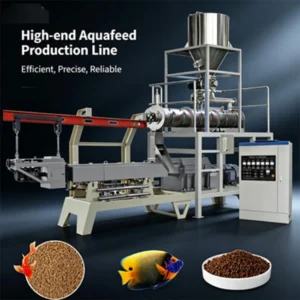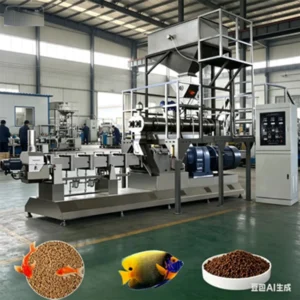
Matched screw and die design — barrel zones and pellet cutting mechanism tuned to the buyer’s raw material formulation, verified on actual feedstock before shipment rather than relying on generic configurations.
Technical Specifications
| Parameter | Value |
|---|---|
| Product Type | Twin Screw Fish Feed Extrusion Production Line |
| Screw Type | Twin-screw |
| Output Capacity | 500 kg/h (basis not stated in source — confirm raw material formulation / moisture / pellet diameter) |
| Pellet Size Range | 0.5 mm – 12 mm |
| Control System | Simple control panel (PLC / MCC not specified in source) |
| Structure Material | Stainless steel (main parts) |
| Automation Level | Fully automatic continuous operation |
| Line Stations | Feeding, mixing, extruding, pelletizing |
| Feed Type Supported | Floating and sinking aquatic feed |
Application Suitability
| Application | Material or Output |
|---|---|
| Floating aquaculture pellets for grow-out fish | Soybean meal, fish meal, corn flour blends at controlled moisture |
| Sinking bottom-feed pellets for shrimp and catfish | High-protein formulations with adjusted barrel temperature profile |
| Fry-stage micro pellets (0.5–2 mm) | Fine-ground raw materials with specialized die plate configuration |
| Large-diameter pellets for pond and cage systems (8–12 mm) | Coarse grain mixes requiring extended barrel residence time |
Why Density Control Fails Before the Dryer Even Starts
Floating and sinking pellet density is decided inside the barrel, not downstream.
A buyer sets up a new aquatic feed line, runs a trial, and watches half the floating pellets sink to the bottom of the test tank. The immediate instinct is to blame the dryer temperature or the cooling conveyor speed. But the real problem almost always traces back to how shear force, moisture injection, and barrel zone temperatures interact inside the extruder. When screw configuration is copied from a generic template rather than matched to the buyer’s actual protein-to-starch ratio, the expansion rate drops and pellet density climbs past specification. I have seen entire commissioning schedules slip by weeks because the twin screw fish feed extruder extrusion technology parameters were never validated against the production formulation [NEED_CITE: aquaculture feed density specifications by species].
Shear, Moisture and Barrel Zone Tuning
The twin-screw mechanism generates uniform shear across the barrel cross-section, which is what separates consistent pellet expansion from batch-to-batch variation. Each barrel zone can be heated or cooled independently, so the temperature profile follows the starch gelatinisation curve of the specific raw material blend. Moisture content at the feed inlet directly affects how much expansion occurs at the die face. Getting this balance right is the core of twin screw fish feed extruder extrusion technology — it determines whether a pellet holds air pockets for buoyancy or compresses into a sinking format.
Die Configuration and Pellet Diameter Range
Swapping from a 12 mm grow-out pellet to a 0.5 mm fry pellet requires more than changing the die plate hole diameter. The screw speed, feed rate, and cutter mechanism all shift to maintain forming pressure and cut consistency at smaller diameters. A line that handles this full 0.5–12 mm range on a single extruder body gives producers the flexibility to serve multiple aquaculture stages without investing in separate machines [NEED_CITE: pellet diameter requirements across fish growth stages]. The stainless steel contact surfaces across barrel and screw assemblies also keep feed-grade hygiene standards intact during changeovers.
Reading the Spec Sheet Against Your Actual Formulation
The rated output of 500 kg/h is a reference figure that shifts depending on raw material density, moisture content, and target pellet diameter. A high-protein sinking feed formulation behaves very differently from a corn-dominant floating mix inside the same barrel. Twin-screw systems allow operators to adjust screw element arrangement — combining forwarding flights, kneading blocks, and reverse elements — to match the viscosity curve of each recipe. The control panel manages barrel zone temperatures and screw speed, but the mechanical configuration underneath is what actually governs residence time and shear intensity.
What Happens When Configuration Is Skipped
A generic screw build pushed through production without a trial run on the buyer’s raw material leads to predictable problems: floating pellets that sink, sinking pellets that disintegrate too fast, or pellet diameters drifting outside tolerance after the first hour of operation. The density misses are not random — they repeat every shift because the mechanical setup was never matched to the formulation. Correcting this after installation means shipping replacement screw elements, scheduling another commissioning visit, and absorbing the downtime cost of a line that should have been producing [NEED_CITE: extrusion screw element replacement logistics].
Why Sourcing Here Addresses the Configuration Gap
Every screw configuration and die design is specified to the buyer’s raw material and target pellet type, not pulled from a standard build sheet. The in-house testing workshop runs the buyer’s actual formulation before shipment, generating a trial report that documents float or sink density, pellet diameter consistency, and expansion rate. This twin screw fish feed extruder extrusion technology approach means product development happens before the crate is sealed, not after the machine arrives on the factory floor. Line layout and capacity calculation are based on the buyer’s specific formulation rather than nominal catalog figures.
Documentation & Verification
- Screw and die configuration record matched to your specific aquatic feed formulation
- Trial run report on your raw material confirming float or sink density before dispatch
- Electrical schematic with voltage and frequency confirmed to your local grid standard
- Line layout and capacity calculation based on your actual recipe, not nominal values
- Operation and maintenance manual with wear parts list for screw elements and die plates
Installation, Commissioning & Support
- Foundation and utility planning based on the full line station footprint from feeding through pelletizing
- Power supply verification matching the control panel voltage and frequency to local grid specifications
- On-site assembly supervision covering barrel alignment and screw element sequencing
- First-run parameter setting using your raw material to confirm pellet density targets
- Operator training on die changeover procedures across the 0.5–12 mm pellet range
- Spare screw elements and die plates identified and listed for initial inventory planning
What to Prepare Before Requesting a Quote
Send your raw material formulation with protein, starch, and moisture percentages, along with the target pellet diameters and whether you need floating or sinking output for each size. Include your local voltage and frequency standard, and the control panel language preference for your operators. If you have existing upstream mixing or downstream drying equipment, note the connection points so the line layout accounts for integration.
Frequently Asked Questions
Q: How is floating versus sinking pellet density controlled through screw configuration and barrel temperature?
A: Floating pellets require higher expansion at the die face, achieved by adjusting kneading block placement in the screw assembly and raising specific barrel zone temperatures to promote starch gelatinisation. Sinking pellets need compressed density, so screw elements are arranged to increase shear and reduce expansion. Each barrel zone is tuned independently to match the formulation’s gelatinisation curve.
Q: What trial runs are performed on my raw material before shipment?
A: The testing workshop processes your actual feedstock through the extruder, measuring pellet expansion rate, float or sink behavior, diameter consistency, and surface texture. A written trial report documents these results alongside the screw configuration and barrel temperature profile used, so the same parameters can be replicated during on-site commissioning.
Q: How is screw and die configuration selected for my specific feed formulation?
A: The selection starts with your raw material composition — protein ratio, starch source, fat content, and target moisture. Screw elements are arranged to deliver the shear and residence time that formulation requires, while die hole diameter and land length are matched to your pellet size range. This twin screw fish feed extruder extrusion technology setup is documented before production begins.
Q: How does extruder output capacity relate to my actual raw material and pellet diameter?
A: The stated capacity reference shifts depending on formulation density, moisture content, and die configuration. A high-protein sinking feed running through small-diameter dies produces lower throughput than a starch-dominant floating mix on large dies. Capacity calculation uses your specific recipe and target pellet size to give a realistic output figure for planning.