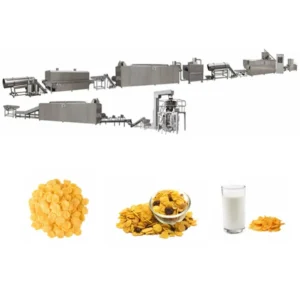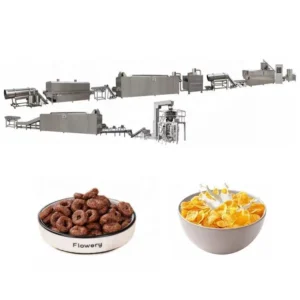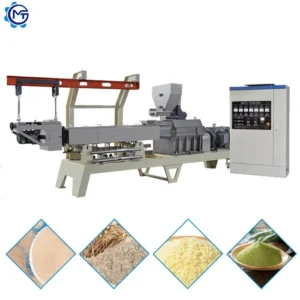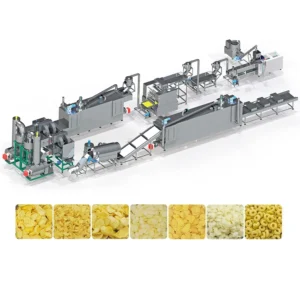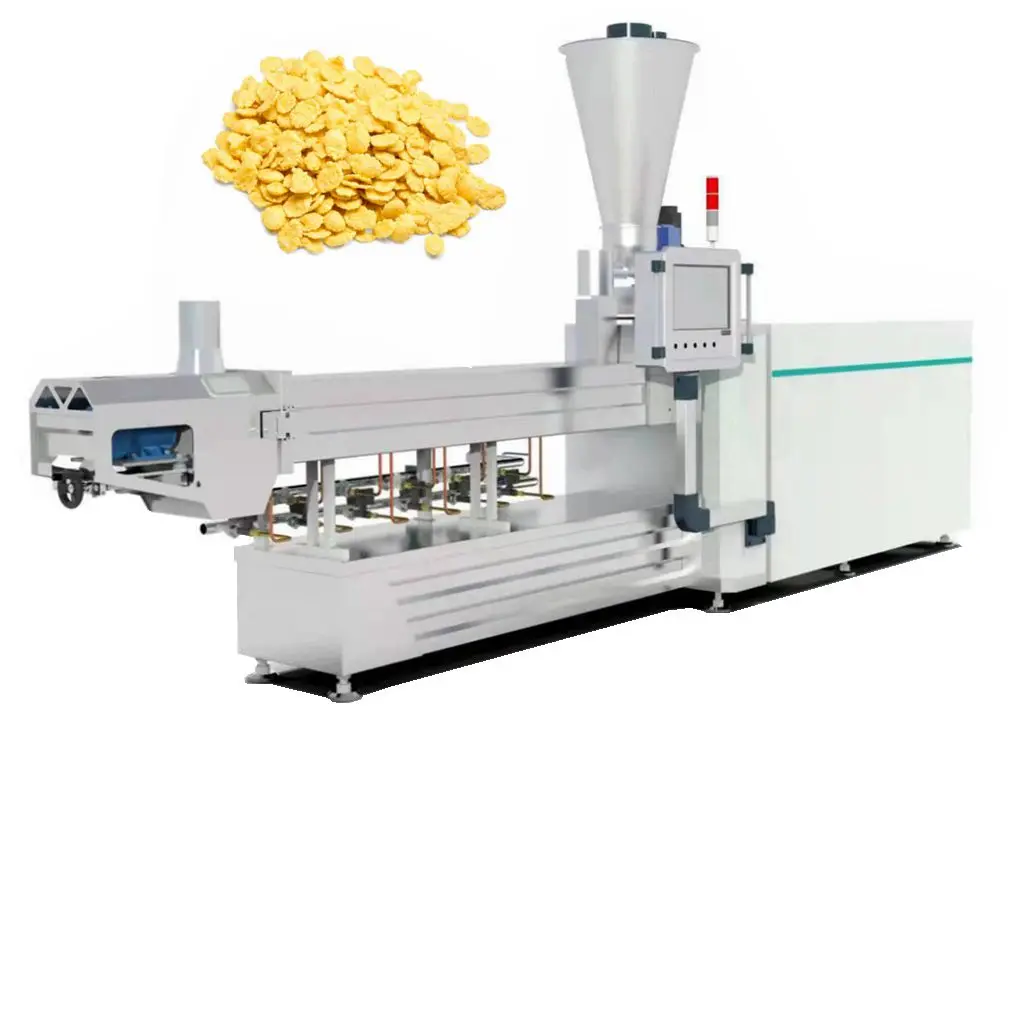
Screw Configuration Matched to Grain — we build the screw profile around your corn, rice or oat formulation and target flake density, not around a generic twin-screw template.
Technical Specifications
| Parameter | Value |
|---|---|
| Product Type | Twin Screw Extrusion Corn Flakes Production Line |
| Models Available | MT70, MT85, MT75 |
| Extruder Type | Twin Screw |
| Installed Power | 160 kW (MT70) / 190 kW (MT85) / 210 kW (MT75) |
| Power Consumption | 120 kW (MT70) / 140 kW (MT85) / 150 kW (MT75) |
| Output Capacity | 150–200 kg/h (MT70, basis not stated in source) / 300–400 kg/h (MT85, basis not stated in source) / 300–500 kg/h (MT75, basis not stated in source) |
| Overall Dimensions (L×W×H) | 41 × 1.5 × 2.2 m (MT70) / 43 × 1.5 × 3.2 m (MT85) / 45 × 1.5 × 3.5 m (MT75) |
| Basic Material Compatibility | Corn, rice, wheat, oat, barley powder |
| Control System | PLC control for flaking machinery, MCC available |
| Flaking Drive | Double motors with separate roller driving, hydraulic system for double rollers |
| Flaking Temperature Control | Infrared sensor |
| Dryer Heating Source | Gas or electric |
| Hot Air Roasting Oven | Vibrating pan, conciliation burner, dual circulating fans, cyclone dust removal |
| Coating System | Double tumble sugar melting, elevator, coating drum, spraying nozzle |
| Screw Feature | Wear-resistant manufacturing, automatic lubricating and cooling function |
| Certifications | CE, ISO |
Application Suitability
| Application | Material or Output |
|---|---|
| Natural corn flakes for retail breakfast cereal packs | Corn grits and corn flour blends |
| Sugar-coated flakes for food-service and children’s cereal markets | Corn base with sugar syrup coating |
| Shaped extruded breakfast cereals (rings, balls, loops, stars) | Corn, rice, wheat, oat and barley powder formulations |
| Fortified breakfast cereals for nutrition programmes | Grain blends with vitamin and mineral premix |
| Mixed-grain flakes for health-oriented retail lines | Oat, barley and rice combined with corn |
Why Nominal Capacity Figures Mislead Corn Flake Buyers
A corn flakes extrusion production line turnkey quoted on a single throughput number rarely accounts for the grain variety, moisture content and grind size that the buyer will actually feed into the hopper — and that gap is where commissioning delays start.
Capacity only becomes real once the extruder is running your specific corn or oat formulation at your target flake moisture.
I have watched buyers sign off on a line rated for a certain hourly output, then discover during on-site commissioning that their local corn grits carry higher moisture than the factory trial material, pushing the actual throughput noticeably lower. The extruder barrel temperature profile, screw combination and die geometry all shift when the raw material changes. That is why every corn flakes extrusion production line turnkey we ship is first trialled on the buyer’s own grain sample in our testing workshop, so the quoted output reflects the formulation that will actually run [NEED_CITE: importance of raw material trial runs in extrusion equipment procurement].
How Extrusion Profiles Shape Flake Density and Bowl Life
The twin-screw extruder is where starch gelatinisation begins, and the screw configuration directly determines how completely the corn or rice starch cooks before the dough reaches the flaking rollers. A screw profile with longer residence time and moderate shear produces a more fully gelatinised dough, yielding flakes that stay crisp longer once milk is added. Die design controls the sheet thickness exiting the extruder, which in turn sets the load the flaking station must handle. On a corn flakes extrusion production line turnkey, matching the screw combination to the target expansion and density is not optional — it defines whether the final flake sinks or floats in the bowl.
Temperature Profiling Across the Barrel Zones
Each barrel zone on the twin-screw extruder operates at an independent temperature, and the profile across those zones controls how moisture migrates through the dough. For corn-based formulations, a gradual temperature ramp from the feed zone to the die prevents premature flash-off of steam, which would leave uncooked starch pockets inside the pellet. Oat and barley blends behave differently because of higher fibre and fat content, demanding a cooler profile to avoid oil separation inside the barrel. Getting this profile right during the workshop trial run eliminates weeks of parameter adjustment after installation [NEED_CITE: barrel temperature profiling in twin-screw food extrusion].
What the Specifications Actually Mean for Your Floor
The installed power spread across the MT70, MT85 and MT75 models reflects the motor capacity needed to push different dough viscosities through the barrel at varying throughputs. Power consumption figures sit noticeably below installed power because the extruder rarely draws peak load once steady-state running temperature is reached. The flaking station uses separate motors for each roller, driven through a hydraulic system that maintains consistent gap pressure — this is what keeps flake thickness uniform across the full roller width. Infrared temperature monitoring at the flaking rollers catches surface temperature drift before it translates into thickness variation. The hot air roasting oven pairs a conciliation burner with dual circulating fans and a cyclone dust removal device, giving even surface blistering without scorching the edges of thinner flakes.
The Hidden Cost of Skipping the Raw Material Trial
Lines assembled from separate vendors often arrive with an extruder tuned to a generic corn recipe, a flaker set to a default gap, and a roaster calibrated for a standard belt speed. When the buyer’s actual corn variety carries a different starch-to-protein ratio, the flakes crack during roasting instead of blistering evenly. I have seen entire commissioning schedules pushed back by weeks because the flake density specification the local market expected was never built into the screw and die configuration from the start. Correcting this after installation means re-machining die plates, re-ordering screw elements and burning raw material through repeated test runs — costs that a workshop trial eliminates before the line ever ships [NEED_CITE: commissioning delays caused by unmatched extrusion tooling].
Why Sourcing the Full Line Under One Supplier Matters
Throughput matching across every station — extruder, dryer, flaker, roaster and coating drum — means no single unit bottlenecks the rest of the line. Screw configuration and die design are specified to the buyer’s grain type and target flake specification, not copied from a standard build. An in-house testing workshop runs the buyer’s actual raw material before shipment, producing a trial report that confirms output, flake thickness and density. The hot air roasting oven, coating system and packing station are all sized to the extruder’s verified throughput on that specific formulation. CE and ISO documentation accompanies every line, supporting customs clearance and local regulatory registration.
Documentation & Verification
- Line layout drawing showing throughput matching across extruder, flaker, roaster and coating drum
- Screw and die configuration record matched to your corn, rice or oat formulation
- Trial run report on your raw material covering flake thickness, density and verified output
- Electrical schematic with voltage, frequency and control language confirmed for your site
- CE declaration of conformity and ISO certificate for customs and regulatory filing
- Operation and maintenance manual with wear parts list for screws, dies and flaking rollers
Installation, Commissioning & Support
- Foundation plan accounts for the full line length of up to 45 m and vibration loads from the flaking station
- Dedicated electrical circuit sized to the model’s installed power, up to 210 kW for MT75
- Line arrives in modular sections for assembly inside workshops with standard ceiling clearance
- Commissioning includes barrel temperature profiling and flaker gap calibration on your grain formulation
- Operator training covers PLC interface for flaking controls and roaster burner adjustment
- Spare screws, die plates and flaking rollers stocked and listed in the wear parts manual
What We Need to Configure Your Line
To size the extruder, flaker and roaster correctly, share your primary grain type and its typical moisture content, the target flake thickness and bowl-life specification, and the daily output your market demands. We also need your workshop floor dimensions and ceiling height, the local voltage and frequency standard, and whether you plan to run sugar-coated and natural variants on the same line.
Frequently Asked Questions
Q: How is line capacity verified on my specific grain formulation?
A: We run your actual corn, rice or oat sample through the extruder in our testing workshop before shipment. The trial covers your target moisture content and grind size, and the report records verified throughput, flake thickness and density. Capacity figures quoted without this step reflect only generic test conditions that may not match your production reality.
Q: How is screw and die configuration determined for natural versus sugar-coated flakes?
A: Natural flakes typically need a denser pellet to survive roasting without excessive breakage, so the screw profile favours longer residence time. Sugar-coated variants can tolerate a slightly more expanded pellet because the coating adds structural mass. We document the configuration for each variant in the screw and die record supplied with the line.
Q: What voltage, frequency and control language are confirmed before production?
A: We request your site electrical specification during the quotation stage and confirm voltage, frequency and phase before the electrical schematic is finalised. PLC interface language for the flaking station and MCC panel labelling are agreed at the same point, so the control system arrives ready for your operators.
Q: What does the pre-shipment trial run report cover?
A: The report records the raw material batch used, moisture content at each stage, barrel temperature profile, screw and die configuration, verified output over a sustained run, flake thickness measurements and density readings. This document becomes the baseline for your on-site commissioning parameters.
Q: How are spare wear parts supplied after installation?
A: Every line ships with a wear parts list identifying screws, die plates and flaking roller assemblies specific to your configuration. We stock matching replacements and provide dimensional drawings so local machinists can fabricate non-critical items when lead time on shipped parts is not practical.