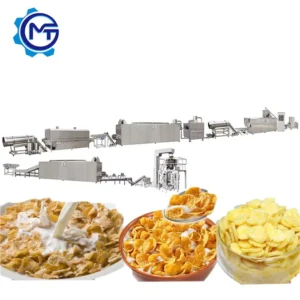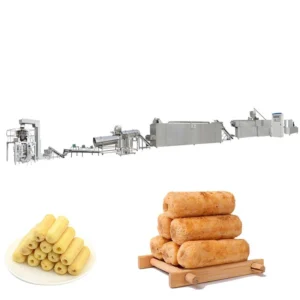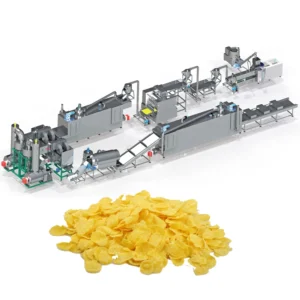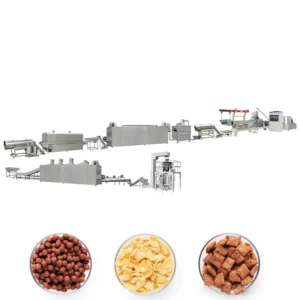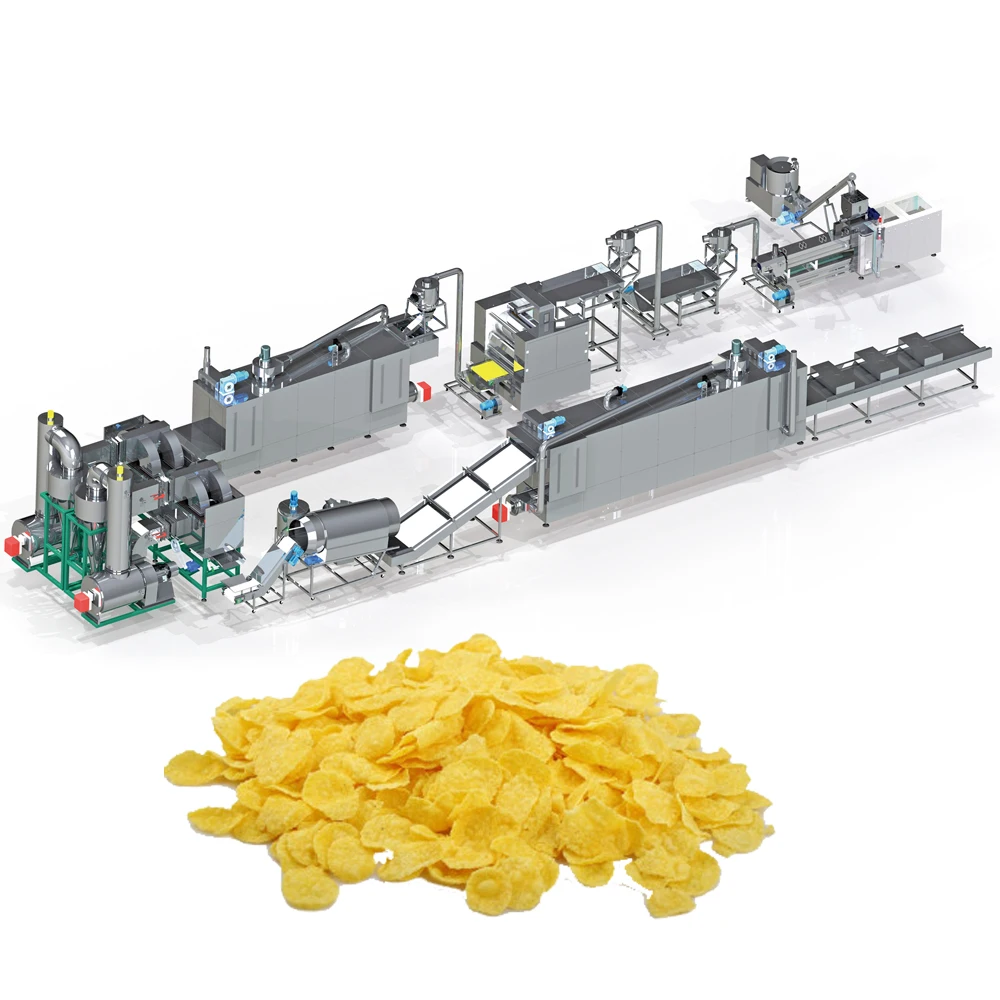
Precision-Matched Screw Geometry — Every MT75 build starts with the buyer’s actual cereal blend, locking in screw profile and barrel zones before the line leaves the factory.
Technical Specifications
| Parameter | Value |
|---|---|
| Model | MT75 |
| Product Type | Corn Flakes Production Line |
| Extruder Type | Twin Screw |
| Installed Power | 210 kW |
| Power Consumption | 150 kW |
| Output Capacity | 300–500 kg/h (basis not stated in source) |
| Overall Dimensions (L×W×H) | 45 × 1.5 × 3.5 m |
| Control System | PLC |
| Heating Source (Dryer) | Gas / Electric |
| Flaking Drive | Double motors for separate roller driving |
| Flaking Hydraulic System | Hydraulic system for double rollers |
| Flaking Temperature Control | Infrared sensor |
| Roasting Oven Features | Vibrating pan, conciliation burner, two circulating fans, cyclone dust removal |
| Coating System | Double tumble sugar melting, elevator, coating drum, spraying nozzle |
| Line Stations | Mixing, Extruding, Flaking, Drying, Hot Air Roasting, Sugar Spraying, Sugar Coating, Cooling, Packing |
| Assembly State | Complete production line |
| Standards | CE, ISO |
Application Suitability
| Application | Material or Output |
|---|---|
| Natural corn flakes | Corn grits and corn flour blends |
| Sugar-coated corn flakes | Toasted flakes with sugar syrup glaze |
| Multi-grain breakfast flakes | Rice, wheat, oat, and barley powder formulations |
| Shaped cereal pieces | Custom die geometries for varied flake profiles |
| Fortified breakfast cereals | Vitamin- and mineral-enriched cereal blends |
Why Generic Screw Profiles Destroy Corn Flake Bowl Life
Corn flake density is decided in the first three barrel zones, not at the toaster.
I once watched a Middle East buyer run a high-moisture steam-cooked formula on standard yellow corn meal using a generic screw setup copied from a snack line. Gelatinisation never reached target, the flakes shattered after toasting, and the entire first batch was scrapped. The problem was not the raw material — it was a screw profile that generated insufficient shear in the cooking zones while overworking the melt at the die. When corn flakes extrusion technology is treated as interchangeable with puffed snack extrusion, the result is always the same: inconsistent starch conversion that no downstream dryer or roaster can fix [NEED_CITE: starch gelatinisation thresholds in twin-screw cereal extrusion].
Screw Configuration and Barrel Temperature Mapping
The MT75 twin-screw extruder allows independent screw element sequencing across the full barrel length, meaning the feeding, kneading, cooking, and metering zones can each be tuned to the specific starch behaviour of corn, rice, or multi-grain blends. Barrel temperature profiling works in tandem — each heating zone is set to hold the melt within the gelatinisation window required by the buyer’s recipe. This level of corn flakes extrusion technology control is what separates a flake that holds its crunch in milk from one that disintegrates on contact.
Die Geometry and Moisture Injection Control
Die orifice size and land length govern the expansion ratio of the extrudate rope before it reaches the flaking rolls. Too much expansion produces a porous, brittle flake; too little yields a dense, hard piece that toasts unevenly. Moisture injection points along the barrel let operators fine-tune the dough consistency in real time, compensating for seasonal variation in raw material humidity [NEED_CITE: moisture-starch interaction in cereal extrusion dies]. The PLC control system logs every adjustment, creating a repeatable process record that carries from trial run to full production.
Reading the Specs That Actually Matter
The 210 kW installed power and 150 kW operating consumption reflect a line sized for continuous cereal production rather than intermittent snack runs — the thermal mass of the barrel heaters, flaking roll drive, and roasting oven all draw simultaneously during steady-state operation. The double-motor flaking machinery with independent roller driving prevents the speed differential that causes flake tearing on single-drive units. Infrared sensor temperature regulation on the flaking rolls ensures the surface heat stays uniform across the full roller width, which is critical when running thin-flake formats below one millimetre. The roasting oven’s two separate circulating fans and cyclone dust removal maintain even hot-air distribution while pulling fines out of the airstream, preventing burnt particles from contaminating the finished product.
The Hidden Cost of Skipping Extrusion Validation
Buyers who specify a corn flake line on catalogue capacity alone — without confirming the screw configuration against their actual flour — routinely discover that the extruder cannot hold rated output on their material. The flaker then starves, the dryer runs below design load, and the entire line bottlenecks at the station that was never matched to the real formula. Worse, flake density drifts outside market specification: too light and the product crumbles in the bag; too heavy and consumers perceive it as under-toasted. These are not warranty claims — they are process failures that only surface after installation, when the cost of correction includes shipping new screw elements across continents [NEED_CITE: post-installation screw reconfiguration lead times].
Why Buyers Run Trials Here Before Committing
Every MT75 line goes through an in-house testing workshop where the buyer’s own raw material is processed before shipment, generating a trial run report that documents actual throughput, screw settings, barrel temperatures, and flake density. The screw and die configuration record travels with the machine, so the commissioning engineer knows exactly which element sequence was validated. Line layout and capacity calculation ensures the extruder, flaker, dryer, and roaster are throughput-matched to each other rather than assembled from independent vendor catalogues. Electrical schematics and voltage confirmation are locked in before production begins, eliminating the commissioning delays that arise when control language or power supply do not match the destination factory. The PLC control architecture records every parameter change during the trial, giving process engineers a baseline to replicate or adjust on-site.
Documentation & Verification
- Screw and die configuration record matched to your cereal blend and target flake thickness
- Trial run report on your raw material documenting gelatinisation degree and flake density
- Electrical schematic with voltage and control language confirmed for your destination market
- Line layout and capacity calculation showing throughput balance across all nine stations
- CE declaration of conformity and ISO certificate for customs and regulatory clearance
- Operation and maintenance manual with wear parts list specific to your screw element sequence
Installation, Commissioning & Support
- Foundation plan sized to the 45 m line length with anchor point mapping for extruder and flaker vibration isolation
- Dedicated power circuit planning for the 210 kW installed load with voltage and frequency matched to local supply
- Modular station delivery allowing phased installation of mixing, extruding, flaking, drying, roasting, coating, cooling, and packing sections
- On-site commissioning with PLC parameter upload from the factory trial run report to replicate validated settings
- Operator training covering screw element handling, infrared sensor calibration, and roasting oven fan balance procedures
- Wear parts inventory recommendation based on your cereal formulation abrasiveness and planned annual operating hours
What We Need to Configure Your Line
To specify the screw profile, die geometry, and barrel temperature map for your application, we need your target cereal formulation including grain types and ratios, desired flake thickness and diameter, and the moisture content of your incoming flour. Share your local voltage, frequency, and preferred control language so the PLC and electrical systems are built to match. If you have existing upstream milling or downstream packing equipment, provide interface dimensions so the line layout integrates without gap stations.
Frequently Asked Questions
Q: How do screw configuration and barrel temperature profile affect corn flake density and bowl life?
A: Screw element sequencing determines the shear and residence time applied to your cereal dough, while barrel zone temperatures control the starch gelatinisation window. Together they set the extrudate density before flaking. A profile matched to your specific grain blend produces flakes that retain crunch in milk rather than shattering or turning soggy within minutes.
Q: What moisture level and starch gelatinisation degree should I target for my cereal blend?
A: Target values depend entirely on your grain ratio and desired flake texture. Corn-dominant blends typically require different moisture injection points and barrel temperatures than oat- or rice-heavy formulations. We establish these parameters during the in-house trial run on your actual raw material, documenting the results before shipment.
Q: Can I run a trial on my own raw material before committing to the line?
A: Yes. Every MT75 line is tested in our in-house workshop using the buyer’s own flour blend. The trial generates a full report covering throughput, screw settings, barrel temperatures, flake density, and gelatinisation degree — all documented before the machine ships.
Q: How is die design selected to control flake thickness and expansion ratio?
A: Die orifice diameter and land length are chosen based on your target flake dimensions and the expansion behaviour of your specific cereal dough. We match die geometry to your formulation during the pre-shipment trial, recording the configuration so it can be replicated or adjusted during on-site commissioning.
Q: What documentation verifies the extrusion parameters and process settings?
A: You receive a screw and die configuration record, a trial run report on your raw material, electrical schematics with confirmed voltage and control language, a line layout with capacity calculations, and an operation manual with a wear parts list specific to your build.