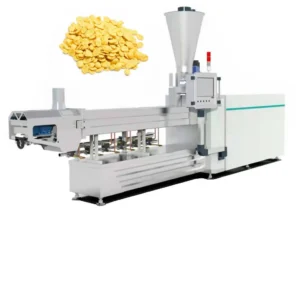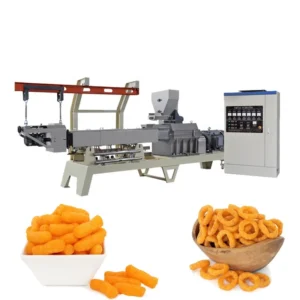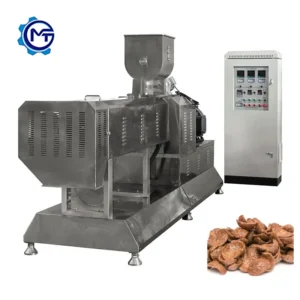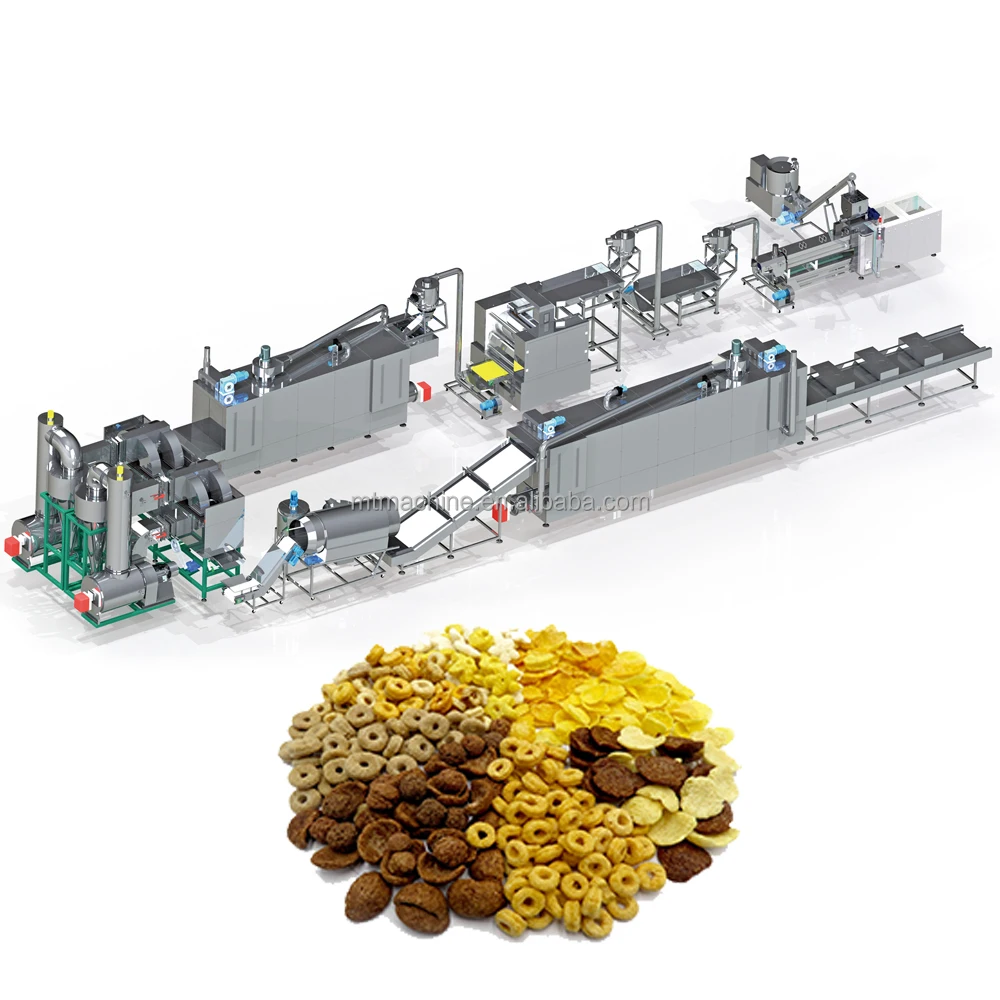
Die Geometry and Screw Profile Matched to Your Grain Blend — every extruder configuration is validated against the buyer’s actual corn, oat, or multi-grain recipe in our testing workshop before the line is cleared for shipment.
Technical Specifications
| Parameter | Value |
|---|---|
| Product Type | Twin Screw Extruder Corn Flakes Production Line |
| Model | MT70 / MT85 / MT75 |
| Screw Type | Twin Screw |
| Installed Power (MT70) | 160 kW |
| Installed Power (MT85) | 190 kW |
| Installed Power (MT75) | 210 kW |
| Power Consumption (MT70) | 120 kW |
| Power Consumption (MT85) | 140 kW |
| Power Consumption (MT75) | 150 kW |
| Output Capacity (MT70) | 150–200 kg/hr (basis not stated in source) |
| Output Capacity (MT85) | 300–400 kg/hr (basis not stated in source) |
| Output Capacity (MT75) | 300–500 kg/hr (basis not stated in source) |
| Overall Dimensions (MT70) | 41 × 1.5 × 2.2 m |
| Overall Dimensions (MT85) | 43 × 1.5 × 3.2 m |
| Overall Dimensions (MT75) | 45 × 1.5 × 3.5 m |
| Control System | PLC control (flaking machinery); MCC and PLC available for extruder |
| Flaking Machinery | Hydraulic double rollers, dual independent motors, infrared sensor temperature control |
| Dryer Heating Source | Gas / Electric |
| Roasting Oven | Conciliation burner, two circulating fans, cyclone dust removal |
| Coating System | Double tumble sugar melting, elevator, coating drum, spraying nozzle |
| Basic Material Input | Corn, rice, wheat, oat, barley powder |
| Certification | CE, ISO |
Application Suitability
| Application | Material or Output |
|---|---|
| Natural corn flakes production | Corn grits and corn flour, single-grain formulation |
| Sugar-coated corn flakes | Corn base with sugar syrup spray and tumble coating |
| Multi-grain flaked cereals | Blends of rice, wheat, oat, and barley with adjusted extrusion shear |
| Extruded cereal snack shapes | Ball, tube, stick, ring, fruit loop, star, wheel, flower, heart via die changeover |
Why Starch Gelatinisation Determines Your Flake Crunch
The barrel temperature profile and moisture window during extrusion decide whether the final flake shatters or bends in the bowl.
A corn flakes extrusion production line that delivers the right pellet density at the die exit is only half the equation. If starch gelatinisation is incomplete or uneven across the barrel zones, the flaking roller will crush rather than flatten the pellet, and the roasting oven cannot rescue a dense interior. We have watched lines shipped with a generic screw build produce thick, chewy flakes on arrival because the gelatinisation degree was never matched to the buyer’s grain blend [NEED_CITE: starch gelatinisation requirements for cereal extrusion]. The corn flakes extrusion production line specifications on paper meant nothing once the actual recipe hit the barrel.
How Screw Element Sequencing Controls Pellet Density
The twin-screw configuration allows mixing, kneading, and conveying elements to be arranged in a specific sequence along the barrel. For a pure corn formulation, a higher proportion of kneading blocks drives thorough starch gelatinisation without excessive expansion at the die. When the recipe shifts to an oat-heavy blend with lower starch content, the screw profile must reduce shear intensity to prevent over-working the dough, which collapses the pellet structure before it reaches the flaking station. Selecting the correct corn flakes extrusion production line specifications means documenting the screw element arrangement against the buyer’s declared formulation.
Barrel Zone Temperature and Moisture Management
Each barrel zone is independently heated, and moisture is injected at defined ports to reach the target dough consistency. Corn requires a different thermal ramp than wheat or barley because its starch granules swell and rupture at distinct temperature thresholds [NEED_CITE: cereal grain starch gelatinisation temperature ranges]. If the moisture window is too narrow for the grain blend, the dough exits the die either under-expanded or over-blown, and neither condition flakes properly. The PLC-controlled system monitors barrel temperature continuously so that drift in one zone does not cascade into the next.
Reading the Specs That Actually Matter
Installed power across the MT70, MT85, and MT75 models ranges from 160 kW to 210 kW, and power consumption sits roughly 25–30% below that figure during steady operation. The difference matters for electrical infrastructure planning at the installation site. The flaking station uses hydraulic pressure on double rollers with dual independent motors, meaning roller speed and gap can be adjusted separately to achieve uniform flake thickness without tearing the pellet. Infrared sensors on the flaking rollers provide closed-loop temperature feedback, preventing the roller surface from overheating and sticking to the dough sheet. The roasting oven employs a conciliation burner with two circulating fans and a cyclone dust removal device — this arrangement generates the surface blistering that defines a quality corn flake while extracting fines that would otherwise scorch inside the chamber.
The Cost of Skipping the Trial Run
Lines that ship without a trial run on the buyer’s actual grain formulation arrive with a screw and die setup calibrated to a generic corn flour standard. When the buyer loads an oat-barley blend, the pellets may exit the die at the wrong density, flake unevenly, and roast into a product with no audible crunch. Correcting this on-site means pulling screws, swapping die inserts, and re-mapping barrel temperatures — work that delays production start by weeks and burns raw material [NEED_CITE: extrusion line commissioning delays from untested formulations]. Every corn flakes extrusion production line should be validated in the testing workshop before it is crated.
Why Procurement Starts with Extrusion Engineering
Complete line throughput is calculated station by station so the extruder output, flaker capacity, dryer residence time, and roaster belt speed are balanced — no single station bottlenecks the next. Screw configuration and die geometry are specified against the buyer’s raw material data sheet, not copied from a previous build. The in-house testing workshop runs the buyer’s actual grain blend before shipment, producing a documented trial report that records expansion ratio, pellet density, and flake integrity. Electrical schematics confirm voltage and frequency for the destination site before the control panel is wired [NEED_CITE: industrial voltage and frequency standards by region]. CE and ISO certifications cover the full assembly, and the PLC and MCC control architecture supports remote diagnostics after commissioning.
Documentation & Verification
- Line layout showing throughput matching across extruder, flaker, dryer, and roaster stations
- Screw and die configuration record tied to your declared grain formulation
- Trial run report on your raw material with expansion and density data before dispatch
- Electrical schematic with voltage and frequency confirmed for your site
- Operation and maintenance manual covering screw wear intervals and roller calibration
- CE declaration of conformity and ISO certificate for the complete line assembly
Installation, Commissioning & Support
- Foundation plan aligned to the 41–45 m line footprint and 2.2–3.5 m clearance height
- Dedicated power circuit sized for 160–210 kW installed load at confirmed site voltage
- Flaking station hydraulic system pressure set and roller gap calibrated during commissioning
- PLC interface language configured to operator preference before training begins
- Wear parts inventory covering screw elements, die inserts, and flaking roller sleeves
- Dryer and roaster burner tuned to available gas supply or electrical heating infrastructure
What We Need to Configure Your Line
Share your grain formulation and the percentage breakdown of corn, rice, wheat, oat, or barley in the recipe. Confirm the target flake thickness, whether the final product is natural or sugar-coated, and the hourly throughput you plan to sustain. Provide your site voltage, frequency, and available floor space so the line layout and electrical design can be finalised before production starts.
Frequently Asked Questions
Q: How is screw configuration selected for different cereal grain formulations?
A: The screw element sequence — conveying, kneading, and mixing blocks — is arranged based on the starch content and gelatinisation behaviour of the declared grain blend. A pure corn recipe demands a different shear profile than an oat-dominant mix. The configuration is documented and validated on the buyer’s raw material during the pre-shipment trial run.
Q: What barrel temperature and moisture range are needed for proper gelatinisation?
A: Each barrel zone is set to a temperature ramp matched to the grain’s starch swelling threshold, with moisture injected at specific ports. Corn typically requires a higher thermal input than wheat or barley. The PLC system monitors zone temperatures in real time to maintain consistency across production batches.
Q: How does die design affect the final flake blistering pattern after roasting?
A: Die aperture shape and land length control the pellet’s expansion ratio and density at exit. A pellet that is too dense will not blister properly in the roasting oven; one that is over-expanded will collapse under the flaking rollers. Die geometry is selected to produce the pellet density that yields the target crunch after hot-air roasting.
Q: Can the extruder be reconfigured for shape changeover on the same line?
A: Yes. The twin-screw extruder supports die swaps to produce ball, tube, stick, ring, fruit loop, star, wheel, flower, and heart shapes. Each shape requires a documented screw and die setup, and the changeover procedure is covered in the operation manual provided with the line.
Q: How is throughput capacity verified against the actual raw material?
A: The stated capacity ranges are reference figures. Actual throughput depends on the buyer’s formulation, moisture content, and target flake density. During the in-house trial run, the line is run at the buyer’s declared recipe, and the output rate is measured and recorded in the trial report before the equipment is released for shipment.