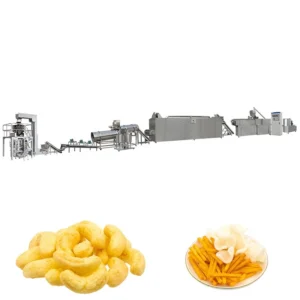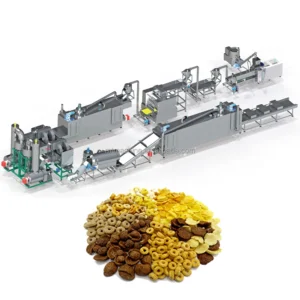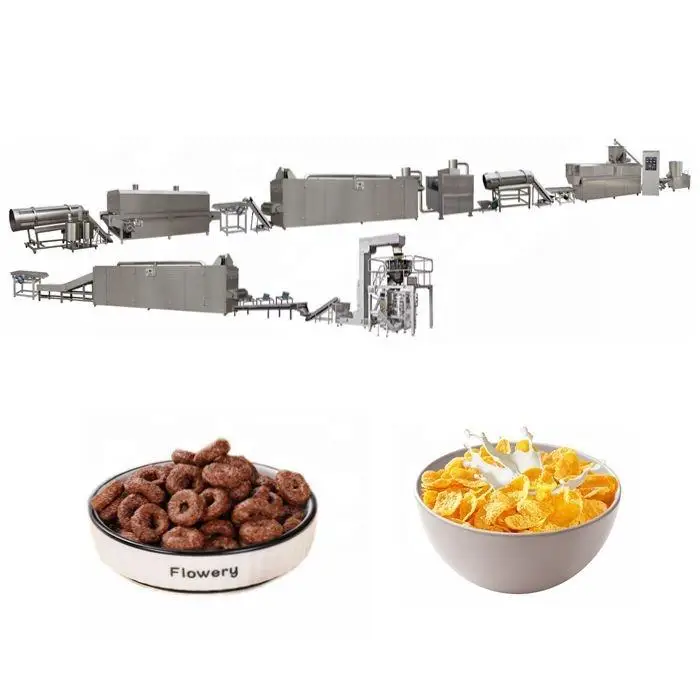
Screw-Configured Extrusion — Twin-screw assemblies and die profiles are built around your actual corn, rice, or multi-grain formulation rather than a generic default, ensuring the starch gelatinisation degree matches your target flake density and crispness.
Technical Specifications
| Parameter | Value |
|---|---|
| Product Type | Corn Flake Extruder Production Line |
| Models Available | MT70, MT75, MT85 |
| Screw Type | Twin Screw |
| Installed Power (MT70 / MT75 / MT85) | 160 kW / 210 kW / 190 kW |
| Power Consumption (MT70 / MT75 / MT85) | 120 kW / 150 kW / 140 kW |
| Output Capacity (MT70) | 150–200 kg/hr (basis not stated in source — confirm raw material formulation and moisture content) |
| Output Capacity (MT75) | 300–500 kg/hr (basis not stated in source — confirm raw material formulation and moisture content) |
| Output Capacity (MT85) | 300–400 kg/hr (basis not stated in source — confirm raw material formulation and moisture content) |
| Overall Dimensions (MT70 / MT75 / MT85) | 41×1.5×2.2 m / 45×1.5×3.5 m / 43×1.5×3.2 m |
| Control System | PLC and MCC; flaking unit features PLC with hydraulic system |
| Raw Materials | Corn, rice, wheat, oat, barley powder |
| Key Features | Automatic lubricating and cooling on extruder screws; infrared sensor temperature control on flaking rollers; cyclone dust removal on roasting oven |
| Dryer Heating Source | Gas or Electric |
| Standards | CE, ISO |
Application Suitability
| Application | Material or Output |
|---|---|
| Natural corn flake production | Corn grits and corn flour blends |
| Sugar-coated breakfast cereals | Corn, rice, or wheat base with sugar spray coating |
| Multi-grain flake cereals | Oat, barley, and wheat powder formulations |
| Shaped cereal pieces | Rings, balls, stars, and fruit loops via die adjustment |
Why "Rated Capacity" Means Nothing Without Your Raw Material
A corn flake line rated at 500 kg/hr on one formulation may deliver considerably less on yours if starch content and grind size differ.
I once watched a Nordic producer fly in for a factory acceptance test on a corn flake line we had already validated with standard corn grits. The moment their own organic coarse-ground flour hit the barrel, the gelatinisation degree dropped and the flakes came out dense and chewy instead of crisp. We rebuilt the screw configuration and adjusted the barrel temperature profile twice before the line held their specification. That kind of mismatch is not a defect — it is simply what happens when extrusion parameters are set without the buyer’s actual raw material in hand [NEED_CITE: impact of raw material particle size on twin-screw extrusion gelatinisation].
When you evaluate any corn flake extrusion technology screw configuration, the first question should not be about throughput but about whether the vendor has tested on your specific blend at your target moisture level.
Barrel Zone Profiling and Starch Gelatinisation
Each heating zone along the twin-screw barrel is set independently, creating a temperature curve that controls how completely the starch granules absorb water and swell. Too low in the early zones and the starch remains partially raw, producing a floury mouthfeel in the finished flake. Too high and the material scorches before it reaches the die. A correctly profiled barrel brings the corn mass through gelatinisation gradually, giving the flake its characteristic crispness after roasting.
Die Geometry and Flake Expansion Ratio
The die opening shape and land length determine how much the extrudate expands the instant it exits the barrel. A shorter land allows greater radial expansion — desirable when the downstream flaking rolls need a thicker, softer pellet to press. A longer land restricts expansion and yields a denser pellet suited to thin, shattering-crisp flakes. Matching die geometry to your target bowl-life is a core part of corn flake extrusion technology screw configuration work before the line is built.
Screw Element Sequencing for Shear Control
Twin-screw extruders use alternating conveying, kneading, and reverse-flight elements to manage mechanical shear. More kneading blocks increase shear, driving deeper gelatinisation but also raising barrel wear and power draw. The right sequence depends on your formulation’s fat content and fibre level — high-fibre oat blends need different element spacing than pure corn grits [NEED_CITE: screw element arrangement and shear rate in food extrusion]. Getting this wrong shows up as inconsistent flake thickness after the rolling stage.
What the Power and Dimension Figures Tell You
The MT75 draws 150 kW in operation across a 45-metre line footprint, meaning it requires a dedicated transformer circuit and a bay with sufficient length for the cooling conveyor run. The MT70 at 120 kW and 41 metres suits smaller facilities where ceiling height limits the dryer stack. Hydraulic double-roller flaking with PLC control and infrared temperature sensing keeps roller gap and surface heat stable — essential because a one-degree drift in roller temperature can shift flake moisture by enough to affect roasting time downstream. Gas-heated versus electric-heated dryer options let you align the line with local utility costs, while the roasting oven’s dual circulating fans and cyclone dust removal keep surface browning even and the workshop air clean.
The Hidden Cost of a Generic Screw Build
Copying a screw and die setup from a previous project is the fastest way to ship a line that underperforms. Flakes may emerge with the wrong density — sinking in milk within seconds or staying too hard after prolonged soaking. Producers then face weeks of trial-and-error on site, burning raw material and missing delivery windows while the screw combination is reworked [NEED_CITE: cost of post-installation extrusion trials versus pre-shipment testing]. The expense is not the replacement screws themselves; it is the lost production time and the off-spec product already in the warehouse.
Why Procure the Extrusion Section Here
Every screw configuration and die design is documented to your raw material blend and target flake density, not pulled from a standard library. An in-house testing workshop runs your actual corn, rice, or oat formulation before the line ships, and a written trial report accompanies delivery. Throughput is calculated across every station — mixing, extruding, flaking, drying, roasting, coating, and packing — so the flaking rolls and roasting oven are sized to the extruder’s real output, not its nameplate rating. Electrical schematics, voltage, frequency, and control language are confirmed before production begins, preventing commissioning delays. Automatic lubricating and cooling on the extruder screws supports continuous multi-shift runs without unscheduled barrel disassembly.
Documentation & Verification
- Screw and die configuration record matched to your raw material and target flake density
- Trial run report on your corn or multi-grain formulation before dispatch
- Line layout and capacity calculation showing throughput balance across all stations
- Electrical schematic with confirmed voltage, frequency, and PLC language
- Factory test record covering extruder barrel zones, flaking roller gap, and roasting temperature curve
- CE declaration of conformity and ISO certificate
Installation, Commissioning & Support
- Dedicated power circuit sized to the MT75’s 210 kW installed load or equivalent model rating
- Foundation plan accounts for the 45-metre line length and roasting oven vibration isolation
- Hydraulic flaking roller system calibrated on site to your target flake thickness tolerance
- PLC and MCC parameters set in your preferred control language during commissioning
- Operator training covers barrel zone temperature adjustment and screw element inspection intervals
- Wear parts list provided for screws, dies, and flaking roller surfaces with recommended replacement schedule
What to Include in Your Enquiry
To move from a general specification to a line configuration that holds on your material, share your raw material data sheet including starch content, particle size distribution, and target moisture at the extruder inlet. Confirm your local voltage, frequency, and preferred PLC language. If you already have upstream mixing or downstream packing equipment, provide the interface dimensions and throughput so the extrusion section can be matched without bottlenecks.
Frequently Asked Questions
Q: How do I verify that the quoted capacity holds on my specific raw material formulation?
A: Capacity figures are based on defined formulations and moisture levels. We run your actual corn, rice, or multi-grain blend in our testing workshop before shipment and provide a trial report documenting output rate, gelatinisation degree, and flake density so you see real numbers on your material before committing.
Q: How is screw configuration and die design matched to my target flake density?
A: We review your formulation’s starch, fibre, and fat content, then select screw element sequencing and die land length to control shear and expansion. The configuration is documented in a record sheet you receive with the line, and adjustments are validated during the pre-shipment trial run.
Q: Can a trial run be performed on my raw material before shipment?
A: Yes. Our in-house testing workshop is equipped for full extrusion, flaking, and roasting trials. You supply a sample batch of your raw material, and we return a trial report covering throughput, flake thickness, crispness, and any screw or die adjustments made during the run.
Q: How are throughput rates matched between extruder, flaking rolls, and roasting oven?
A: Each station is calculated against the extruder’s verified output on your formulation — not its nameplate rating. Flaking roller width, dryer belt length, and roasting oven pan area are all scaled so no single station creates a bottleneck during continuous operation.