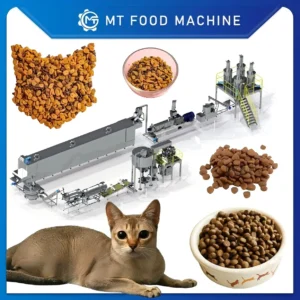
Recipe-Driven Extrusion Engineering — Screw configuration and die geometry are matched to your actual raw material before the line ships, not copied from a generic build.
Technical Specifications
| Parameter | Value |
|---|---|
| Product Type | Pet Food Extrusion Production Line |
| Output Capacity | 250-300 kg/h (basis not stated in source — confirm raw material, moisture content, and kibble size) |
| Control System | PLC Controlled |
| Automation Level | Full Automation |
| Supported Product Formats | Dry kibble, semi-moist, treats |
| Target Species | Multi-species (cat and other pets) |
| Screw Type | Available on request |
| Barrel Zones | Available on request |
| Die Configuration | Available on request |
| Overall Dimensions | Available on request |
| Net Weight | Available on request |
| Voltage & Frequency | Available on request |
| Rated Power | Available on request |
| Key Features | Full automation, recipe-driven PLC control, multi-format versatility |
Application Suitability
| Application | Material or Output |
|---|---|
| Dry kibble production for cats and dogs | Corn flour, meat meal, fish meal, grain blends |
| Semi-moist pet food manufacturing | High-moisture meat slurry, starch binders, humectants |
| Treat and snack extrusion | Concentrated protein mixes, vitamin-fortified bases |
| Multi-species production environments | Recipe switching between cat, dog, and small animal formulations |
What "250-300 kg/h" Actually Means on Your Formula
A capacity number without raw material context is marketing, not engineering.
I have stood next to extruders in European workshops where the nameplate said one thing and the actual output on the customer’s high-fresh-meat recipe said another. The gap is almost never the motor — it is the screw profile failing to build enough shear for proper starch gelatinisation when fresh meat slurry pushes moisture well above the standard test condition. A PLC controlled pet food extrusion line can only hold its rated throughput if the screw configuration and barrel temperature profile were engineered around the buyer’s actual formulation, not a lab-grade corn flour benchmark. [NEED_CITE: Starch gelatinisation behaviour under variable protein and moisture ratios in twin-screw extrusion]
Barrel Temperature Zones and Shear Control
Every zone along the barrel is a separate thermal event. On a high-protein cat food recipe, the feed section must move material forward without premature gelatinisation, while the melt and metering zones need to generate enough shear to fully cook the starch fraction. The PLC on this PLC controlled pet food extrusion line stores zone-specific temperature set points as part of each saved recipe, so an operator switching from a standard dry kibble run to a semi-moist batch does not have to rebuild the thermal profile from memory.
Die Geometry and the Expansion Ratio Problem
Die hole diameter, land length, and open-area ratio together decide whether your kibble exits dense and slow-expanding or light and fragile. Cat kibble typically demands a tighter, more uniform cell structure than dog kibble because the target size is smaller and the density window is narrow. When the die is specified generically, the expansion ratio drifts as moisture fluctuates, and the result is a bag of kibble that floats in the bowl or crumbles during coating. Matching die geometry to the specific recipe is the only reliable way to control final product density. [NEED_CITE: Die design influence on expansion ratio in pet food extrusion]
Reading the Specs That Matter
The control system being PLC-based means parameter logging is possible — motor amperage, barrel zone temperatures, feeder screw speed — all recorded per batch. This is not a luxury; it is the only way to trace why batch seven looked different from batch three. Full automation across the line means the downstream stations (dryer, coating drum, cooler) follow the extruder output signal rather than running on independent timers, which prevents the bottleneck and pile-up problems that plague loosely integrated lines. The supported formats — dry kibble, semi-moist, and treats — indicate that the extruder can handle a wide moisture range, but the screw and die must be reconfigured between those formats, and that changeover time should be factored into your production planning.
The Cost of a Generic Screw Build
When screw elements are selected from a default set rather than matched to the buyer’s raw material, the problems do not appear on day one. They appear in week three, when the maintenance team notices the barrel liner wearing unevenly, or when the coating drum cannot achieve the target fat uptake because the kibble surface is too smooth. These are not extruder failures — they are specification failures, and they cost real money in scrap, rework, and lost production days. [NEED_CITE: Wear pattern analysis on extruder screws running non-matched configurations]
Why This Line Is Built Differently
The screw configuration and die design are specified after reviewing the buyer’s raw material data sheet and target product density, not pulled from a standard catalogue. The in-house testing workshop runs trial production on the customer’s actual formula before the line ships, so expansion, texture, and moisture content are verified in advance. Throughput across every station — extruder, dryer, flavouring drum, cooler — is calculated as a matched system, so no single unit bottlenecks the rest. Electrical schematics and voltage are confirmed against the buyer’s facility specification before production begins, preventing the commissioning delays that happen when a 380V machine arrives at a 415V plant.
Documentation & Verification
- Line layout with throughput calculation across extruder, dryer, and coating stations
- Screw and die configuration record specific to your raw material and target kibble density
- Trial run report produced on your own formula in the testing workshop before shipment
- Electrical schematic with confirmed voltage, frequency, and PLC language for your facility
- Factory test record documenting motor amperage, barrel temperatures, and output rate
- CE declaration of conformity and ISO certificate included with shipping documentation
Installation, Commissioning & Support
- Foundation and utility layout provided based on the confirmed PLC control cabinet placement and dryer footprint
- Dedicated circuit requirements specified by rated power and voltage before electrical rough-in begins
- Modular line sections arrive labelled for assembly sequence, reducing on-site installation time
- First-run commissioning includes parameter tuning on your actual raw material, not a generic test formula
- Operator training covers recipe storage, screw changeover, and die cleaning procedures for each product format
- Wear parts list specifies screw elements, barrel liners, and die plates with recommended replacement intervals
Before You Request a Quote
Send us your raw material formulation — especially the fresh meat or slurry percentage, starch source, and target moisture — along with the kibble size, shape, and density you need to hit. Include your facility voltage, frequency, and preferred PLC display language so the electrical package matches your site from day one. If you are running multiple species or formats on the same line, list each SKU and the expected changeover frequency.
Frequently Asked Questions
Q: How is the 250-300 kg/h capacity verified, and on which raw material and kibble format?
A: That figure represents a capacity range and must be confirmed against your specific raw material, moisture content, and kibble size. We run a trial in the testing workshop using your formula to document the actual sustainable output before quoting a final number.
Q: How do you configure screw and die for my specific pet food recipe and target density?
A: We review your ingredient list, protein-to-starch ratio, and target kibble density, then select screw element geometry and die hole dimensions accordingly. The configuration is recorded and included in your documentation package.
Q: What voltage, frequency, and control language options are confirmed before shipment?
A: We request your facility electrical specification and PLC language preference during the quotation stage. The electrical schematic and control panel are built to match those requirements before the line leaves the factory.
Q: Can I run a trial on my own raw material before the line ships?
A: Yes. We conduct trial runs in the in-house testing workshop using your raw material and record expansion, texture, moisture, and output data. The trial report is shared with you before shipment is arranged.
Q: How do you ensure the dryer and coating drum capacity matches the extruder output without bottlenecking?
A: Every station in the line is calculated against the extruder’s verified output on your material. The layout document shows throughput at each stage so you can see that drying, coating, and cooling capacities are balanced.