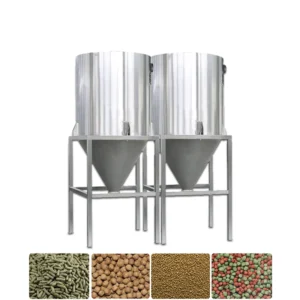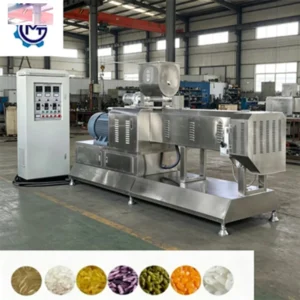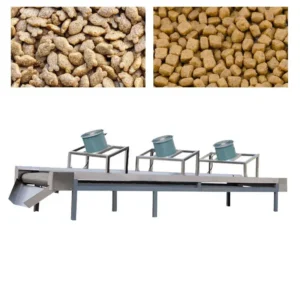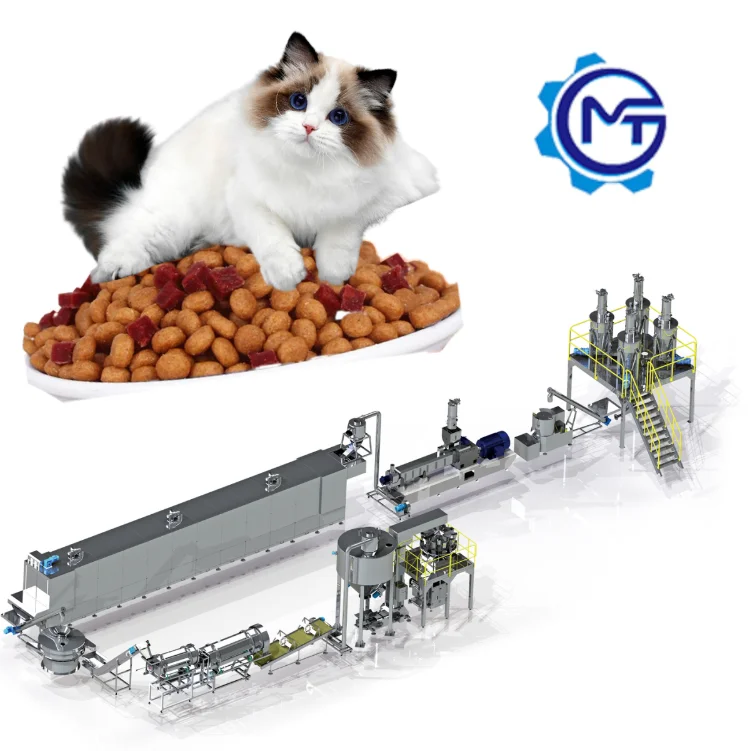
Screw geometry matched to recipe — MT70 barrel and screw segments are selected against the buyer’s actual protein, starch and fat ratios before the line is built, not copied from a stock configuration.
Technical Specifications
| Parameter | Value |
|---|---|
| Model | MT70 |
| Product Type | Twin Screw Pet Food Extrusion Line |
| Output Capacity | 200-250 kg/h (basis not stated in source — confirm raw material / moisture content / kibble size) |
| Rated Power | 45 kW |
| Voltage & Frequency | 380V 50Hz Three Phase |
| Screw Type | Twin Screw |
| Control System | PLC and MCC |
| Line Stations | Mixing, Extrusion, Drying, Packaging |
| Assembly State | Complete production line, fully automated |
| Standards | CE, ISO |
Application Suitability
| Application | Material or Output |
|---|---|
| Dry kibble production | Corn, rice, wheat blended with meat meal, fish meal or bone meal |
| Semi-moist pet food | High moisture dough with humectants and protein concentrates |
| Pet treats and bites | Starch and protein pastes shaped through custom die plates |
| Functional diet formulations | Added fibre, vitamin premix and fat-coated kibble |
Why "200 kg/h" Means Nothing Without the Raw Material
A rated capacity figure on a twin screw pet food extrusion line specification sheet tells you what the motor and gearbox can push through the barrel under ideal conditions. It does not tell you what happens when your recipe is sixty percent fish bone meal instead of corn grits. I once spent four days in a workshop adjusting feed rate, barrel temperature and screw speed on a line that kept surging — the issue was not the machine, it was a high-calcium raw material that required a completely different screw element sequence. Capacity is only meaningful when tied to a specific formulation, moisture level and target kibble density. Buyers who skip this step end up with a line that either starves the dryer or floods the flavouring drum, and the bottleneck is never obvious until commissioning week [NEED_CITE: extrusion throughput dependence on raw material composition].
Screw Element Sequencing for Protein-Rich Formulas
Twin screw extrusion gives you the freedom to rearrange conveying, kneading and reverse elements along the shaft. On the MT70, the screw configuration is specified after reviewing the buyer’s raw material sheet — a high-provenance kibble with forty percent fresh meat slurry needs aggressive shear in the melting zone and gentle conveying through the metering section, while a budget dry food running mostly maize flour requires the opposite balance. Getting this wrong means either under-gelatinised starch that crumbles in the bag or over-worked protein that burns on the die face.
Barrel Temperature Profile and Moisture Control
Starch gelatinisation in pet food extrusion typically requires the dough to reach between 120°C and 150°C inside the barrel, but the path to that temperature matters as much as the peak. The MT70 barrel is divided into independently heated and cooled zones, allowing the operator to build a gradual temperature ramp that matches the residence time of the specific recipe. Pre-conditioning moisture — whether through steam injection or liquid addition at the mixer — sets the baseline, and the barrel zones then fine-tune the expansion that happens the instant the dough exits the die [NEED_CITE: starch gelatinisation temperature range in twin screw extrusion].
Reading the Specifications That Actually Matter
The 45 kW main drive on the MT70 sets the upper limit for mechanical energy input, which directly governs how much shear you can apply to viscous, high-fat doughs without stalling the screws. The PLC and MCC control architecture means process parameters — screw speed, barrel zone temperatures, feeder rate — are logged and repeatable across shifts, reducing the batch-to-batch density variation that causes kibble to float in one production run and sink in the next. Voltage at 380V 50Hz three-phase is standard for many export markets, but buyers in regions running 440V 60Hz or 220V 50Hz must confirm transformer or motor winding changes before the machine is wired at the factory. The twin screw design itself provides a self-wiping action that single screw machines lack, making recipe changeover faster and reducing the burnt residue that contaminates the first bags after a product switch.
The Hidden Cost of a Generic Screw Build
I have watched a pet food producer lose an entire week of commissioning because the extruder arrived with a screw configuration copied from a corn snack template. The kibble density was too high, the product sank in the bowl, and the end consumer — a dog owner expecting a particular kibble behaviour — returned the bags. Re-cutting screw elements on site is not an option; you either fly in a new screw set or live with the wrong product. This is why the twin screw pet food extrusion line specifications must include a documented screw and die configuration record tied to the buyer’s exact raw material, not a generic part number [NEED_CITE: importance of screw configuration documentation in extrusion procurement].
Why Procurement Teams Specify This Line
Meiteng builds the MT70 as part of a complete line from batching through extrusion to drying and packaging, so throughput at every station is calculated against the same raw material rather than assembled from mismatched vendors. The in-house testing workshop runs the buyer’s actual formula before shipment, generating a trial run report that confirms expansion ratio, kibble density and colour — issues that would otherwise surface only after the line is bolted to your factory floor. Screw and die configuration records are provided as part of the documentation package, giving your process engineer a baseline to adjust from when new recipes enter the production plan. Electrical schematics arrive with voltage and frequency already confirmed for your site, eliminating the week-long delay of rewiring a control cabinet during commissioning.
Documentation & Verification
- Screw and die configuration record matched to your raw material formula
- Trial run report on customer raw material from in-house testing workshop
- Electrical schematic with voltage and frequency confirmed for your site
- CE declaration of conformity covering the complete extrusion line
- Machine specification sheet detailing barrel zones and control parameters
- Operation and maintenance manual with wear parts list
Installation, Commissioning & Support
- Foundation plan accounts for the MT70 extruder footprint and dryer length
- Dedicated 380V three-phase circuit sized for the 45 kW main drive plus heating loads
- Line arrives in modular sections for assembly onto pre-set anchor bolts
- First-run parameter tuning covers screw speed, barrel zones and feeder calibration
- Operator training includes recipe changeover and die swap procedures
- Wear parts list identifies screw elements, die plates and seals for reorder
What to Include in Your Inquiry
Send your raw material formula with protein, fat, starch and moisture percentages, along with the target kibble size, shape and whether the product must float or sink. Confirm your site voltage, frequency and preferred PLC language. If you are replacing an existing extruder, note the current output rate and the specific quality issue you are trying to resolve — density drift, inconsistent expansion or slow recipe changeover — so the line configuration can address it directly.
Frequently Asked Questions
Q: How is screw configuration selected for a specific raw material and kibble density target?
A: The buyer submits a raw material data sheet listing protein, starch, fat and fibre ratios. Screw elements — conveying, kneading and reverse — are then sequenced to deliver the shear and residence time needed for full starch gelatinisation at the target moisture, producing the expansion ratio that yields the correct kibble density.
Q: What barrel temperature profile and moisture range are needed for proper starch gelatinisation?
A: Most dry kibble recipes require barrel zone temperatures ramping from approximately 80°C at the feed end to 140°C near the die, with pre-conditioning moisture between 20% and 28%. The exact profile depends on starch source and protein content, and is verified during the pre-shipment trial run.
Q: Can a trial run on my raw material be done before shipment?
A: Yes. The MT70 line is available for testing in the manufacturer’s in-house workshop using the buyer’s actual raw material. The trial generates a report documenting expansion, density, colour and texture, allowing recipe adjustments before the equipment leaves the factory.
Q: How do I confirm voltage, frequency and PLC control language match my factory?
A: During the specification confirmation stage, the buyer provides site electrical details and preferred interface language. The electrical schematic and PLC programme are then prepared accordingly, and the final documents are reviewed before production begins to avoid rewiring on arrival.
Q: What die options are available and how do they affect kibble shape and density?
A: Dies are selected based on the target kibble geometry — round, triangle, bone-shape or custom profile — and the required expansion ratio. Smaller die openings increase back-pressure and density, while larger openings produce a lighter, more expanded kibble suitable for floating aquatic feed or low-calorie dog food.