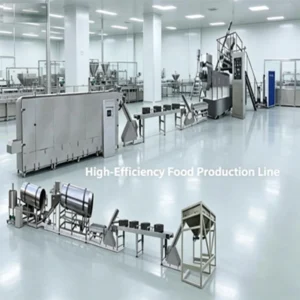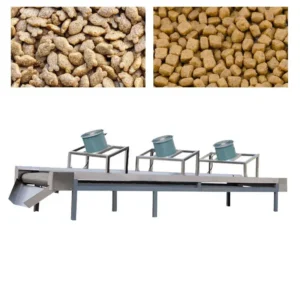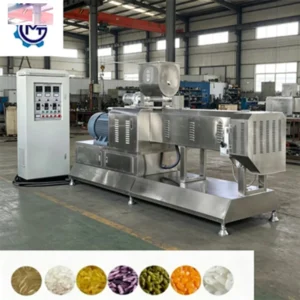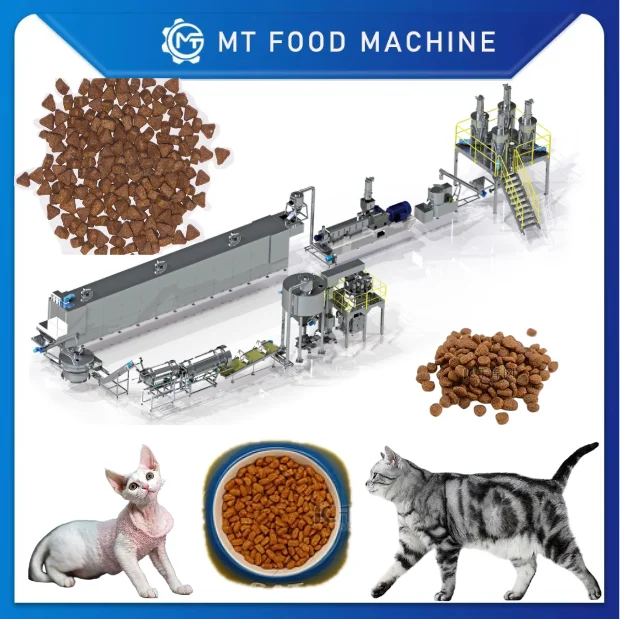
Matched Throughput Stations — every segment from batching through packing is calculated against the same target output, preventing the dryer or coater from choking an otherwise capable extruder.
Technical Specifications
| Parameter | Value |
|---|---|
| Model | MT100 |
| Product Type | Multi-Species Pet Food Processing Line |
| Extruder Configuration | Twin-screw |
| Control System | PLC Controlled |
| Output Capacity | 1.5-2.0 t/h (basis not stated in source — confirm raw material, moisture, and kibble size) |
| Line Stations | Batching, Extrusion, Drying, Flavouring, Packing |
| Application Scope | Cat, dog, fish, bird, and cattle feed |
| Assembly State | Complete processing line |
| Certification | CE, ISO |
Application Suitability
| Application | Material or Output |
|---|---|
| Dry kibble for cats and dogs | Poultry meal, corn, wheat, soy, and vitamin premix formulations |
| Floating and sinking aquaculture pellets | Fish meal, starch binders, and lipid coatings for catfish, tilapia, and shrimp |
| High-protein extruded bird feed | Seed blends, protein concentrates, and calcium supplements |
| Cattle feed pellets | Grain by-products, roughage, and mineral additives |
What the Nameplate Capacity Leaves Out About Twin-Screw Pet Food Extrusion
A declared tonnage figure means nothing until you know which raw material, moisture level, and kibble size it was measured on.
I have watched lines run perfectly during a factory test on corn grits, only to stall at half output when the buyer switched to a high-protein, high-fat formulation on their own floor. The extruder barrel may be rated for a certain mass flow, but dense protein matrices generate different shear and gelatinisation behaviour than starchy grains. Before any capacity number is committed to a purchase order, the formulation must be run through the twin-screw pet food extrusion line PLC controlled system in a testing workshop [NEED_CITE: raw material impact on extruder throughput].
Barrel Temperature Profile and Screw Configuration
Extrusion is a balance of thermal energy and mechanical shear. The PLC manages barrel zone temperatures so that starch gelatinises progressively rather than in a single spike, which protects both texture and nutritional value. Screw elements are selected and sequenced — conveying, kneading, reverse — based on the buyer’s specific formulation. A high-meat recipe demands a different screw combination than a cereal-dominant mix, and getting this wrong shows up immediately as inconsistent expansion at the die plate.
Die Geometry and Kibble Density Control
The die determines the final shape, but it also governs the pressure drop that drives expansion. A small die opening with a high-moisture dough will produce a dense, slow-expanding kibble that may sink in a water bowl — unacceptable for most cat and dog food markets. Die design is therefore specified together with the moisture dosing rate and screw speed to hit the target bulk density. This matching process is where a twin-screw pet food extrusion line PLC controlled setup earns its flexibility, as adjustments can be logged and recalled for each recipe [NEED_CITE: die design influence on extrudate density].
Reading the Specs That Matter
The twin-screw configuration handles a wider range of fat and protein levels than single-screw alternatives because the intermeshing flights create a self-wiping action that prevents material buildup. PLC control over moisture dosing is critical — even a slight moisture deviation changes the expansion ratio and can push kibble density outside the market specification. The included line stations must be read together: a dryer that cannot remove moisture fast enough will back up the entire line, no matter how quickly the extruder runs. Always compare the dryer residence time against the extruder output at your target moisture differential.
The Bottleneck That Doesn’t Appear on the Quotation
A common mistake is evaluating the extruder in isolation. If the flavouring drum cannot coat at the same mass flow rate, product piles up between stations, cools unevenly, and loses its surface adhesion for fats and palatants. Similarly, a packing station rated below the line output forces the entire system to idle on a cycle, degrading product that sits in the buffer. These mismatches rarely surface during a short factory demo but become daily frustrations once production ramps up [NEED_CITE: line throughput balancing in food extrusion projects].
Why This Line Is Specified as a System
Screw configuration and die design are locked to the buyer’s raw material and target kibble specification, not pulled from a generic catalogue. Every station is throughput-matched during the layout phase, so the dryer, flavouring drum, and packing segment all carry the same mass flow with headroom for recipe variation. An in-house testing workshop runs the buyer’s actual raw material before the line ships, generating a trial run report that confirms output and product quality. CE and ISO compliance covers the full assembly, not just the extruder barrel, so electrical safety and mechanical guarding meet export requirements from day one. Voltage, frequency, and HMI language are confirmed in writing before production begins, eliminating the commissioning delays that arise when a control panel arrives with the wrong transformer or an unfamiliar interface language.
Documentation & Verification
- Line layout with throughput calculation at every station from batching to packing
- Screw and die configuration record matched to your raw material formulation
- Trial run report on customer-supplied raw material generated before dispatch
- Electrical schematic confirming voltage, frequency, and PLC language for your market
- CE declaration of conformity and ISO certificate covering the full line assembly
Installation, Commissioning & Support
- Foundation plan accounts for the combined footprint and dynamic load of all stations
- Dedicated power circuit sized to the PLC-controlled extruder drive and dryer heating load
- Modular station design allows phased assembly matching your workshop access constraints
- Commissioning includes first-run parameter logging on your formulation across all barrel zones
- Operator training covers recipe recall, screw changeover, and die cleaning procedures
- Wear parts list specifies screw elements, die plates, and cutter bearings with reorder intervals
What to Include in Your Enquiry
Tell us the primary protein and starch sources in your formulation, the target kibble size range, and the bulk density your market expects. Specify your local voltage and frequency standard, the preferred PLC interface language, and the daily output you need to sustain. If you can ship a sample of your raw material, we will run it through the testing workshop and return a trial report with the quotation.
Frequently Asked Questions
Q: How is the declared output capacity verified, and on which raw material formulation is it based?
A: The capacity figure is confirmed through a trial run on your actual raw material in our testing workshop, not taken from a generic benchmark. The resulting report documents the formulation, moisture level, screw speed, and kibble size at which the output was measured, so you know exactly what to expect on your own production floor.
Q: How is screw configuration and die design determined for my specific formulation?
A: We review your ingredient list, target kibble density, and expansion requirement, then select screw elements and die geometry accordingly. A high-protein recipe may need more kneading blocks and a larger die opening, while a starchy mix uses different flight sequencing. The chosen configuration is recorded and shipped with the line.
Q: What does the in-house trial run cover, and what documentation comes with it?
A: The trial uses your raw material to extrude product under controlled conditions, measuring output rate, expansion ratio, kibble density, and moisture at the dryer exit. You receive a trial run report detailing all parameters, along with a sample of the extruded product for your own evaluation before the line ships.
Q: How are voltage, frequency, and PLC language confirmed before production begins?
A: We request your local electrical standard and preferred interface language during the quotation stage and confirm them in writing before manufacturing starts. The electrical schematic and HMI configuration are verified during the factory test, so the control panel arrives ready for your site without transformer swaps or software reloads.
Q: How is throughput balanced between the extruder, dryer, flavouring, and packing stations?
A: Each station is sized during the layout phase to carry the same mass flow with margin for recipe variation. The dryer residence time, flavouring drum volume, and packing speed are all calculated against the extruder output at your target moisture differential, preventing bottlenecks that would otherwise force the line to idle between cycles.