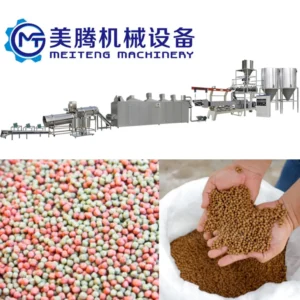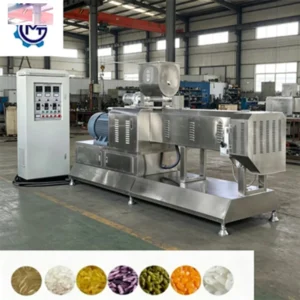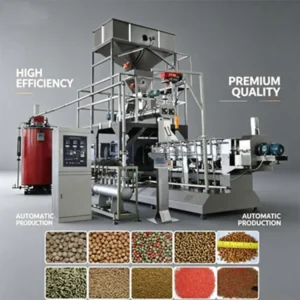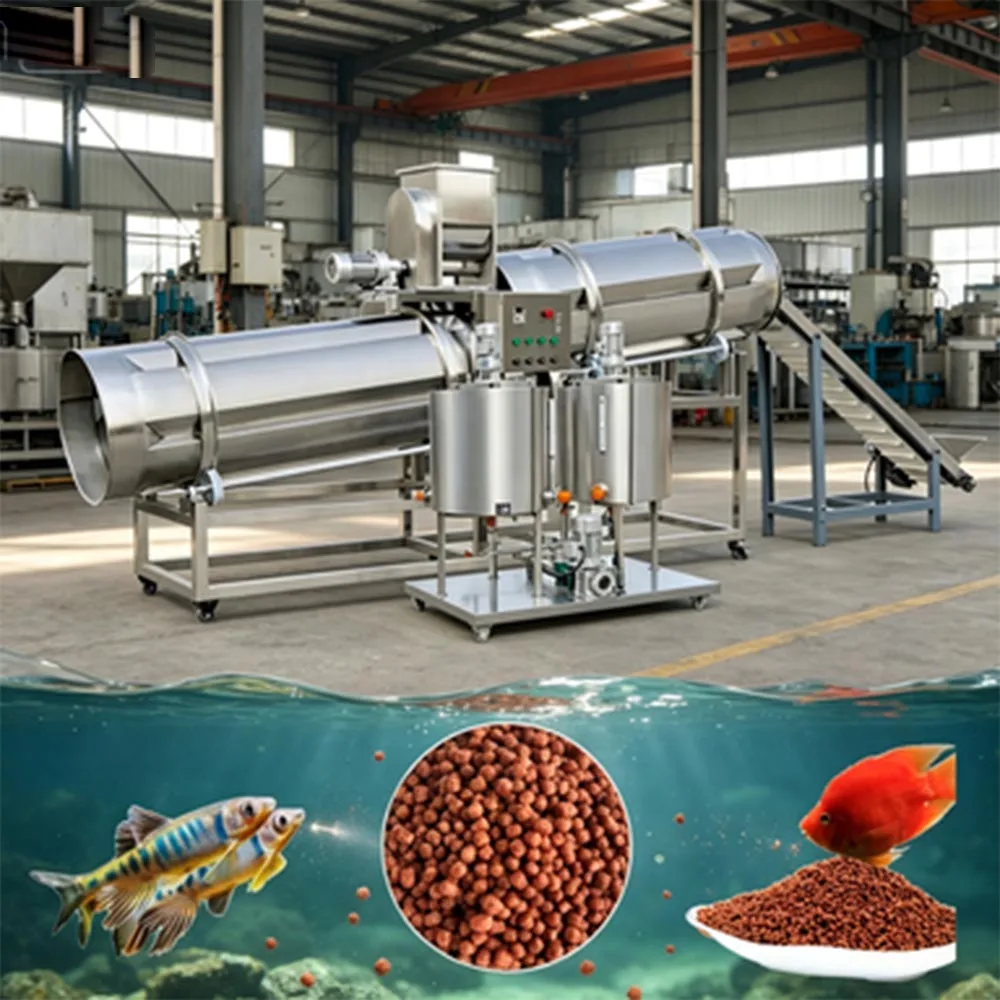
Precision Extrusion — Every screw element and die insert is selected against the buyer’s actual fish meal, soybean meal, and starch ratio rather than copied from a generic aquatic feed build.
Technical Specifications
| Parameter | Value |
|---|---|
| Product Type | Twin Screw Aquatic Feed Extrusion Production Line |
| Screw Type | Twin screw |
| Control System | PLC automatic control |
| Material Contact Parts | Food grade 304 stainless steel |
| Output Capacity | Large stable processing capacity for medium to large scale production (basis to be confirmed) |
| Pellet Types | Floating and sinking aquatic feed pellets |
| Pellet Adjustability | Size, hardness, buoyancy adjustable per breeding requirements |
| Line Stations | Raw material mixer, extruder, dryer, seasoning coating machine, vibrating sieve, conveyor equipment |
| Production Mode | Full continuous automatic production from mixing to finished product discharging |
| Transmission and Heating | Optimized energy saving transmission structure and heating system |
| Operation Interface | Humanized operation interface |
| Maintenance Design | Convenient daily cleaning, regular maintenance, quick replacement of vulnerable parts |
Application Suitability
| Application | Material or Output |
|---|---|
| Floating pellets for koi and goldfish | Fish meal, corn powder, wheat flour, compound additives |
| Sinking pellets for catfish and bottom-feeders | Soybean meal, corn powder, vitamin premix |
| Tropical ornamental fish feed | Blended protein and starch sources with pigment additives |
| Medium to large scale aquaculture feed production | Compound formulations with varying fat and moisture levels |
| Long-duration uninterrupted production runs | Heat-stable raw material blends compatible with high-temperature high-pressure extrusion |
Why Pellet Buoyancy Fails Before the Line Even Ships
A twin screw extrusion aquatic feed production line quoted at a nominal output means nothing when the pellets sink instead of float. Buoyancy is determined by screw geometry, barrel temperature zones, and die design — not by motor power or line speed.
I once worked with a Southeast Asian aquaculture producer whose previous line was built on a generic screw configuration. Their high-fat fish meal recipe needed a completely different compression ratio than the standard setup provided. The result was pellets that looked fine on the outside but sank in the water column within seconds. That kind of mismatch does not show up on a spec sheet. It only surfaces when you actually run the buyer’s raw material through the barrel [NEED_CITE: starch gelatinisation thresholds in high-fat aquatic formulations].
Barrel Temperature Profile and Starch Gelatinisation
Achieving consistent pellet buoyancy requires the barrel to maintain distinct temperature zones from the feed section to the metering section. In a twin screw extrusion aquatic feed production line, the operator must manage moisture injection and shear intensity simultaneously. Too little gelatinisation and the pellet lacks internal structure; too much and the starch matrix collapses during drying. The PLC control system allows real-time adjustment of each barrel zone, which is critical when switching between floating and sinking formulations.
Die Geometry and Pellet Density Control
The die plate determines not only pellet diameter but also the expansion ratio as material exits the barrel. For floating pellets, the die must allow rapid steam expansion at the exit face, creating a porous internal structure. Sinking pellets require a tighter die geometry that restricts expansion and compresses the starch-protein matrix. Matching die insert profiles to the target species and feeding behavior is part of the configuration process before the line ships. This is where generic builds fail most often [NEED_CITE: die design impact on aquatic pellet buoyancy standards].
Reading the Spec Sheet for What It Actually Controls
The twin screw configuration matters because it provides positive conveying of viscous, high-moisture aquatic feed formulations that a single screw cannot handle reliably. The food grade 304 stainless steel contact surfaces resist corrosion from fish meal oils and acidic additives over long production runs. PLC automatic control across the full chain — mixer, extruder, dryer, coating drum, vibrating sieve — keeps extrusion parameters stable when ambient humidity or raw material moisture shifts between batches. The humanized operation interface gives operators direct access to barrel zone temperatures, screw speed, and moisture injection rates without navigating buried menus.
The Cost of Skipping a Trial Run
When a line ships without testing on the buyer’s actual formulation, the first weeks of production become an expensive experiment. Pellet density drifts, sinking rates exceed specification, and the coating drum may apply flavoring to product that does not meet buoyancy targets. Operators adjust parameters blindly, generating waste and downtime. These losses compound across every shift until the screw configuration is finally corrected — a correction that could have happened in a testing workshop before the crate left the factory [NEED_CITE: commissioning delays from untested screw configurations].
Engineering Decisions That Show Up in Every Batch
Every station on this line is specified so that throughput does not bottleneck at any single point. The dryer capacity matches the extruder output to prevent moisture buildup in finished pellets. The seasoning coating machine is sized to handle the full discharge rate without tumbling damage. Screw elements and die inserts are selected based on the buyer’s raw material blend and target pellet specification, not pulled from a catalog default. In-house trial runs on the buyer’s actual formulation produce a documented report covering buoyancy, density, and surface quality before shipment. The PLC control language and electrical specifications are confirmed against the destination market before production begins, avoiding commissioning delays caused by voltage or interface mismatches.
Documentation & Verification
- Line layout with throughput calculation matching every station to extruder discharge rate
- Screw and die configuration record documented against buyer’s raw material formulation
- Trial run report on customer’s actual aquatic feed recipe covering buoyancy and pellet density
- Electrical schematic with voltage, frequency, and PLC control language confirmed pre-production
- Machine specification sheet detailing barrel zone count, screw L:D ratio, and motor rating
- Factory test record and packing photographs for customs documentation support
Installation, Commissioning & Support
- Foundation must accommodate full line length from mixer through vibrating sieve with level tolerance
- Dedicated power circuit sized to PLC-controlled extruder motor and dryer heating load
- Extruder barrel sections and screw shafts arrive separated for site assembly and alignment
- First-run parameter setting includes barrel zone calibration and die expansion verification
- Operator training covers PLC interface navigation for buoyancy adjustment between floating and sinking recipes
- Vulnerable parts list covers screw elements, die inserts, and dryer belt segments
What We Need From You to Configure the Line
To specify the screw configuration, die geometry, and dryer capacity correctly, we need your raw material formulation including fish meal percentage, starch source, and target moisture content. Share the pellet diameter and buoyancy requirement for each species you produce, along with your local voltage and frequency standard. If you have an existing mixer or packing system upstream or downstream, provide the interface dimensions so throughput matching accounts for your current equipment.
Frequently Asked Questions
Q: How is screw configuration and die geometry determined for my specific raw material blend and target pellet buoyancy?
A: The screw element arrangement — conveying, kneading, and reverse sections — is calculated based on your formulation’s fat, protein, and starch ratios. Die insert profiles are selected to control expansion at the exit face, producing the internal pore structure needed for floating pellets or the compressed matrix needed for sinking pellets. Both are documented in a configuration record tied to your recipe.
Q: What barrel temperature profile and moisture range are required to achieve full starch gelatinisation for floating versus sinking pellets?
A: Floating pellets typically need higher barrel temperatures and controlled moisture injection to create steam expansion at the die face. Sinking pellets require lower expansion with higher compression through the metering zone. The exact profile depends on your starch source and moisture content, which is why a trial run on your actual material is necessary to lock in parameters.
Q: Can a trial run be conducted on my raw material before shipment, and what does the trial run report cover?
A: Yes. The in-house testing workshop runs your actual formulation through the configured extruder and downstream stations. The trial run report documents pellet buoyancy test results, density measurements, surface quality assessment, and the final screw and die configuration used. This report ships with the line.
Q: How is throughput balanced between the extruder, dryer and coating stations to prevent bottlenecking?
A: Each station is specified based on the extruder’s verified discharge rate on your formulation. The dryer length and belt speed are calculated to reduce pellet moisture to target without restricting upstream flow. The coating drum volume and rotation speed match the seasoning application rate to the full production output.
Q: What PLC control parameters are accessible to the operator for adjusting pellet density and buoyancy during production?
A: The operator can adjust barrel zone temperatures, screw speed, moisture injection rate, and feeder speed through the humanized interface. These parameters directly influence shear intensity, residence time, and expansion ratio — the variables that determine whether pellets float or sink.