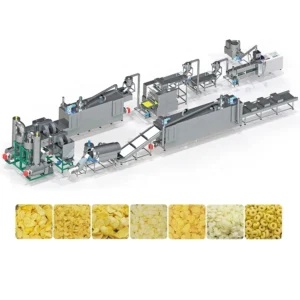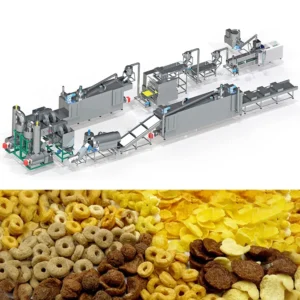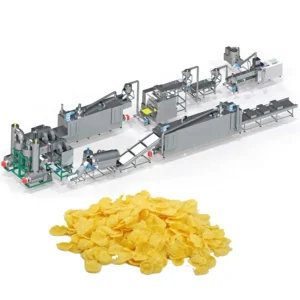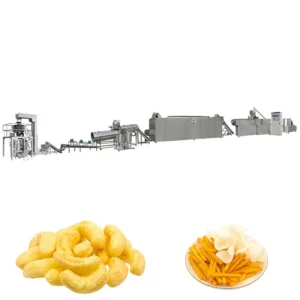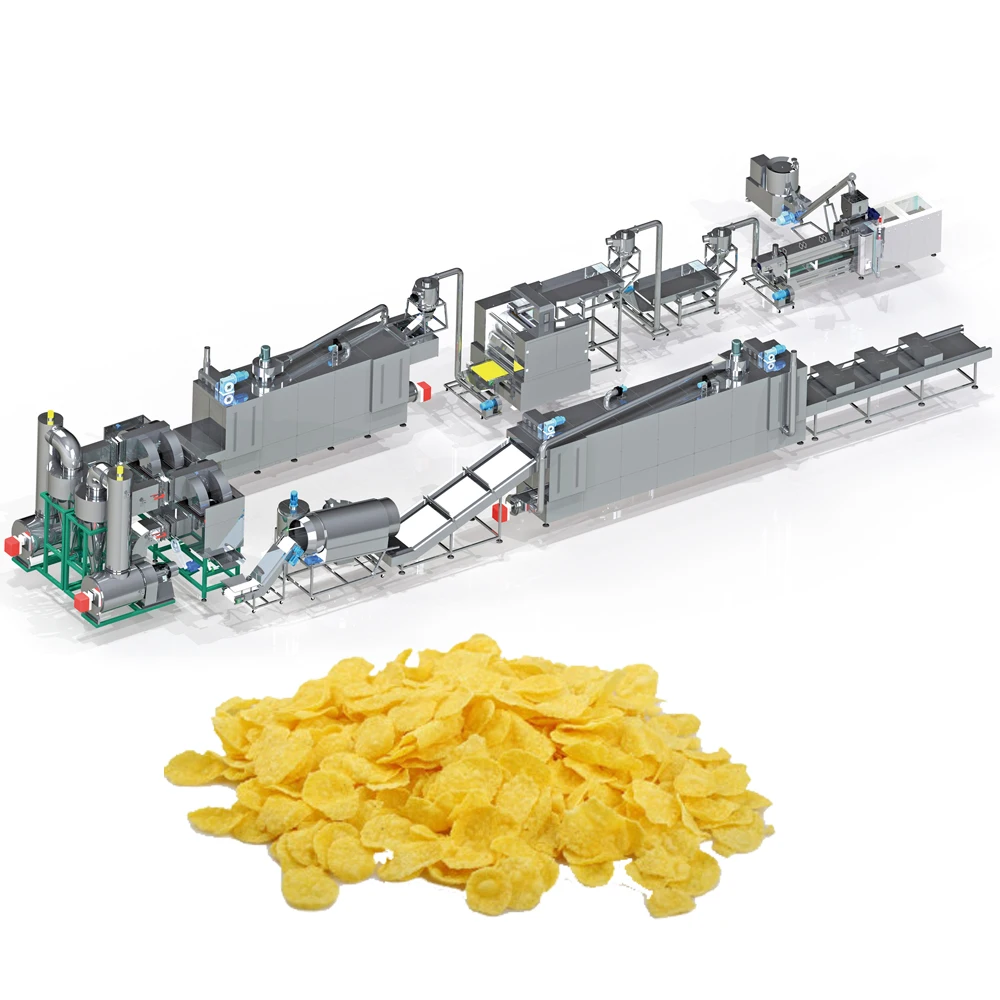
Hydraulic Flaking & Twin-Screw Precision — MT70 / MT85 / MT75 extruders pair matched screw geometries with infrared-monitored double-roller flaking so corn-flake density, blister pattern and bowl-life crispness stay inside specification from first run to hundredth shift.
Technical Specifications
| Parameter | Value |
|---|---|
| Model | MT70 / MT85 / MT75 |
| Product Type | Corn Flakes Twin Screw Extruder Production Line |
| Screw Type | Twin Screw |
| Installed Power | 160 kW (MT70) / 190 kW (MT85) / 210 kW (MT75) |
| Power Consumption | 120 kW (MT70) / 140 kW (MT85) / 150 kW (MT75) |
| Output Capacity | 150–200 kg/h (MT70), 300–400 kg/h (MT85), 300–500 kg/h (MT75) (basis not stated in source — confirm raw material type, moisture content and recipe) |
| Overall Dimensions | 41 × 1.5 × 2.2 m (MT70) / 43 × 1.5 × 3.2 m (MT85) / 45 × 1.5 × 3.5 m (MT75) |
| Control System | PLC; MCC |
| Flaking Unit | Hydraulic double-roller, separate dual motors, infrared temperature sensing |
| Dryer Heating Source | Gas / Electric |
| Roaster | Hot air circulating, conciliation burner, twin circulating fans, cyclone dust removal |
| Coating System | Double tumble sugar melting unit, elevator, coating drum, spray nozzle |
| Die Configuration | Interchangeable moulds: ball, tube, stick, ring, fruit loop, star, wheel, flower, heart |
| Screw Material | Special-process alloy, wear-resistant, automatic lubrication and cooling |
| Line Assembly | Complete turnkey line from batching through packing |
| Standards | CE (declared since 2014); ISO certified |
Application Suitability
| Application | Material or Output |
|---|---|
| Natural corn flakes (no sugar) | Corn grits and corn flour, target bowl-life crispness |
| Sugar-coated corn flakes | Corn base with double tumble sugar coating and secondary drying |
| Multi-grain breakfast cereals | Rice, wheat, oat and barley flour blends requiring re-tuned screw elements |
| Puffed cereal shapes | Interchangeable dies for fruit loops, stars, rings and balls on the same line |
| Fortified breakfast cereal | Vitamin and mineral premix added at batching stage before extrusion |
Why "Rated Output" Means Nothing Without the Recipe Behind It
A capacity number is only honest when the raw material, moisture content and screw configuration that produced it are written next to it.
I watched a Middle-East buyer arrive with oat-blended flour after the corn flakes extruder extrusion technology trial had run on standard corn grits. Expansion dropped, density climbed and the flakes sank in milk. Five days on site re-tuning barrel zones and swapping screw elements finally brought the line back into spec [NEED_CITE: starch gelatinisation behaviour of oat versus corn flour]. That episode is why every quotation now ships with a screw-and-die configuration record tied to the buyer’s actual recipe, and why a trial run on the customer’s own raw material happens before the crate is nailed shut.
Barrel Temperature Zones and Starch Gelatinisation Window
Corn starch gelatinises inside a narrow temperature band. Too cool and the dough sheet leaves the die under-cooked, producing a hard, glassy flake that shatters in the roaster. Too hot and the melt fractures, giving ragged edges and uneven blistering. The corn flakes extruder extrusion technology on the MT series uses independently heated barrel zones so the profile can be stepped from pre-conditioning through peak gelatinisation to a controlled pressure drop at the die face. Moisture injection points let the operator fine-tune water activity without stopping the line.
Die Geometry Meets Hydraulic Double-Roller Flaking
The die orifice decides pellet cross-section; the hydraulic flaking rollers decide final thickness. If the pellet is too thick before it reaches the rollers, the flake cracks at the centre. If it is too thin, the rollers flatten it into a translucent sheet that burns during roasting. Infrared temperature sensing on the roller surface keeps gap and heat matched to the dough temperature exiting the die. Separate dual motors on each roller allow micro-adjustment of nip pressure so flake density stays inside the range the market expects [NEED_CITE: hydraulic roller gap tolerance for breakfast cereal sheeting].
Screw Configuration for Multi-Grain Recipes
Oat flour has roughly three times the lipid content of corn grits, and wheat flour develops gluten that corn does not. Running a multi-grain blend on a screw profile designed for pure corn gives under-expanded, gummy pellets that refuse to blister in the roaster. The L:D ratio and element sequence on the MT series are specified after a bench trial on the buyer’s exact flour blend. Conveying sections, kneading blocks and reverse-screw elements are rearranged so residence time and shear match the new recipe’s gelatinisation and expansion behaviour.
What Power Consumption Tells You About Real Operating Cost
Installed power and consumed power are different numbers. The MT70 draws 160 kW at the main breaker but runs at roughly 120 kW during steady-state extrusion. That gap matters when you size transformers and calculate kWh cost per tonne. The PLC logs real-time amperage on each barrel heater and the main drive, giving the shift supervisor a live energy-per-kg figure. When the roaster switches from electric to gas firing, overall line consumption drops further, a detail that only shows up once utility tariffs are on the table.
The Hidden Cost of an Unmatched Dryer and Roaster
An extruder that out-runs its dryer creates a bottleneck that no amount of screw tweaking can fix. Wet flakes pile up on the belt, stick together and enter the roaster in clumps, producing a mix of burnt and under-toasted product. The line stations on the MT series are throughput-matched so the hot-air roaster with twin circulating fans and cyclone dust removal can handle the full output of the flaker without backlog [NEED_CITE: drying curve requirements for corn flake moisture reduction]. Undersizing the cooling conveyor downstream of the roaster is equally costly; warm flakes going straight into the packing bag sweat, soften and lose the crispness the brand promises.
Why Procurement Starts With the Raw Material, Not the Brochure
- Screw and die configuration record is generated from a trial on your flour, not copied from a generic build sheet.
- Barrel-zone count, temperature resolution and moisture-injection points are confirmed against your target flake density before the purchase order is signed.
- In-house testing workshop runs your exact raw material, producing a written expansion-rate and blister-pattern report before shipment.
- Line layout matches throughput across extruder, flaker, dryer and roaster so no station bottlenecks the next.
- PLC and MCC panels are wired for your site voltage and frequency, with control language set to your operators’ preference.
Documentation & Verification
- Line layout drawing with capacity calculation matched to your grain recipe
- Screw and die configuration record locked to your raw material trial
- Electrical schematic confirming voltage, frequency and breaker sizing
- Factory trial-run report showing expansion rate and flake density on your flour
- CE declaration of conformity and ISO certificate copy
- Operation and maintenance manual with wear-parts list and replacement intervals
Installation, Commissioning & Support
- Foundation plan accounts for the 41–45 m line length and 1.5 m minimum aisle width
- Dedicated circuit sized for 160–210 kW installed load with PLC-controlled soft start
- Extruder, flaker and roaster ship in separate crates for container loading and on-site assembly
- First-run commissioning sets barrel-zone profile, roller gap and roaster curve to your recipe
- Operator training covers PLC screen navigation, screw-element swap and daily lubrication check
- Wear-parts list specifies screw segments, die plates and roller shells with reorder part numbers
What to Include in Your First Inquiry
Send the exact flour blend and moisture content you plan to run, your target daily output in tonnes, and the local voltage and frequency at the installation site. If you already have a packing line or a bulk silo system upstream, share the interface height and throughput so the cooling conveyor and elevator can be matched.
Frequently Asked Questions
Q: How is screw configuration specified for different grain flours and target flake densities?
A: We run your flour blend through the in-house testing workshop, measure expansion rate and gelatinisation degree at each barrel zone, then rearrange conveying, kneading and reverse-screw elements until the pellet density matches your target flake specification. The final element sequence is recorded on the configuration sheet that ships with the machine.
Q: What barrel temperature profile and moisture range give the correct starch gelatinisation for corn flakes?
A: Corn starch gelatinises between roughly 65 °C and 75 °C, but the exact peak depends on grit size and lipid content. The PLC logs each zone so the operator can shift the profile in one-degree steps while watching torque and pressure. Moisture injection is adjusted in parallel to keep the dough plasticity inside the window the die expects.
Q: How does die geometry interact with the hydraulic flaking rollers to control final flake thickness?
A: The die orifice sets pellet diameter; the roller gap sets final flake thickness. Infrared sensors on the roller surface feed real-time temperature back to the PLC so gap pressure can be micro-adjusted. If the pellet exits the die too thick, the rollers crack it; too thin and the flake burns in the roaster.
Q: Can a trial run on my raw material confirm expansion rate and blister pattern before shipment?
A: Yes. The testing workshop runs a batch of your flour, measures expansion ratio, records blister frequency per square centimetre and photographs the flake cross-section. The report is sent to you for approval before production of the full line begins.
Q: How is the roasting temperature curve set to produce surface bubbles without over-drying the flake?
A: The hot-air roaster uses a conciliation burner and twin circulating fans to step temperature through three zones. The first zone drives surface moisture off quickly to form the blister skin; the second zone dries the core to target water activity; the third zone cools the flake before it reaches the packing station, preventing sweat inside the bag.