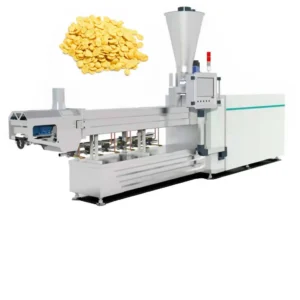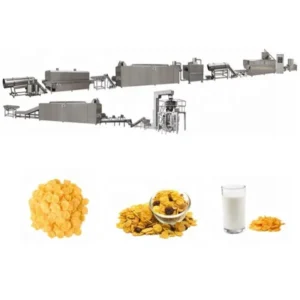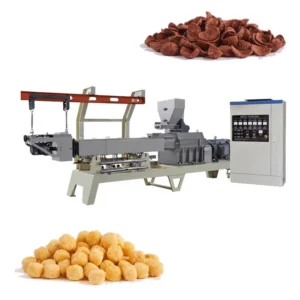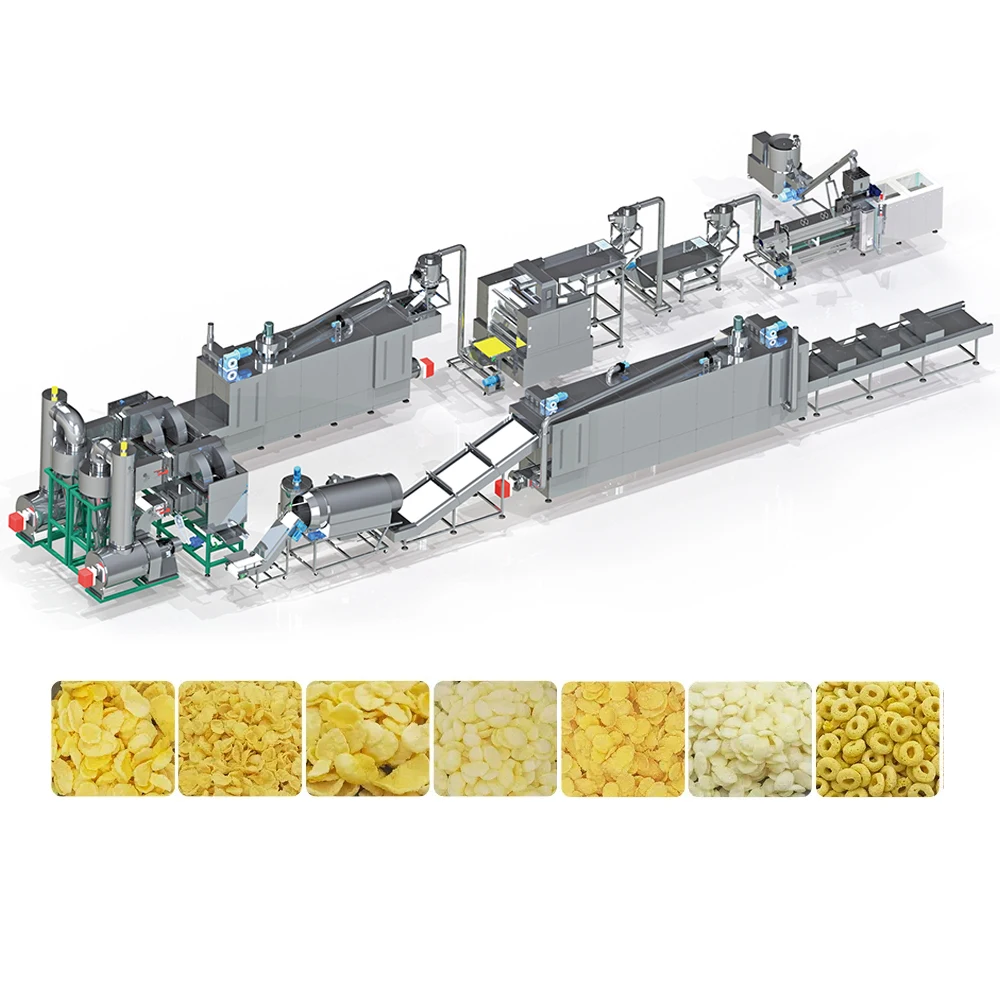
Screw Configuration Matched to Raw Material — corn flakes extrusion line specified to buyer’s grain blend and moisture content rather than generic builds, ensuring starch gelatinisation targets are met on actual production feedstock.
Technical Specifications
| Parameter | Value |
|---|---|
| Product Type | Corn Flakes Production Line |
| Models Available | MT70, MT85, MT75 |
| Extruder Type | Twin Screw |
| Installed Power (MT70) | 160 kW |
| Installed Power (MT85) | 190 kW |
| Installed Power (MT75) | 210 kW |
| Power Consumption (MT70) | 120 kW |
| Power Consumption (MT85) | 140 kW |
| Power Consumption (MT75) | 150 kW |
| Capacity (MT70) | 150–200 kg/h (basis to be confirmed) |
| Capacity (MT85) | 300–400 kg/h (basis to be confirmed) |
| Capacity (MT75) | 300–500 kg/h (basis to be confirmed) |
| Overall Dimensions (MT70) | 41 × 1.5 × 2.2 m |
| Overall Dimensions (MT85) | 43 × 1.5 × 3.2 m |
| Overall Dimensions (MT75) | 45 × 1.5 × 3.5 m |
| Control System | PLC (flaking machinery), MCC / PLC (line level) |
| Flaking Drive | Double motors for separate roller driving; hydraulic system |
| Flaking Temperature Control | Infrared sensor |
| Dryer Heating Source | Gas or Electric (configurable) |
| Roasting Oven | Hot air with vibrating pan, dual circulating fans, cyclone dust removal |
| Coating System | Double tumble for sugar melting, elevator, coating drum, spraying nozzle |
| Screw Construction | Special wear-resistant treatment |
| Lubrication | Automatic lubricating and cooling |
| Basic Raw Materials | Corn, rice, wheat, oat, barley powder |
| Standards | CE, ISO |
Application Suitability
| Application | Material or Output |
|---|---|
| Natural corn flakes production | Degerminated corn grits at controlled moisture |
| Sugar-coated breakfast cereal | Corn base with sucrose glaze spray |
| Multi-grain flake variants | Blends of rice, wheat, oat, and barley powder |
| Shaped extruded cereal formats | Rings, stars, fruit loops, ball, tube, stick forms |
| High-volume cereal manufacturing | Continuous shift operation with PLC line coordination |
Why "Nominal Capacity" Means Nothing Without Your Raw Material Report
The corn flakes extrusion production line specifications on the nameplate assume a baseline formulation that rarely matches what actually arrives at your loading dock.
I spent three consecutive nights in a Guangdong workshop re-tuning a five-zone barrel temperature profile because the buyer’s degerminated corn grits carried higher residual fat than the standard test flour. Starch gelatinisation stalled, the flakes came off the roller dense as cardboard, and no amount of dryer adjustment could rescue the bowl crispness. Every grain source behaves differently under shear and heat [NEED_CITE: starch gelatinisation kinetics in twin-screw extrusion]. That is why the first question on any corn flakes extrusion production line specifications inquiry should be: send the raw material certificate of analysis before we quote screw pitch and die aperture.
Barrel Temperature Profile and Starch Gelatinisation Control
Twin-screw extrusion for corn flakes demands precise thermal staging across multiple barrel zones. The screw configuration must balance residence time against shear intensity so that starch granules swell and rupture uniformly without scorching at the barrel wall. When the corn flakes extrusion production line specifications list installed power figures like 160 kW or 210 kW, those numbers reflect the thermal and mechanical energy available for this transformation — but only the screw profile determines how that energy transfers into the dough mass.
Die Aperture and Flake Expansion Behaviour
The die design governs the cross-section and moisture flash behaviour at exit. A narrow aperture forces higher shear and greater expansion, which suits thin natural flakes; a wider opening retains more moisture downstream, requiring heavier dryer and roaster loads. The MT70, MT85, and MT75 models each accommodate different die plate geometries, and the selection must align with target flake thickness and the hydraulic roller gap on the flaking station [NEED_CITE: die geometry influence on extrudate expansion ratio]. Mismatched die and roller settings produce flakes that either shatter during roasting or remain doughy at the centre.
Reading the Power and Dimension Data Correctly
The installed power spread across the three models — 160 kW, 190 kW, and 210 kW — correlates with barrel diameter, screw length-to-diameter ratio, and throughput envelope rather than a simple "bigger is faster" relationship. Power consumption figures sit noticeably lower at 120 kW, 140 kW, and 150 kW, reflecting typical load factors during steady-state extrusion. Overall line dimensions stretching 41 to 45 metres in length signal that the corn flakes extrusion production line specifications account for the full sequence: mixer, extruder, flaker, dryer, hot air roaster, cooling conveyor, and packing interface. Buyers must verify that facility ceiling height accommodates the 2.2 to 3.5 metre profile and that floor loading can sustain the combined equipment mass.
The Hidden Cost of Skipping the Trial Run
Lines shipped without a raw material trial run frequently arrive at sites where the extruder barrel zones need complete re-profiling, the flaking roller hydraulic pressure cannot compensate for extrudate density variation, and the roasting oven circulating fans push surface bubbling past the point of acceptable colour [NEED_CITE: post-installation commissioning delays in food extrusion projects]. Operators spend weeks adjusting parameters that should have been locked in at the factory. The result is lost production days, wasted raw material, and strained relationships between buyer and supplier before the first saleable batch leaves the packing station.
Engineering Accountability Behind the Specification Sheet
Screw configuration and die design are documented against the buyer’s specific grain blend and moisture range, not copied from a catalogue default. The in-house testing workshop runs the buyer’s actual raw material through the extruder before crating, generating a trial run report that travels with the shipment. Line layout and capacity calculation show throughput matching between extruder, flaker, dryer, roaster, and coater so that no single station bottlenecks the sequence. Electrical schematics confirm voltage, frequency, and control language before fabrication begins, eliminating the commissioning delays that arise when a 50 Hz panel meets a 60 Hz supply. The hot air roasting oven integrates dual circulating fans and cyclone dust removal to maintain consistent surface bubbling across the vibrating pan width.
Documentation & Verification
- Line layout and capacity calculation matched to your corn or multi-grain formulation
- Screw and die configuration record tied to buyer-supplied raw material certificate
- Trial run report on your grain blend conducted in testing workshop before dispatch
- Electrical schematic with voltage and frequency confirmation for destination facility
- CE declaration of conformity and ISO certificate for customs and regulatory clearance
Installation, Commissioning & Support
- Floor plan must accommodate 41–45 m line length and 2.2–3.5 m ceiling clearance depending on model
- Dedicated power circuit sized for 160–210 kW installed load with confirmed voltage and frequency
- PLC and MCC control language configured to operator preference before shipment
- First-run commissioning includes barrel temperature re-profiling on site-specific raw material
- Wear parts list covering screws, dies, and flaking roller surfaces supplied at installation
- Preventive maintenance schedule aligned with automatic lubrication system intervals
What We Need From Your Side to Proceed
Share the raw material certificate of analysis — grain type, moisture content, fat percentage, and particle size distribution — so the screw configuration can be specified before quotation. Provide facility dimensions including available line length, ceiling height, and column spacing for layout drafting. Confirm local voltage, frequency, and preferred control language so the electrical package matches site conditions on arrival.
Frequently Asked Questions
Q: How is screw configuration matched to a specific grain blend for corn flakes?
A: The screw pitch, flight depth, and kneading block arrangement are selected after reviewing the buyer’s raw material certificate, including starch content, moisture, and fat residue. A trial run in the testing workshop validates gelatinisation behaviour before the configuration is finalised and documented.
Q: What throughput differences exist between MT70, MT85, and MT75?
A: Each model occupies a different capacity envelope, but stated figures depend on the grain formulation, moisture content, and target flake density. Buyers should request throughput calculations based on their specific raw material rather than relying on generic range values.
Q: How does hot air roasting temperature affect final flake crispness?
A: The roasting oven uses dual circulating fans and high-temperature spraying tubes to control surface bubbling. Temperature profile and residence time on the vibrating pan determine whether flakes achieve bowl-stable crispness or remain chewy at the core. Parameters are tuned during trial runs.
Q: Can the flaking roller gap produce different thicknesses from the same extrudate?
A: The hydraulic double-roller system with infrared temperature monitoring allows gap adjustment to vary flake thickness. However, extrudate moisture and die configuration must also align with the target thickness to prevent cracking or delamination during downstream drying.
Q: Is a trial run performed before shipment?
A: Yes. The buyer’s raw material is processed through the extruder and flaking station in the testing workshop. The resulting trial run report documents screw configuration, barrel temperatures, flake density, and visual product assessment, and ships with the equipment.