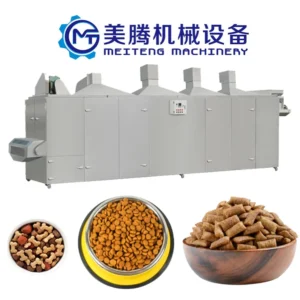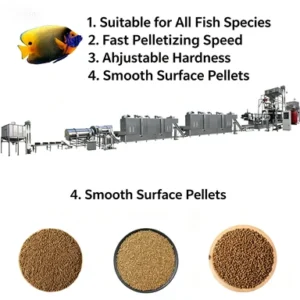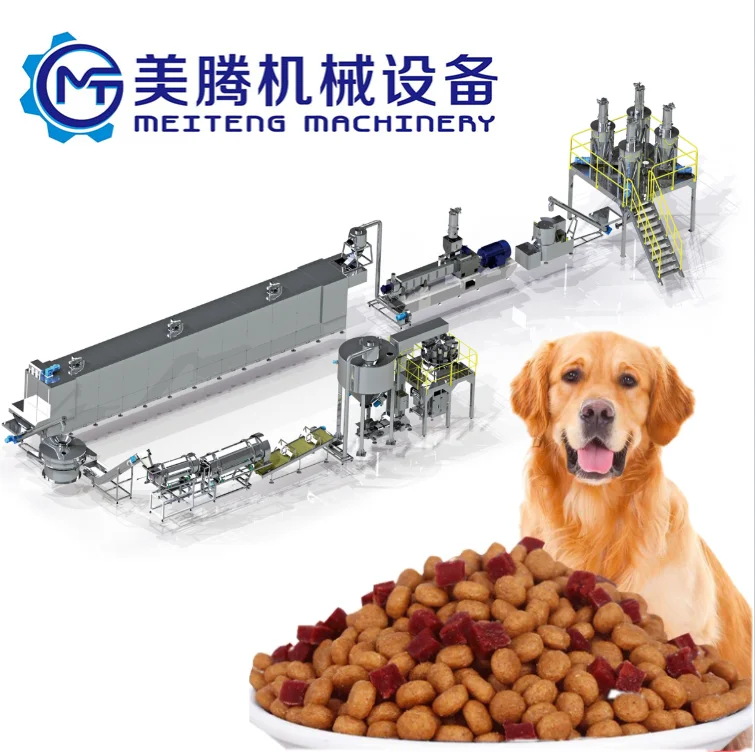
Precision-Calibrated Extrusion — Screw geometry and barrel zones matched to your actual formulation, validated with your raw material in our testing workshop before the line ships.
Technical Specifications
| Parameter | Value |
|---|---|
| Product Type | Pet Food Extrusion Production Line |
| Automation Level | Full automation from raw material mixing to packaging |
| Recipe Adaptability | Dry kibble, semi-moist, and treats |
| Control System | Advanced sensors and precision controls |
| Line Stations | Mixing, extrusion, drying, packaging |
| Energy Efficiency | Energy-saving design |
| Maintenance | Modular components for quick cleaning and maintenance |
| Configuration | Customizable capacity and layout |
| Material | Food-grade materials |
| Output Capacity | To be confirmed based on raw material, moisture content, and kibble size |
| Screw Type | Single or twin screw (basis to be confirmed) |
| Standards | CE, FDA |
Application Suitability
| Application | Material or Output |
|---|---|
| Dry kibble production for dogs and cats | Corn, meat meal, bone meal, cereal blends |
| Semi-moist pet treats | Fresh meat slurry, starch, glycerin formulations |
| Bird feed pellets | Seed mixes, grain flour, vitamin premixes |
| Aquatic feed for fish | Fish meal, soy protein, wheat flour blends |
| Cattle feed pellets | Grain by-products, fiber, protein concentrates |
Why Kibble Density Fails on Generic Extrusion Setups
Consistent kibble density demands screw configuration and barrel profiling tied to your specific raw material blend, not copied from a catalog build.
I have watched entire production runs sink when a line built for corn-based formulas met a recipe loaded with fresh meat slurry. The expansion collapsed because the screw pitch and barrel zones were never adjusted for that formulation’s gelatinisation window. In Colombia, a pet food plant lost three days of output before we reconfigured the screw combination and die plate to match their high-protein input. Buyers who skip raw material trials before shipment routinely face density variation, shape inconsistency, and market rejection [NEED_CITE: starch gelatinisation temperature ranges for cereal and protein blends].
Screw Configuration as the Foundation of Expansion Control
The Pet Food Extrusion Production Line extrusion technology starts at the screw element level. Feed section pitch, compression ratio, and kneading block arrangement determine how much mechanical energy transfers into the dough. A recipe heavy in meat meal requires different shear intensity than one based primarily on corn grits. Getting this wrong produces either under-expanded dense pellets or over-expanded fragile kibble that shatters during packaging.
Barrel Temperature Profiling for Repeatable Gelatinisation
Each barrel zone operates under independent thermal control so the material experiences a precise heating curve from feed intake to die exit. Starch granules must reach their gelatinisation threshold at exactly the right point in the barrel, not too early where they cause buildup on the screw flights, and not too late where expansion becomes uneven. This profiling is what separates a batch that holds its shape on the cooling conveyor from one that warps and cracks.
Reading the Specs That Actually Matter
The L:D ratio governs residence time, which directly influences how completely the starch cooks and how uniform the moisture distribution becomes before the material exits the die. Longer barrels allow gentler, more complete gelatinisation at lower shear, reducing the risk of protein denaturation in high-meat formulations. Die orifice diameter and land length together set the expansion ratio and surface finish of each kibble piece. Moisture injection capability, whether steam or liquid water, gives operators a real-time variable to tune expansion without stopping the line. Control system precision on barrel zones determines whether temperature deviation stays within the narrow band required for batch-to-batch consistency [NEED_CITE: die land length effect on extrudate expansion in food processing].
The Hidden Cost of Skipping Configuration Validation
When extrusion parameters are set without testing the buyer’s actual raw material, the failures do not appear during factory acceptance — they show up weeks later on the production floor. Kibble that sinks when it should float, treats that harden beyond spec, and density swings that trigger customer complaints are all downstream consequences of unverified screw and die combinations. Rectifying these issues on-site means production stoppages, replacement screw orders, and reformulation cycles that consume far more time than a pre-shipment trial ever would [NEED_CITE: cost of unplanned downtime in continuous food processing lines].
Why Sourcing This Line Here Makes the Difference
Every station from batching through packaging is supplied as one integrated system, so throughput is balanced across mixing, extrusion, drying, and coating rather than bottlenecked by mismatched vendors. Screw configurations and die designs are specified against your raw material data sheet, not pulled from a generic template. Our in-house testing workshop runs your actual formulation before the equipment leaves the factory, producing a trial report that documents expansion, density, and texture outcomes. Twin-screw expertise spans dry kibble, semi-moist treats, and aquatic feed, meaning the engineering team has encountered formulation challenges close to yours. Pre-sales consultation extends through on-site installation, commissioning, operator training, and ongoing wear parts support.
Documentation & Verification
- Line layout and capacity calculation matching your workshop dimensions and throughput target
- Screw and die configuration record specific to your raw material formulation
- Trial run report on your raw material documenting expansion, density, and texture results
- Machine specification sheet with barrel zone count and die specifications
- Electrical schematic with voltage and frequency confirmed for your facility
- CE declaration of conformity and FDA material compliance documentation
Installation, Commissioning & Support
- Foundation and utility planning based on the customized line layout and station footprint
- Dedicated electrical circuits sized to the confirmed rated power and local voltage
- Modular station assembly allowing phased installation within your facility’s access constraints
- First-run parameter tuning on your raw material with screw speed and barrel zone adjustment
- Operator training covering recipe changeover, die replacement, and moisture calibration procedures
- Wear parts list including screw elements and die plates with reorder specifications
What We Need to Build Your Line Accurately
Share your target product format — dry kibble, semi-moist treat, or aquatic pellet — along with the raw material formulation you plan to run. Specify your local voltage and frequency so the control panels and motor drives are built to match. Provide workshop dimensions and ceiling height so the line layout fits your existing space, and let us know whether you need a raw material trial run in our testing workshop before shipment.
Frequently Asked Questions
Q: How is screw configuration determined for my specific raw material blend?
A: We start with your formulation data sheet, analyzing protein content, starch source, fat percentage, and target moisture. Based on these inputs, we select screw element types, kneading block angles, and compression ratios that deliver the shear and residence time your recipe requires. The configuration is then validated in our testing workshop using your actual raw material before the line is finalized for production.
Q: What barrel temperature profile is needed for optimal starch gelatinisation?
A: The profile depends on your starch source and protein ratio. Corn-based recipes gelatinise at different barrel zone temperatures than wheat or rice-dominant blends. We map the heating curve across each zone during the trial run, adjusting until the material reaches complete gelatinisation at the correct point without scorching or undercooking, then document the profile in your commissioning records.
Q: How do you control kibble density to meet floating or sinking specifications?
A: Density is governed by expansion ratio, which we tune through screw compression, barrel temperature, moisture injection, and die design. For floating aquatic pellets, we increase expansion to trap air cells within the matrix. For sinking feed, we reduce expansion through higher compression and modified die land geometry. Your trial run confirms the density target is met consistently.
Q: Can the die design be changed to produce different kibble shapes and sizes?
A: Yes, the die plate is interchangeable, allowing you to switch between shapes and sizes without replacing the barrel or screw assembly. We engineer each die to your target kibble geometry, accounting for post-extrusion shrinkage and drying deformation. Multiple die plates can be supplied so your line handles different product formats on the same extrusion platform.