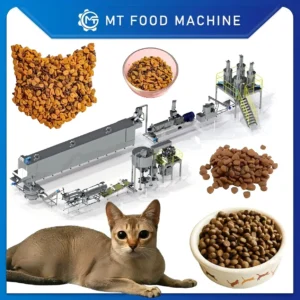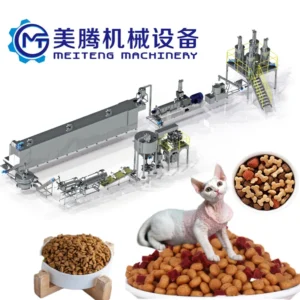
Matched Screw Geometry — Every barrel segment and screw element in this pet food extrusion production line technology is specified against your actual bone meal ratio and starch content, not copied from a generic catalog build.
Technical Specifications
| Parameter | Value |
|---|---|
| Product Type | Pet Food Extrusion Production Line |
| Capacity Range | 150 kg/h – 3 T/h (basis not stated in source — confirm raw material, moisture content, kibble size) |
| Screw Type | Twin-screw |
| Automation Level | Fully automated from mixing to packaging |
| Control System | Available with PLC or MCC control |
| Line Stations | Raw material mixing, extrusion, drying, flavoring/coating, cooling, packaging |
| Recipe Adaptability | Dry kibble, semi-moist, treats |
| Energy Design | Energy-saving technologies integrated |
| Assembly State | Complete line, modular components |
| Certification | CE, FDA, ISO |
| Food Contact Materials | Food-grade materials throughout |
| Voltage & Frequency | Configurable to destination market (basis to be confirmed) |
Application Suitability
| Application | Material or Output |
|---|---|
| Dry kibble for dogs and cats | Corn, meat meal, bone meal, vitamin premix blends |
| Semi-moist pet food formulations | High-moisture protein bases with humectants |
| Extruded pet treats | Starch-protein mixes shaped through custom dies |
| Aquatic feed pellets | Fish meal and plant protein for floating or sinking density targets |
| Bird and small animal feed | Seed-based and grain-based recipes with varied kibble geometry |
Why Nominal Capacity Figures Mislead Pet Food Producers
A line rated at a given throughput on corn starch will behave entirely differently when your recipe contains heavy bone meal or high-fat protein concentrates.
The pet food extrusion production line technology you evaluate must be tested against your exact formulation before anyone commits to a capacity claim. I have watched lines stall mid-run because the screw profile was optimized for a simple corn base while the buyer’s recipe carried a heavy mineral load that changed melt viscosity inside the barrel. Density shifts, die blockages, and inconsistent kibble expansion follow when process parameters are never validated against real material [NEED_CITE: extrusion behavior variance across pet food raw materials].
Screw Element Sequencing and Melt Rheology
The arrangement of conveying, kneading, and reverse elements along the screw shaft determines how much shear energy transfers into your dough at each barrel zone. For a kibble formula heavy in bone meal, the kneading blocks must be positioned and angled to generate enough mechanical energy for full starch gelatinisation without degrading protein structures. This is where pet food extrusion production line technology either holds consistent texture or drifts batch-to-batch.
Barrel Temperature Zoning and Starch Conversion
Each barrel segment carries independent heating and cooling circuits so that the thermal profile tracks the physical transformation happening inside. Early zones need moderate heat to hydrate starch granules, while later zones demand precise control to manage melt temperature before the die plate. Incorrect zoning causes under-gelatinised cores or surface scorching, both of which compromise kibble digestibility and palatability in the final product [NEED_CITE: starch gelatinisation temperature thresholds in twin-screw extrusion].
Reading the Specs That Actually Matter for Kibble Quality
The twin-screw configuration gives processors the ability to handle recipes with high fat, high protein, or high mineral content — materials that would cause slip or surging in single-screw designs. The length-to-diameter ratio of the screws governs residence time: longer barrels allow more complete cooking at lower screw speeds, which matters when heat-sensitive vitamins and amino acids are part of the premix. Die geometry — hole diameter, land length, and face plate thickness — sets the expansion ratio and final kibble density. A die specified for light, airy treats will produce unacceptably dense kibble if the same plate is used for a high-protein adult dog formula without adjustment. The PLC control system captures temperature, screw speed, and feeder rates at every zone, creating a process signature that can be recalled for repeat orders.
The Hidden Cost of Generic Screw Configurations
When an extruder ships with a screw build copied from a standard template rather than matched to your recipe, the problems do not appear in the factory acceptance test on corn flour — they appear three weeks after commissioning when your actual bone-meal-heavy formula produces kibble that sinks when it should float, or crumbles during the coating drum. Reconfiguring the screw elements on site means production downtime, wasted raw material, and a commissioning engineer flying in at the buyer’s expense [NEED_CITE: costs of post-installation screw reconfiguration in food extrusion].
Why Sourcing This Line Here Reduces Process Risk
Every screw and die combination is documented against the buyer’s raw material sheet before production begins, so the configuration record travels with the machine. An in-house testing workshop runs your actual formula through the extruder before crating, producing a trial report with expansion ratio, density measurements, and kibble cross-section photographs. Throughput calculations match every station — mixer output to extruder intake, dryer belt speed to extruder discharge rate — so no single unit bottlenecks the line. PLC and MCC panels are wired to the destination voltage and frequency, and control language is confirmed before the cabinet is sealed. The food-grade contact materials across all wetted surfaces meet CE and FDA requirements without requiring aftermarket upgrades.
Documentation & Verification
- Screw and die configuration record matched to your raw material formulation
- Trial run report with density and expansion data from in-house testing workshop
- Electrical schematic reflecting confirmed voltage, frequency, and control language
- Line layout drawing with throughput matching across every station
- CE declaration of conformity and ISO certificate included in shipment documentation
Installation, Commissioning & Support
- Foundation plan accounts for twin-screw extruder vibration isolation and dryer belt length
- Dedicated power circuit sized to the confirmed motor load and heating element draw
- Modular line stations arrive labeled for sequential assembly on your factory floor
- First-run commissioning includes screw speed and barrel zone calibration on your recipe
- Operator training covers PLC parameter recall for batch-to-batch repeatability
- Wear parts list identifies screw elements, die plates, and cutter bearings for reorder
What We Need to Configure Your Line
Send your target kibble format, a raw material breakdown with approximate proportions, and your daily production target so the line capacity calculation reflects actual conditions rather than a generic baseline. Confirm your local voltage and frequency, the control language your operators will use, and whether you want to ship a batch of your material to our testing workshop for a pre-delivery trial run.
Frequently Asked Questions
Q: How is screw configuration matched to my specific raw material and kibble target?
A: We review your formula sheet — protein source, starch type, fat level, mineral content — and select conveying, kneading, and reverse screw elements in a sequence that delivers the shear and residence time your recipe requires. The die plate hole diameter and land length are then calculated to hit your target expansion ratio and kibble density.
Q: How do barrel temperature zones affect starch gelatinisation and expansion?
A: Each zone is independently heated and cooled so that starch granules hydrate in early segments and fully gelatinise before reaching the die. The thermal profile is tuned during the trial run to prevent under-cooked cores or surface scorching, both of which alter kibble texture and nutritional availability.
Q: How is kibble density controlled and verified against my market specification?
A: Density is governed by the interplay of screw speed, barrel temperature, moisture injection rate, and die geometry. During the in-house trial run, sample kibble is measured for bulk density and cross-section expansion, and the results are compared against your target specification before the line is cleared for shipment.
Q: Can I run a trial with my own raw material before shipment?
A: Yes. Our testing workshop accepts shipments of your actual raw material blend. We run the extruder on your formula, document process parameters, and provide a trial report with density, expansion, and kibble appearance data so you can evaluate product quality before the line leaves our factory.
Q: What process data does the PLC capture for batch consistency?
A: The PLC logs barrel zone temperatures, screw speed, feeder rates, and moisture injection volumes throughout each production run. This process signature can be saved and recalled for subsequent batches, allowing operators to replicate the exact conditions that produced approved kibble during commissioning.