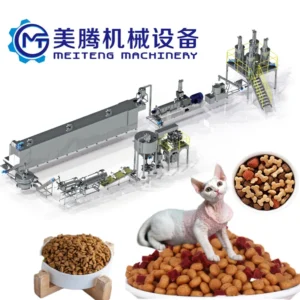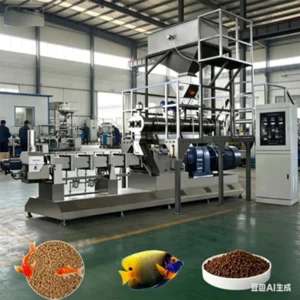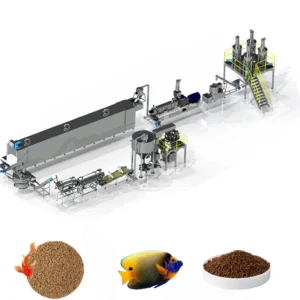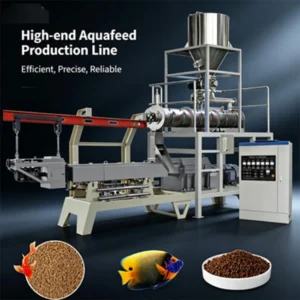
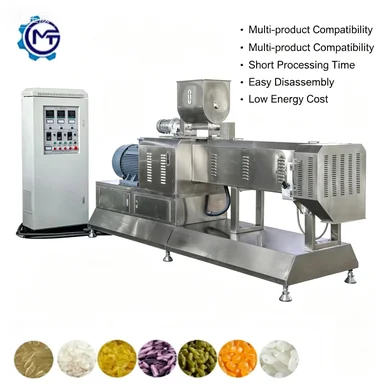
Screw Geometry Matched to Feed Density — Every twin-screw aquatic feed extrusion line we ship carries a configuration record tied to the buyer’s specific raw material formulation and target float-sink behaviour, not a generic build copied from a catalogue.
Technical Specifications
| Parameter | Value |
|---|---|
| Product Type | Twin Screw Aquatic Feed Extrusion Line |
| Output Capacity | 500 kg/h (basis not stated in source — confirm raw material formulation, moisture content and pellet size) |
| Screw Type | Twin-screw |
| Pellet Size Range | 0.5 mm – 12 mm |
| Feed Type Supported | Floating and sinking aquatic feed |
| Line Functions | Feeding, mixing, extruding, pelletizing (integrated) |
| Automation Level | Fully automatic, continuous operation |
| Control System | Simple control panel (PLC / MCC available on request) |
| Structure Material | Stainless steel (main contact parts) |
| Standards | CE certified; ISO certified |
Application Suitability
| Application | Material or Output |
|---|---|
| Floating pellets for surface-feeding species | Tilapia and catfish formulations with high starch content for maximum expansion |
| Sinking pellets for bottom feeders | Shrimp and benthic fish feeds requiring controlled density and slow water stability |
| Fry-stage micro pellets | 0.5 mm – 2 mm pellets from finely ground meal and protein concentrate |
| Grow-out stage pellets | 4 mm – 12 mm pellets from mixed grain, fish meal and oil-based formulations |
| Small to medium feed mills | Continuous production lines transitioning from land-animal feed to aquatic feed |
Why Generic Screw Builds Sink Your Floating Pellets
A screw and die set that was never matched to your actual formulation will produce pellets that drift outside the density window your market demands.
I once watched a Southeast Asian aquaculture producer lose nearly half his rated output on a floating tilapia line because the extruder arrived with a screw profile designed for standard corn-soy blends — his recipe ran heavy on fish meal with elevated fat, and the shear profile simply could not gelatinise the starch fast enough. The pellets came out dense, sank in the pond, and the farmer faced returns from his own distributors. That producer had paid for a line rated at a certain capacity on paper, but the twin screw extrusion aquatic feed line specifications he needed were never reconciled with his raw material reality [NEED_CITE: starch gelatinisation thresholds in high-fat aquatic formulations]. When the screw geometry, barrel temperature zones and die orifice are all selected against a generic reference material instead of the buyer’s formulation, the entire production window narrows and floatability becomes unpredictable.
How Screw Configuration Governs Pellet Buoyancy
The flight depth, pitch angle and kneading block arrangement inside the barrel determine how much mechanical energy transfers into the dough matrix at each stage. For floating pellets, the screw profile must generate sufficient shear to fully gelatinise starch while retaining enough moisture to drive expansion at the die face. Sinking pellets demand the opposite balance: controlled compression and lower expansion, achieved through tighter kneading zones and reduced dwell time. Getting this right means the twin screw extrusion aquatic feed line specifications must be locked to a specific formulation before metal is cut.
Barrel Temperature Profiling and Moisture Control
Aquatic feed extrusion lives or dies on how well the barrel zones manage the transition from raw meal to a homogeneous, plasticised dough. Too much heat early in the barrel and the starch skins over before it fully hydrates; too little and the matrix exits the die under-expanded, producing pellets that crack during drying. Moisture injection points and steam conditioning upstream of the feed zone add another variable that must be mapped against the barrel profile. Each zone’s setpoint interacts with the next, which is why trial runs on the buyer’s actual raw material remain the only reliable way to validate the temperature curve [NEED_CITE: barrel zone interaction effects in twin-screw food extrusion].
Reading the Specs That Actually Matter
The pellet size range of 0.5 mm to 12 mm covers fry through grow-out stages, but achieving the full span requires die plate changes and corresponding adjustments to cutter speed. Stainless steel contact surfaces are essential in aquatic feed environments where high moisture and salt-laden formulations accelerate corrosion on carbon steel components. The integrated feeding, mixing, extruding and pelletizing sequence means throughput at each station must be balanced; an extruder pushing 500 kg/h into an undersized dryer creates a bottleneck that backs up the entire line. Control system options range from a simple panel to PLC with MCC, and the choice affects how precisely operators can hold barrel temperatures and screw speed across long production runs. Voltage and frequency must be confirmed against the installation site before electrical cabinets are wired — a mismatch discovered at commissioning delays start-up by weeks.
The Hidden Cost of Skipping the Trial Run
Producers who accept shipment without a pre-dispatch trial on their own raw material often discover density problems only after installation, when the cost of reconfiguration multiplies. Screws must be pulled, barrel segments inspected, and new die plates ordered — all while the line sits idle and contractual delivery windows to the producer’s own customers slip. In some cases the formulation itself needs reformulation because the available shear window cannot accommodate the original recipe, meaning the producer faces ingredient sourcing changes on top of hardware delays [NEED_CITE: post-installation reconfiguration costs in extrusion lines]. These are problems that an in-house test run would have surfaced before the machine left the factory.
Why Source This Line From Meiteng
Complete throughput matching across every station — extruder, dryer, coating drum, cooler — is calculated under one supplier, so no single unit bottlenecks the line. Screw configuration and die geometry are specified against the buyer’s raw material data sheet rather than pulled from a standard library. An in-house testing workshop allows trial runs on customer-supplied formulations before shipment, generating a documented report that travels with the machine. Twin-screw expertise spans pet food, aquatic feed, snacks, cereals and protein applications, meaning cross-contamination of knowledge from adjacent categories informs the screw design. Pre-sales consultation extends through engineer-designed line layout, on-site installation, commissioning and ongoing maintenance support.
Documentation & Verification
- Line layout drawing with throughput calculation for your target pellet size and formulation
- Screw and die configuration record matched to your raw material data sheet
- Trial run report on your actual formulation performed before dispatch
- Electrical schematic with voltage and frequency confirmed to your installation site
- CE declaration of conformity and ISO certificate for the complete line
- Operation and maintenance manual with wear parts list and replacement intervals
Installation, Commissioning & Support
- Foundation plan accounting for extruder weight distribution and vibration isolation at full load
- Dedicated power circuit sized to the confirmed motor rating and local voltage standard
- Barrel and screw assembly verified on-site after transit to confirm alignment
- First-run parameter logging across all barrel zones with your raw material formulation
- Operator training covering die changes across the 0.5 mm to 12 mm pellet range
- Wear parts inventory list with lead times for screws, dies and barrel liners
What We Need From You to Configure the Line
Send your formulation data sheet including protein, fat, starch and moisture percentages for each recipe you plan to run. Confirm the target pellet diameter range and whether you need floating, sinking or both profiles. Share your workshop floor plan with ceiling height so we can lay out the dryer and cooler runs, and specify your local voltage, frequency and preferred control language so the electrical cabinet is built correctly before it ships.
Frequently Asked Questions
Q: How is screw configuration selected for floating versus sinking pellet targets?
A: Floating pellets require a screw profile that maximises shear and dwell time to fully gelatinise starch and drive expansion at the die. Sinking pellets need tighter compression zones and shorter residence to limit expansion. We build the configuration record against your specific formulation data, then validate it during a trial run before shipment.
Q: What formulation data must be provided to set the barrel temperature profile?
A: We need protein, fat, starch and moisture percentages for each recipe, along with particle size distribution of the ground meal. Fat content above certain thresholds suppresses expansion, so the barrel zone setpoints must compensate. This data lets us map the temperature curve before your line enters production.
Q: How is pellet density and floatability verified before the machine ships?
A: We run your raw material through the extruder in our testing workshop, measure pellet bulk density and conduct a float-sink test in water at controlled temperature. The trial run report documents screw speed, barrel temperatures, moisture levels and the resulting pellet behaviour, and ships with the machine.
Q: What moisture range and steam setup does aquatic feed extrusion require?
A: Typical preconditioning moisture sits between 22% and 28% depending on starch content and target expansion. Steam injection upstream of the barrel raises dough temperature and aids hydration. The exact moisture window is confirmed during the trial run on your formulation and recorded in the configuration document.
Q: How must downstream dryer and cooler capacities match extruder throughput?
A: If the extruder outputs 500 kg/h but the dryer can only handle 350 kg/h, pellets queue in the transfer chute, cool unevenly and develop moisture gradients that cause cracking. We calculate dryer belt length, airflow and cooler volume against the extruder’s confirmed output so every station holds the same throughput.