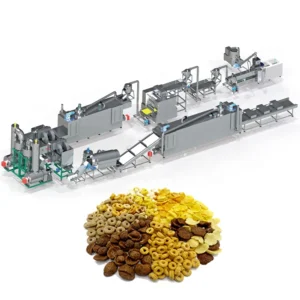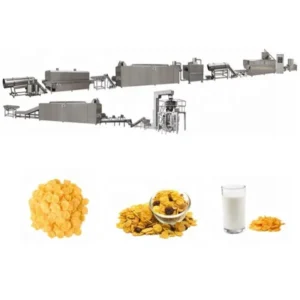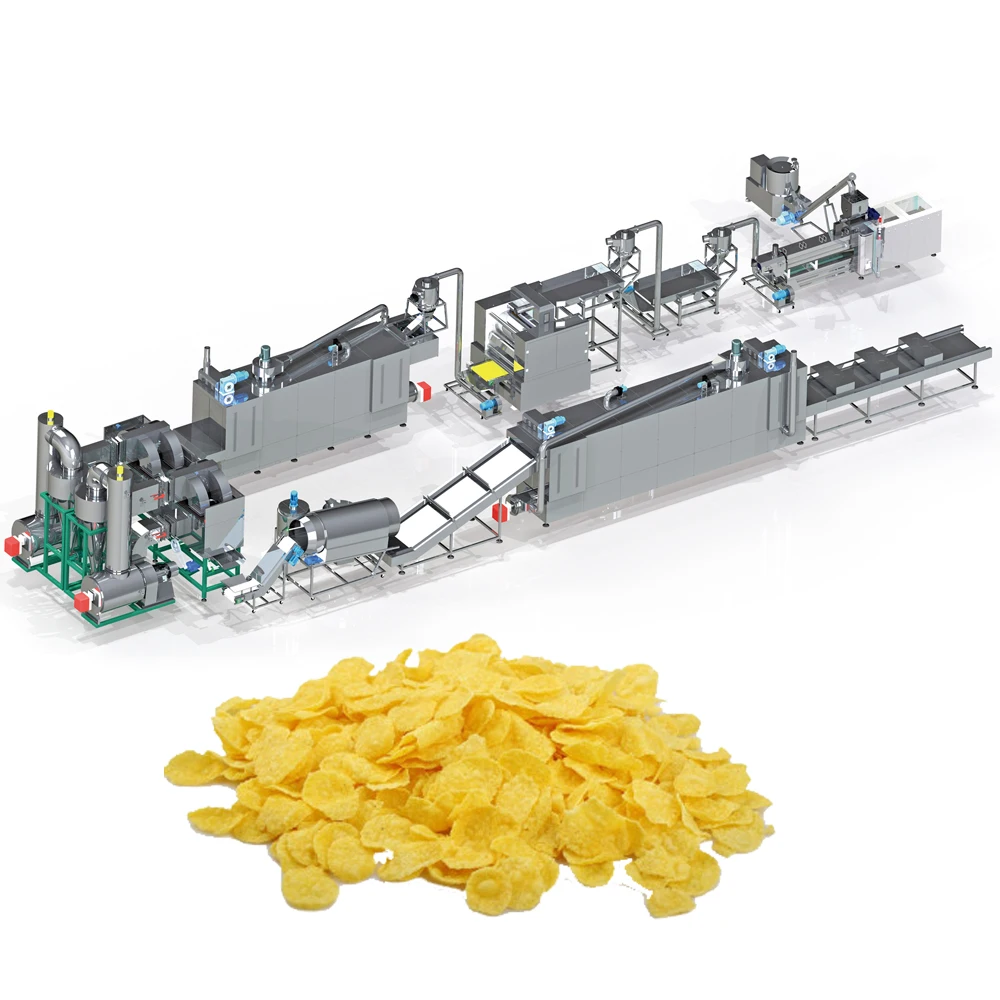
Screw Configuration Matched to Material — Every MT series corn flakes line ships with a documented screw and die profile developed from your actual raw material trial, not a generic extruder build.
Technical Specifications
| Parameter | Value |
|---|---|
| Model | MT70 / MT85 / MT75 |
| Product Type | Corn Flakes Production Line (Twin-Screw Extrusion System) |
| Screw Type | Twin-screw |
| Installed Power (MT70) | 160 kW |
| Installed Power (MT85) | 190 kW |
| Installed Power (MT75) | 210 kW |
| Power Consumption (MT70) | 120 kW |
| Power Consumption (MT85) | 140 kW |
| Power Consumption (MT75) | 150 kW |
| Output Capacity (MT70) | 150–200 kg/h (basis not stated in source) |
| Output Capacity (MT85) | 300–400 kg/h (basis not stated in source) |
| Output Capacity (MT75) | 300–500 kg/h (basis not stated in source) |
| Overall Dimensions (MT70) | 41 × 1.5 × 2.2 m |
| Overall Dimensions (MT85) | 43 × 1.5 × 3.2 m |
| Overall Dimensions (MT75) | 45 × 1.5 × 3.5 m |
| Extruder Working Principle | Feeding, extruding, cutting, heating, gearing, controlling systems |
| Extruder Features | Automatic lubricating and cooling function |
| Flaking Machine Control | PLC control with hydraulic double-roller system, infrared sensor temperature control |
| Dryer Heating Source | Gas or Electric |
| Roasting Oven Type | Hot air with vibrating pan, conciliation burner, cyclone dust removal |
| Coating System | Double tumble sugar melting, elevator, coating drum, spraying nozzle |
| Line Control Integration | PLC at flaking station; MCC/PLC integration across full line |
| Standards | CE, ISO |
Application Suitability
| Application | Material or Output |
|---|---|
| Natural corn flakes production | Corn powder with controlled moisture for consistent gelatinisation |
| Sugar-coated corn flakes | Corn or cereal extrudate with sugar spraying and tumble coating |
| Shaped breakfast cereals | Corn, rice, wheat, oat, barley blends formed into ball, tube, stick, ring, fruit loop, star, wheel, flower, or heart shapes via adjustable extruder mould |
| Multi-grain flake production | Blended cereal powders requiring matched barrel temperature profiling |
What "Nominal Capacity" Means When Your Corn Grits Hit the Barrel
A capacity figure without raw material and moisture context is not a capacity — it is a guess.
When a breakfast cereal line is quoted on a generic throughput number, the real test begins the moment your specific corn powder enters the feed hopper. I have stood beside extruders in humid workshops where the corn grits were coarser than the trial sample, and the original screw profile simply could not maintain consistent pressure across the barrel zones. The flakes came out uneven in thickness, the roasting oven produced excessive breakage, and the line sat idle while we reconfigured the screw elements and die geometry. Understanding corn flakes extrusion machine specifications starts with knowing exactly what material will run through the barrel. [NEED_CITE: starch gelatinisation requirements vary by corn variety and particle size distribution]
Barrel Zone Profiling and Starch Gelatinisation Control
The twin-screw extruder in this corn flakes production line uses a multi-zone heating arrangement along the barrel, allowing operators to set distinct temperature targets from the feed section through to the die plate. Corn starch gelatinises within a narrow thermal window, and the moisture-shear balance inside the barrel determines whether the extrudate emerges with the correct plasticity for downstream flaking. The screw configuration is specified based on your raw material formulation — adjusting element pitch, kneading block arrangement, and residence time to match the gelatinisation behaviour of your particular corn or multi-grain blend.
Die Geometry and Flake Density Targeting
Die design on a corn flakes extrusion machine directly governs the cross-section and expansion ratio of the extrudate rope before it reaches the flaking rollers. A die orifice that is too large produces a thick, under-expanded rope that flakes into dense, hard pieces with poor bowl life. The MT series uses interchangeable die plates matched to the target flake thickness and surface texture. The hydraulic double-roller flaking station, controlled by PLC with infrared sensor feedback, then compresses the extrudate to the precise gauge required — with roller gap and temperature held uniform across the full roller face. [NEED_CITE: die land length influence on extrudate expansion in cereal processing]
Reading the Power and Dimension Data Correctly
The installed power across the MT70, MT85, and MT75 models ranges from 160 kW to 210 kW, with actual running consumption lower at 120 kW to 150 kW respectively. This gap reflects the motor sizing needed for peak startup torque and the thermal load of barrel heaters rather than continuous draw. The overall line length stretches from 41 metres on the MT70 to 45 metres on the MT75 — this includes every station from mixing through extrusion, flaking, drying, roasting, and cooling. Before finalising a factory layout, confirm the footprint against your available floor space and ceiling height, particularly for the roasting oven which requires clearance for the cyclone dust removal ductwork.
The Cost of Mismatched Station Throughput
When an extruder is paired with a dryer or roaster that was not sized to its actual output, the bottleneck appears within the first production shift. Wet flakes pile up ahead of an undersized dryer, sticking together in clumps that the roasting oven cannot separate. A coating drum that cannot keep pace with the upstream line forces operators to slow the extruder, running it below its designed throughput and wasting the screw configuration work. These mismatches are not visible in a line quotation that lists each machine independently without a unified throughput calculation. [NEED_CITE: downstream equipment sizing errors in extrusion-based food lines]
Why Source the Full Line From One Engineering Team
Every station in this corn flakes production line — from the batching mixer through the extruder, flaker, dryer, roasting oven, coating drum, and cooling conveyor — is configured as a single throughput-matched system. The screw and die record is developed against your raw material, not pulled from a standard library. An in-house testing workshop allows trial runs on your actual corn or cereal formulation before the equipment ships, so product development is not deferred to your factory floor. Pre-sales engineering covers the line layout and capacity calculation, and the documentation package includes the electrical schematic with your facility voltage confirmed. On-site installation, commissioning, and operator training are part of the delivery sequence, with ongoing maintenance support and wear parts supply after startup.
Documentation & Verification
- Line layout and capacity calculation showing station-by-station throughput matching
- Screw and die configuration record developed for your corn or cereal formulation
- Trial run report on your raw material conducted before shipment
- Electrical schematic with voltage, frequency, and PLC control language confirmed
- CE declaration of conformity and ISO certificate for customs clearance
- Wear parts list specifying screw elements, die plates, and roller surfaces
Installation, Commissioning & Support
- Floor plan confirmation against MT70/85/75 line dimensions up to 45 metres length
- Dedicated power circuit sized for installed power up to 210 kW with voltage confirmed
- MCC and PLC panels commissioned with control language set to your operator requirement
- First-run parameter logging across barrel zones, flaking roller gap, and roasting temperature
- Operator training on screw element inspection and die plate changeover procedures
- Scheduled wear parts supply for screws, dies, and flaking roller surfaces
What to Include With Your Inquiry
Provide your raw material type and particle size specification, the target flake density or bowl-life requirement, and your daily production volume target. Include your factory floor dimensions and ceiling height, along with the local voltage and frequency standard. Specify whether you require natural or sugar-coated output, and confirm the preferred PLC interface language. If you can ship a raw material sample, a trial run in the testing workshop can validate the screw configuration before the quotation is finalised.
Frequently Asked Questions
Q: How is output capacity verified against my specific corn or cereal raw material?
A: The supplier conducts a trial run using your actual raw material in their in-house testing workshop before shipment. The screw configuration, die geometry, and barrel temperature profile are adjusted during this trial, and a documented report is issued showing the verified throughput and product quality against your target specification. This ensures the quoted capacity reflects your real formulation rather than a generic benchmark.
Q: How are screw configuration and die design determined for my target flake density?
A: The engineering team analyses your raw material composition, particle size, and moisture content to select the screw element arrangement — including kneading block positioning and pitch sequence — that delivers the correct starch gelatinisation. The die plate orifice diameter and land length are then matched to produce an extrudate rope with the expansion ratio needed for your target flake thickness and density after flaking.
Q: How is throughput matched between extruder, flaker, dryer, and roaster?
A: Each station is sized based on the extruder’s verified output on your raw material. The dryer capacity, roasting oven pan area, and coating drum volume are calculated to handle the actual mass flow without accumulation or starvation. A line layout and capacity calculation document is provided showing the throughput balance across every station before the order is confirmed.
Q: What barrel temperature profile is used for starch gelatinisation in corn flakes?
A: The barrel is divided into multiple heating zones, each set independently to guide the corn starch through progressive gelatinisation stages. The feed zone maintains lower temperature to prevent premature swelling, while the metering and high-shear zones raise the thermal input to achieve full gelatinisation before the die. The exact profile is determined during the raw material trial and recorded in the configuration documentation.
Q: Can I run a trial on my raw material before the line ships?
A: Yes. The manufacturer operates an in-house testing workshop where your corn, wheat, oat, or blended cereal sample is run through the extruder with the proposed screw and die setup. You receive a trial run report covering throughput, extrudate appearance, flake gauge, and roasting response. Any configuration adjustments identified during the trial are implemented before the production equipment is assembled for shipment.
 词汇验证: - Industrial(通用限定词库) - Corn Flakes Production Line(来自【分类】breakfast cereals corn flakes machine + 【产品草稿】.product_type "Corn Flakes Production Line") - Complete Line(站点修饰词池:产线方案类角色→Production Line / Turnkey Solution / Complete Line) 记录ID 10631 数字和=11,11%6=5(结构5),11%3=2(池索引2→Complete Line) 无禁用词/无编造规格/无价格/无禁用符号](https://mtextrusion.com/wp-content/uploads/2026/05/He55b4c1cec294192a848b7f7f2ee8e4dS-300x300.webp)