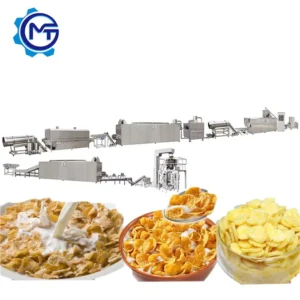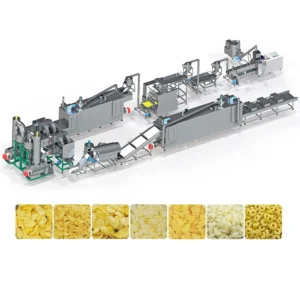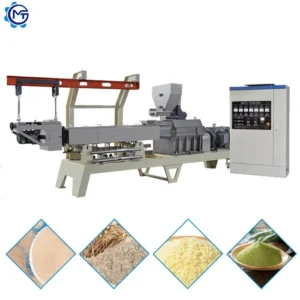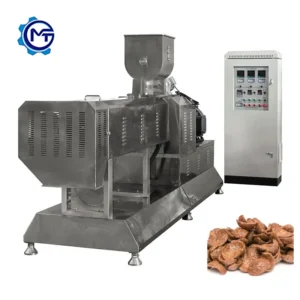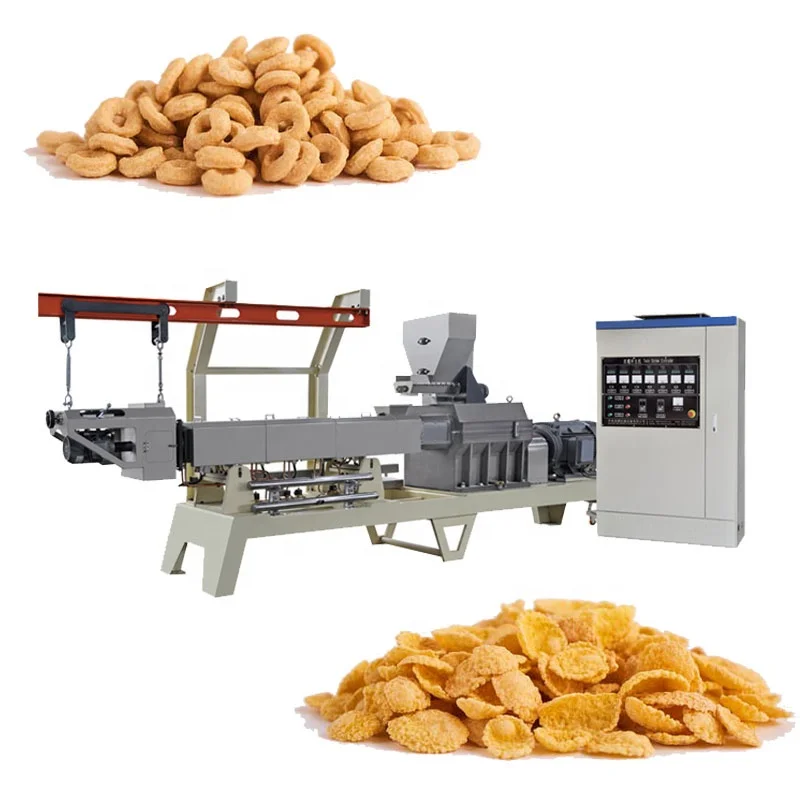
Screw Configuration Matched to Raw Material — MT70, MT85, and MT75 extruders are specified with screw profiles and die geometry based on the buyer’s actual grain formulation and target flake density, not copied from a generic build.
Technical Specifications
| Parameter | Value |
|---|---|
| Model | MT70 / MT85 / MT75 |
| Product Type | Corn Flakes and Breakfast Cereal Production Line |
| Extruder Type | Twin Screw |
| Installed Power | 160 kW (MT70) / 190 kW (MT85) / 210 kW (MT75) |
| Power Consumption | 120 kW (MT70) / 140 kW (MT85) / 150 kW (MT75) |
| Output Capacity | 150–200 kg/h (MT70, basis not stated in source) / 300–400 kg/h (MT85, basis not stated in source) / 300–500 kg/h (MT75, basis not stated in source) |
| Overall Dimensions | 41 × 1.5 × 2.2 m (MT70) / 43 × 1.5 × 3.2 m (MT85) / 45 × 1.5 × 3.5 m (MT75) |
| Control System | PLC (flaking machinery); MCC and PLC control (extruder line) |
| Flaking Machinery Drive | Double motors for separate roller driving; hydraulic system for double rollers |
| Flaking Temperature Control | Infrared sensor for even temperature pipe control |
| Dryer Heating Source | Gas / Electric |
| Hot Air Roasting Oven | Vibrating pan with high temperature spraying tubes; conciliation burner combustion chamber; two separate circulating fans; cyclone dust removal device |
| Coating System | Double tumble for sugar melting, elevator, coating drum, spraying nozzle |
| Extruder Screw | Special technology, wear-resistant, automatic lubricating and cooling function |
| Basic Raw Materials | Corn, rice, wheat, oat, barley (powder form) |
| Final Product Shapes | Natural corn flakes, coated corn flakes, ball, tube, stick, ring, fruit loop, star, wheel, flower, heart |
| Standards | CE, ISO |
Application Suitability
| Application | Material or Output |
|---|---|
| Natural corn flakes for retail breakfast cereal market | Corn powder processed through extrusion, flaking, drying, and hot air roasting |
| Sugar-coated corn flakes for retail or foodservice channels | Corn or multi-grain base with sugar spraying and coating drum finishing |
| Multi-grain breakfast flakes from oat, wheat, rice, or barley | Blended grain powders with screw configuration adjusted to starch composition |
| Extruded cereal snacks in shaped formats | Same twin-screw platform producing rings, balls, loops, stars, and wheels by die change |
What Nominal Capacity Figures Leave Out About Corn Flake Extrusion
A rated throughput number means nothing until it runs on your specific corn grits at your target moisture content.
I spent three days on-site at a Middle East plant where a corn flakes extrusion production line could not reach its quoted output. The screw combination was configured for standard fine corn flour, but the buyer’s local supplier delivered a coarser grind. Gelatinisation stalled, the extruder discharged half-cooked pellets, and the flaking rollers crushed them instead of pressing them into sheets. We rebuilt the screw profile and adjusted barrel temperatures zone by zone before the line stabilized. That is the gap between a catalogue capacity and a working line [NEED_CITE: starch gelatinisation behaviour in coarse versus fine grain fractions].
Barrel Temperature Profile and Starch Gelatinisation Control
The twin-screw extruder processes grain powder through distinct barrel zones, each with independent temperature control. Corn starch requires a specific thermal history to gelatinise fully before it reaches the die. If the barrel profile is too cool in the early zones, the starch granules enter the high-shear section without adequate hydration, producing a gritty, undercooked extrudate. If too hot, premature expansion inside the barrel causes surging and density variation. The corn flakes extrusion production line relies on this thermal sequence being matched to the exact particle size and moisture of the incoming corn, rice, or oat formulation.
Die Geometry, Moisture, and Flake Density After Pressing
The die plate determines the shape and cross-section of the extrudate as it exits the barrel. For corn flakes, the die opening must produce a pellet that will flatten uniformly under the hydraulic flaking rollers. Too thick a pellet, and the roller pressure cracks the edges rather than pressing a smooth sheet; too thin, and the pellet shatters into fragments before reaching the roasting oven. Moisture content at the die exit directly controls how much the pellet expands before it is captured by the flaking station. The screw configuration, die design, and moisture injection rate must all be set together — adjusting any one parameter shifts the others [NEED_CITE: relationship between extrudate moisture and flaking integrity].
How Installed Power and Screw Speed Shape the Output
The MT70 draws 160 kW installed power with 120 kW typical consumption, while the MT85 and MT75 sit at 190–210 kW installed. These power ratings correspond to the mechanical energy input available for shearing and cooking the grain mass inside the barrel. Higher installed power supports a longer screw assembly and greater throughput, but only if the motor is loaded within its efficient operating range. Running an MT70 at maximum capacity on a dense multi-grain blend with high fibre content may push the motor beyond its continuous duty rating, causing thermal cutouts mid-shift. The automatic lubricating and cooling function on the extruder screw shaft helps manage heat buildup during extended production runs, but it does not compensate for a fundamentally undersized motor selection.
Reading the Specification Sheet Against Your Actual Production Targets
The line stations for natural corn flakes follow a fixed sequence: mixing, extruding, flaking, drying, hot air roasting, cooling, and packing. Each station has its own throughput envelope. The flaking machinery uses double motors for independent roller driving and a hydraulic system to set roller gap pressure, with an infrared sensor monitoring temperature across the pipe. The hot air roasting oven uses a vibrating pan with high-temperature spraying tubes, a conciliation burner combustion chamber, two circulating fans, and a cyclone dust removal device. If the extruder output exceeds the roasting oven’s residence time capacity, wet flakes pile up on the conveyor and stick together before they crisp. The sugar coating system adds a double tumble sugar melter, elevator, coating drum, and spraying nozzle — stations that must also be matched to the upstream throughput or the entire line backs up at the coating stage.
The Cost of Skipping the Trial Run Before Shipment
When an extruder ships without a documented trial on the buyer’s actual raw material, commissioning becomes the trial run — inside the buyer’s factory, with installation crews standing by and production schedules already promised to customers. Screw configurations copied from a reference project may work on the original buyer’s corn variety and grind size, then fail entirely on a different starch source or moisture range. The flaking rollers may produce acceptable sheets for the first hour, then foul as residual ungelatinised starch builds up on the roller surface. Every hour spent reconfiguring screws and dies on-site is an hour the rest of the line sits idle [NEED_CITE: commissioning delays caused by untested raw material compatibility].
Why Sourcing the Full Line From One Supplier Matters Here
Complete throughput matching across every station, from the batching system through the roasting oven, eliminates the bottleneck risk that arises when individual machines are sourced from separate vendors with incompatible capacity ratings. The screw configuration and die design are specified to the buyer’s grain formulation and target flake density rather than pulled from a generic catalogue. An in-house testing workshop allows trial production runs on the buyer’s specific corn, oat, or multi-grain blend before the equipment ships. Electrical schematics with voltage and frequency confirmation are prepared for the target market before production begins, avoiding the commissioning delays that occur when a 50 Hz motor arrives at a 60 Hz facility. The PLC and MCC control system documentation includes the screw and die configuration record so that replacements can be ordered with the exact same profile when wear parts are due.
Documentation & Verification
- Line layout and capacity calculation confirming throughput balance across mixing, extrusion, flaking, drying, and roasting stations
- Screw and die configuration record matched to buyer’s grain formulation and target flake density
- Trial run report produced on buyer’s actual corn or multi-grain raw material in the testing workshop before shipment
- Electrical schematic with voltage, frequency, and control language confirmed for the destination market
- CE declaration of conformity and ISO certificate included with customs documentation support
- Operation and maintenance manual with wear parts list covering screws, dies, and flaking rollers
Installation, Commissioning & Support
- Factory layout customized to buyer’s floor space, with the 41–45 m line length requiring adequate clearance for the full station sequence
- Power supply confirmed against the 160–210 kW installed power range, with dedicated circuits for the extruder motors and roasting oven burner
- Equipment arrives in sectional assembly state for on-site positioning, with flaking machinery and roasting oven aligned to the extruder discharge height
- First-run commissioning includes barrel temperature profiling and hydraulic roller pressure adjustment on the buyer’s actual grain supply
- Operator training covers screw configuration changes for product shape switching and PLC parameter adjustments for different grain blends
- Wear parts list supplied with spare screws, dies, and flaking roller surfaces, with replacements manufactured to the original configuration record
What to Include in Your First Inquiry
To configure a corn flakes extrusion production line that holds its rated output on your material, we need your grain type and particle size specification, target daily throughput, local voltage and frequency standard, and preferred control language. If you are running a multi-grain blend or an oat-dominant formulation, send a sample for the testing workshop so the screw profile can be set before the build begins.
Frequently Asked Questions
Q: How is the extruder screw configuration matched to my specific grain formulation?
A: The screw profile and die geometry are selected based on the starch type, particle size, and moisture content of your raw material. We run your actual corn, oat, or multi-grain sample in the testing workshop, measure gelatinisation degree and extrudate density, then document the configuration so the same setup is used for production and future replacement orders.
Q: Can I run a trial on my own raw material before the line ships?
A: Yes. The in-house testing workshop conducts production trials on the buyer’s specific grain formulation before dispatch. The trial run report documents output rate, extrudate quality, and flaking behaviour, so any screw or barrel adjustments are completed at the factory rather than during on-site commissioning.
Q: How is throughput balanced between the extruder, flaker, and roasting oven?
A: Each station is sized so its maximum capacity matches or slightly exceeds the extruder output on the buyer’s confirmed raw material. The line layout and capacity calculation document this balance, preventing situations where the flaking rollers or roasting oven cannot keep pace and wet product accumulates on conveyors between stations.
Q: What voltage and control language options are confirmed before production?
A: Voltage, frequency, and PLC interface language are confirmed during the specification review stage, before manufacturing starts. The electrical schematic reflects the destination market’s power standard, and the control system documentation is delivered in the agreed language to avoid commissioning delays caused by mismatched motor ratings or unreadable HMI screens.
Q: What spare wear parts are included, and how are replacements handled?
A: The initial delivery includes a wear parts list covering extruder screws, die plates, and flaking roller surfaces. Each component is recorded in the screw and die configuration document, so replacements can be manufactured to the identical profile without requiring a new trial run or process revalidation on site.