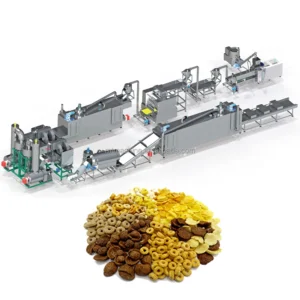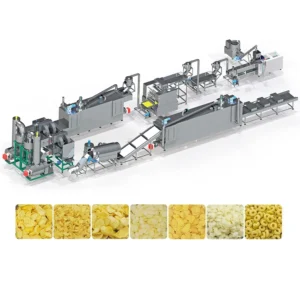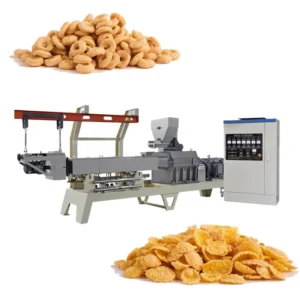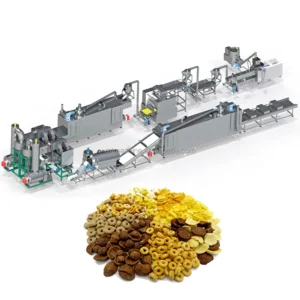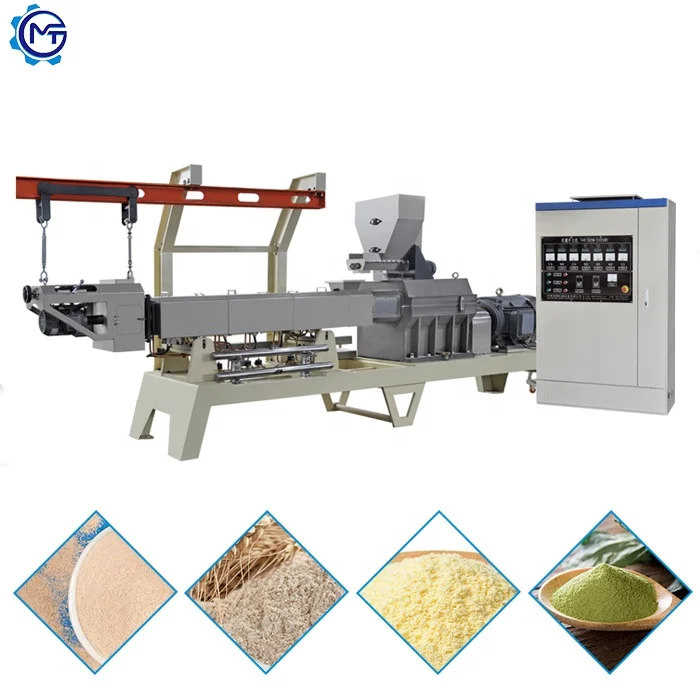
Thermal Profiling Expertise — Every barrel zone and die opening on this twin-screw line is mapped to your grain blend’s gelatinisation curve before the machine leaves our Jinan workshop.
Technical Specifications
| Parameter | Value |
|---|---|
| Model | MT75 |
| Product Type | Twin Screw Corn Flakes Extrusion Line |
| Screw Type | Twin Screw |
| Installed Power | 210 kW (MT75) |
| Power Consumption | 150 kW (MT75) |
| Output Capacity | 300–500 kg/h (basis to be confirmed — dependent on raw material and moisture content) |
| Overall Dimensions | 45 × 1.5 × 3.5 m |
| Control System | PLC and MCC control |
| Flaking Station | Hydraulic double-roller system with separate dual-motor drive; infrared sensor temperature control |
| Dryer Heating Source | Gas or Electric |
| Roasting Oven | Hot air roasting with conciliation burner, dual circulating fans, cyclone dust removal, vibrating pan with high-temperature spraying tubes |
| Coating System | Double tumble sugar melting, elevator, coating drum, spraying nozzle |
| Compatible Raw Materials | Corn, rice, wheat, oat, barley powder |
| Screw Material | Wear-resistant alloy (special treatment) |
| Lubrication | Automatic lubricating and cooling |
| Voltage & Frequency | Configurable to buyer requirement (e.g., 415V 50/60Hz, 440V 50/60Hz, 220V 60Hz) |
| Standards | CE, ISO |
Application Suitability
| Application | Material or Output |
|---|---|
| Natural corn flake production | Corn grits and corn flour blends |
| Sugar-coated breakfast flakes | Corn, rice, or multi-grain base with sugar syrup coating |
| Shaped cereal pieces | Rings, balls, tubes, stars, fruit loops via extruder die adjustment |
| Multi-grain flake formulations | Oat, barley, wheat combined with corn or rice |
| Instant porridge and nutritional cereal powder | Pre-gelatinised grain blends for hot-water reconstitution |
Why the Wrong Barrel Temperature Ruins Your Flake Before It Even Reaches the Dryer
Corn flakes extrusion technology twin screw configuration only works when thermal profiling starts at the feed zone, not at the die.
I remember a buyer who shipped a line configured for pure corn grits, then switched to an oat-heavy blend on day one of production. The starch gelatinisation window shifted entirely — the flakes came off the roller too soft, tore during conveying, and blistered unevenly in the roaster. An entire week of output went to rework because nobody had mapped the barrel temperature profile to the new formulation [NEED_CITE: starch gelatinisation temperature ranges for common cereal grains]. The corn flakes extrusion technology twin screw platform gives you multiple independently heated barrel zones, but that advantage disappears if the setpoints are copied from a generic recipe rather than dialed to your actual material.
Barrel Zone Mapping for Multi-Grain Blends
Each barrel section on the MT75 is individually controlled, allowing the temperature gradient to follow the gelatinisation behaviour of your specific grain mix. A corn-dominant formula needs a different feed-zone entry temperature than a blend heavy in oat or barley, because the lipid content in oat suppresses expansion and shifts the moisture threshold. This is where corn flakes extrusion technology twin screw design earns its keep — the intermeshing screw action generates shear that supplements external heating, so you can maintain gelatinisation without overheating the barrel wall.
Die Design and Flake Density Control
The die plate determines the cross-section of the extrudate before it hits the flaking rollers. A wider die opening produces a thicker ribbon that requires more hydraulic pressure to flatten to target flake thickness. On this line, the hydraulic double-roller flaking station uses separate motors for each roller and an infrared sensor to monitor roller surface temperature evenly. That means the flake density — which directly governs bowl life and crispness — stays within specification across long runs. Getting the die-to-roller match wrong is one of the most common reasons cereal producers see flakes that either sink in milk or shatter during packing [NEED_CITE: relationship between extrudate die geometry and final flake density in breakfast cereal production].
Reading the Specs That Actually Matter
The 210 kW installed power and 150 kW operating consumption tell you the line draws meaningful current — plan your transformer capacity and dedicated circuit accordingly, especially in regions where industrial supply fluctuates. The 45-metre line length means you need a continuous bay with adequate clearance for the hot air roaster’s dual circulating fans and cyclone dust removal ductwork. The PLC and MCC control architecture separates motor protection from process logic, which matters when a drive fault in the coating drum should not crash the extruder. Automatic screw lubrication and cooling extends the service interval on the twin-screw elements, reducing unplanned stops during back-to-back production shifts. Voltage is configurable — confirming your site supply (415V, 440V, or other) before the electrical cabinet is wired prevents costly rewiring after arrival [NEED_CITE: voltage and frequency standards by export market].
The Cost of Skipping the Trial Run
When a line ships without a test run on the buyer’s actual raw material, the first production days become an expensive experiment. Screw elements get swapped, barrel setpoints are guessed, and the flaking roller pressure is adjusted by feel. This is not a commissioning issue — it is a configuration gap that should have been closed before the machine was crated. A generic screw build that works on standard corn grits may fail to convey a high-fibre oat blend through the metering zone, causing surging at the die and inconsistent flake weight.
Why This Line Is Configured Differently
Screw configuration and die design are specified against your raw material formulation and target flake density, not pulled from a catalogue default. The in-house testing workshop runs your actual grain blend through the extruder, flaker, and a sample dryer cycle before shipment, producing a trial run report that documents every setpoint. Thermal profiling covers the entire path — extruder barrel zones, dryer moisture removal rate, and roaster blistering temperature — so throughput is balanced across all stations rather than bottlenecked at one. The PLC control language, voltage, and frequency are confirmed against your factory specification during the electrical design phase, not discovered at commissioning. Documentation includes the screw and die configuration record tied to your specific product, giving your process engineers a baseline to work from on day one.
Documentation & Verification
- Line layout and capacity calculation matched to your grain blend and target flake output
- Screw and die configuration record documenting element arrangement for your raw material
- Trial run report on customer-supplied grain blend before machine dispatch
- Electrical schematic with confirmed voltage, frequency, and PLC language for your market
- CE declaration of conformity and ISO certificate for customs and regulatory filing
Installation, Commissioning & Support
- 45-metre line footprint requires a continuous bay with minimum 3.5-metre clearance for roaster ductwork
- 210 kW installed load demands a dedicated transformer circuit with voltage matching confirmed pre-shipment
- Hydraulic flaking station arrives pre-assembled; roller alignment verified during on-site commissioning
- PLC and MCC cabinets wired to your confirmed language and supply before the electrical team arrives
- Automatic lubrication system filled and tested during first run; maintenance intervals documented in manual
- Wear parts list covers twin-screw elements, die plates, and flaking roller surfaces for your reorder planning
What We Need to Configure Your Line
To move from an inquiry to a line proposal, we need your target flake type (natural, sugar-coated, or shaped), the grain blend composition and moisture range you plan to run, and your daily production target. Confirm your site voltage, frequency, and the PLC display language your operators require. If you can ship a sample of your raw material to our testing workshop, we will run a trial and return a documented parameter set before the quotation is finalised.
Frequently Asked Questions
Q: How is screw configuration determined for my specific grain blend and target flake density?
A: We review your formulation — grain ratios, particle size, fat and fibre content — and select screw element arrangement, pitch, and kneading block positions to achieve the gelatinisation degree your flake requires. A trial run on your material in our workshop validates the configuration before the machine ships, and the full screw and die record is documented for your process team.
Q: What barrel temperature profile and moisture level are needed for proper starch gelatinisation?
A: It depends entirely on your grain mix. Pure corn grits gelatinise at a different barrel zone gradient than an oat-and-barley blend. We set each barrel zone temperature and preconditioner moisture level during the trial run, targeting the expansion ratio and extrudate texture your flaking station needs to produce uniform flakes.
Q: Can I run a trial with my own raw material before the line ships?
A: Yes. Send us a representative sample of your grain blend and we will run it through the extruder and flaking station in our testing workshop. You receive a trial run report with barrel temperatures, screw speed, moisture content, and flake thickness measurements — this becomes your commissioning baseline.
Q: How do I confirm voltage, frequency, and PLC language match my factory?
A: We request your site electrical specification during the proposal stage. The MCC and PLC cabinets are wired and labelled to your confirmed voltage and frequency, and the HMI language is set before shipping. Any mismatch is caught on paper, not on your factory floor.