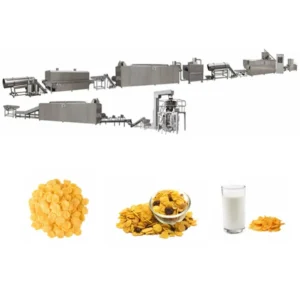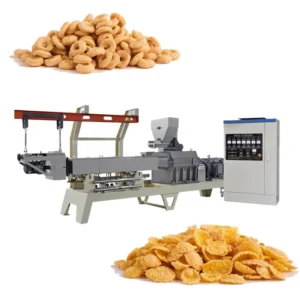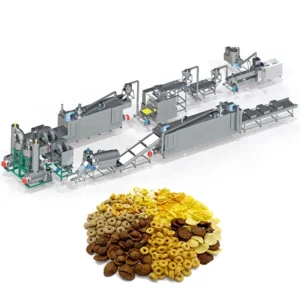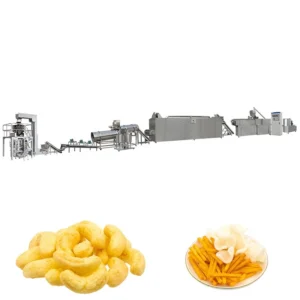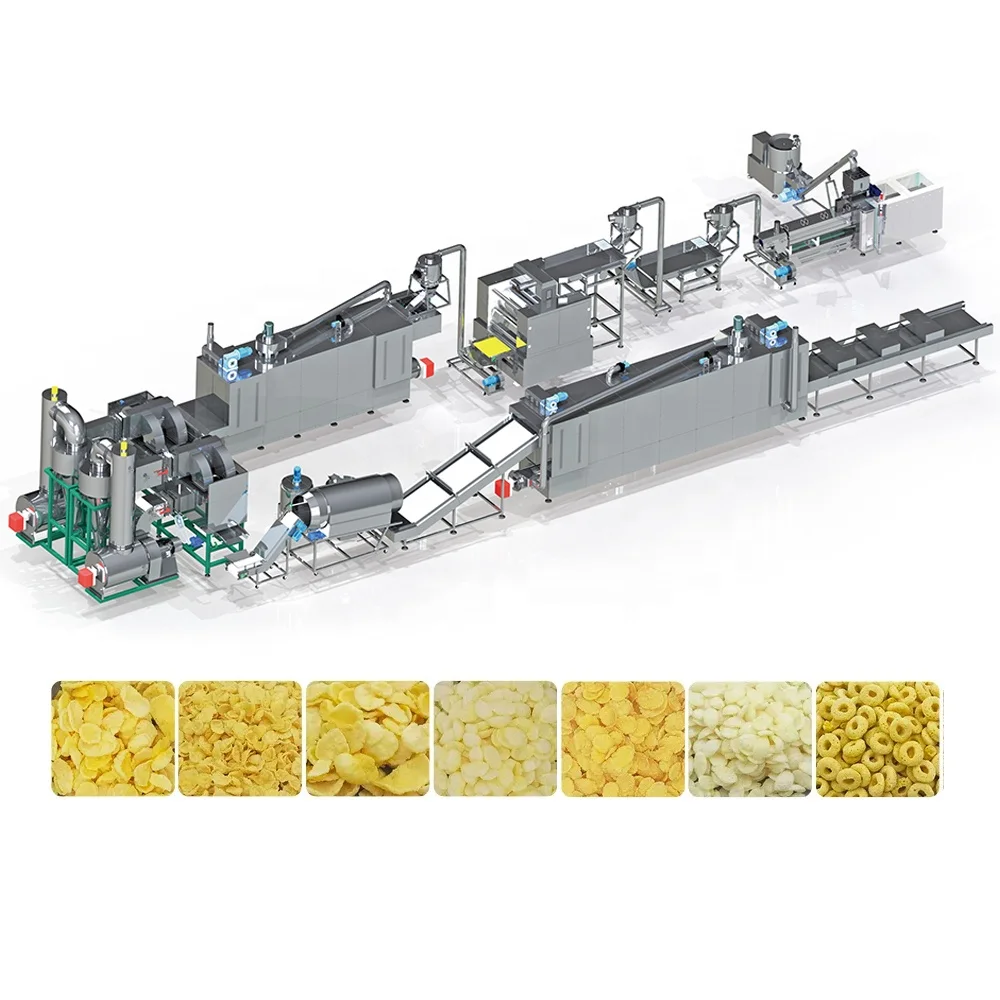
Screw configuration matched to your grain — we run your exact corn, rice, or multi-grain blend in the testing workshop and record the barrel profile before the extruder is finalized.
Technical Specifications
| Parameter | Value |
|---|---|
| Product Type | Corn Flakes Breakfast Cereal Production Line |
| Models Available | MT70 / MT85 / MT75 |
| Extruder Screw Type | Twin-screw |
| Installed Power (MT70) | 160 kW |
| Installed Power (MT85) | 190 kW |
| Installed Power (MT75) | 210 kW |
| Power Consumption (MT70) | 120 kW |
| Power Consumption (MT85) | 140 kW |
| Power Consumption (MT75) | 150 kW |
| Output Capacity (MT70) | 150–200 kg/hr (basis not stated in source — confirm raw material / moisture / product format) |
| Output Capacity (MT85) | 300–400 kg/hr (basis not stated in source — confirm raw material / moisture / product format) |
| Output Capacity (MT75) | 300–500 kg/hr (basis not stated in source — confirm raw material / moisture / product format) |
| Overall Dimensions (MT70) | 41 × 1.5 × 2.2 m |
| Overall Dimensions (MT85) | 43 × 1.5 × 3.2 m |
| Overall Dimensions (MT75) | 45 × 1.5 × 3.5 m |
| Control System | PLC and MCC |
| Extruder Features | Automatic lubricating and cooling; wear-resistant screw manufacturing |
| Flaking Machine | PLC-controlled hydraulic double rollers; infrared temperature sensing |
| Dryer Heating Source | Gas or electric |
| Roasting Oven | Vibrating pan, conciliation burner, dual circulating fans, cyclone dust removal |
| Coating System | Double tumble drum, elevator, coating drum, spraying nozzle |
| Raw Material Compatibility | Corn, rice, wheat, oat, barley powder |
| Certifications | CE, ISO |
Application Suitability
| Application | Material or Output |
|---|---|
| Natural corn flakes for breakfast cereal retail | Corn grits or corn flour, toasted and cooled without coating |
| Sugar-coated corn flakes for supermarket and food service | Corn or multi-grain base with sugar syrup spraying and secondary drying |
| Shaped cereal snacks (rings, stars, loops, wheels) | Corn, rice, wheat, oat, or barley blends with die and screw reconfiguration |
| Fortified breakfast cereals for institutional nutrition programmes | Grain powder blends with added vitamin and mineral premix |
| Multi-grain flakes for health-oriented consumer markets | Blended oat, barley, wheat, and rice formulations |
What the Rated Capacity Leaves Out About Your Grain Blend
A corn flakes line only holds its quoted output when screw geometry and barrel zones match your actual grain formulation and moisture content.
I once spent four days in a Kenyan plant reworking a twin-screw corn flakes extrusion line because the buyer switched from yellow corn to a local white variety after the machine shipped. The starch gelatinisation temperature was different, and the flakes came out hard and fractured — an entire batch scrapped. The corn flakes production line extrusion technology had been configured for one raw material, and nobody tested the alternative beforehand. [NEED_CITE: starch gelatinisation temperature differences between corn varieties]
This is not an isolated event. Grain blends vary in protein structure, fat content, and particle size distribution across regions and harvest seasons. When the screw configuration and barrel temperature profile are copied from a generic build rather than tuned to your specific material, the extruder cannot maintain consistent expansion or density — regardless of what the nameplate says.
Barrel Temperature Zones and Starch Gelatinisation Control
Twin-screw extruders process corn flakes dough through distinct thermal and mechanical stages within a single barrel. The corn flakes production line extrusion technology divides the barrel into multiple heating zones, each set to a specific temperature so that starch gelatinisation occurs progressively rather than in a single shock. Automatic lubricating and cooling functions maintain stable thermal conditions during continuous runs, preventing localized overheating that causes uneven expansion or scorching on the flake surface.
Die Design and the Transition to Flaking
After extrusion, the cooked dough passes through a die that shapes the extrudate into a continuous rope or ribbon. The die geometry directly determines how the material behaves when it enters the flaking station. PLC-controlled hydraulic double rollers with infrared temperature sensing then compress the extrudate into uniform flakes. If the die output moisture and temperature are not aligned with the roller gap and pressure, flakes will crack at the edges or stick to the roller surface — problems that compound through the dryer and roaster. [NEED_CITE: extrudate moisture management before flaking in cereal processing]
Reading the Power and Capacity Data
The installed power across the MT70, MT85, and MT75 models ranges from 160 kW to 210 kW, with operating consumption proportionally lower. This gap between installed and consumed power reflects the headroom needed for start-up torque and viscous dough conditions when processing heavier grain blends like whole oat or barley. The capacity figures listed for each model carry a basis-to-be-confirmed note because output depends on raw material density, target moisture, and flake thickness specification. When evaluating these machines, request a capacity calculation tied to your specific grain blend and target flake weight per unit volume rather than relying on a generic throughput claim. The overall line length spans 41 to 45 meters depending on model, which affects factory layout planning and utility routing for steam, compressed air, and electrical feeds.
When Misconfigured Stations Create a Hidden Bottleneck
An extruder that runs well in isolation can still underperform if the downstream flaker, dryer, or roaster is not specified to handle its actual output volume. I have seen lines where the flaking rollers could not keep pace with the extruder, forcing operators to slow the screw speed and sacrifice gelatinisation quality just to avoid a backlog. When the roaster has insufficient circulating capacity, surface blistering becomes uneven — some flakes are properly toasted while others remain pale and doughy. These mismatches rarely show up in a brochure. They emerge during commissioning, when every station must run simultaneously at production speed. [NEED_CITE: throughput balancing across extrusion line stations]
Why Sourcing the Full Line From One Supplier Matters Here
Screw configuration and die design are specified to your raw material and target flake density, not copied from a default build — every zone setting is recorded before the machine leaves the factory.
The in-house testing workshop runs your actual corn, rice, or multi-grain blend through the extruder before shipment, generating a trial run report that validates expansion, moisture, and flake integrity on your material.
Line layout and capacity calculations balance throughput across every station from mixing through packing, so the flaker, dryer, and roaster are each sized relative to the extruder output rather than selected from a standard catalogue.
PLC and MCC control systems integrate the entire line, allowing coordinated start-up sequences and fault diagnostics across extrusion, flaking, roasting, and coating stations.
Pre-sales engineering consultation covers electrical schematic confirmation, voltage and frequency matching, and control language selection before production begins.
Documentation & Verification
- Line layout and capacity calculation showing throughput balance across every station for your grain blend
- Screw and die configuration record matched to your raw material and target flake specification
- Trial run report on your actual corn, rice, or multi-grain formulation before shipment
- Electrical schematic with voltage, frequency, and control language confirmed for your installation site
- Operation and maintenance manual covering barrel zone settings, roller gap adjustment, and roaster parameters
- Wear parts list identifying screws, dies, and roller surfaces with replacement intervals
Installation, Commissioning & Support
- Factory floor must accommodate 41–45 m line length with utility drops for gas or electric dryer heating and compressed air for PLC actuators
- Electrical supply must match confirmed voltage and frequency; dedicated circuits required for the 160–210 kW installed power range across extruder models
- Line ships in modular sections; flaking station hydraulic system and roaster circulating fans require on-site mechanical assembly and alignment
- First commissioning run includes barrel temperature profiling, die pressure adjustment, and roller gap calibration on your raw material
- Operator training covers PLC interface navigation, alarm response, and screw speed adjustment for different grain formulations
- Wear-resistant screws and die inserts supplied with initial spare set; replacement schedule based on abrasive grain content
What to Prepare Before Requesting a Quotation
To configure the corn flakes production line extrusion technology for your application, provide your grain formulation including variety, particle size, and typical moisture content at intake. Specify whether you are targeting natural flakes, sugar-coated flakes, or shaped formats, along with your daily production volume and shift pattern. Share your factory floor dimensions and ceiling height, and confirm the local voltage, frequency, and preferred control language for the PLC interface.
Frequently Asked Questions
Q: How is the screw configuration matched to my specific grain formulation and target flake density?
A: We test your actual raw material in the workshop before finalizing the screw combination and barrel temperature zones. The trial run records expansion ratio, moisture content, and gelatinisation degree at each zone, producing a configuration document that travels with the machine. Adjustments are made until the extrudate meets your flake thickness and density specification.
Q: Can a trial run be performed on my raw material before the line ships?
A: Yes. The in-house testing workshop runs your grain blend through the extruder and downstream stations to validate capacity, flake quality, and roasting behavior. You receive a trial run report covering throughput, moisture at each stage, and product samples, so production parameters are confirmed before installation begins.
Q: How are barrel temperature zones controlled for consistent starch gelatinisation?
A: The twin-screw extruder uses independent heating zones along the barrel, each monitored and adjusted by the PLC system. Automatic cooling prevents overshoot in high-shear sections. This maintains a progressive gelatinisation profile, avoiding under-cooked centers or surface scorching that would affect flake texture after roasting.
Q: How is throughput matched between extruder, flaker, dryer, and roaster?
A: Each station is sized based on the extruder output calculation for your specific material and moisture target. The line layout document shows mass flow at every stage, ensuring the hydraulic flaking rollers, dryer belt speed, and roaster pan capacity all handle the same volume without creating bottlenecks or forcing speed reductions upstream.
Q: What voltage and control options are confirmed before the machine is built?
A: Electrical schematics are prepared with your local voltage, frequency, and phase confirmed in writing before production starts. The PLC interface language is set to your operator requirement. This prevents commissioning delays caused by mismatched motor ratings or unreadable control screens after the line arrives at your facility.