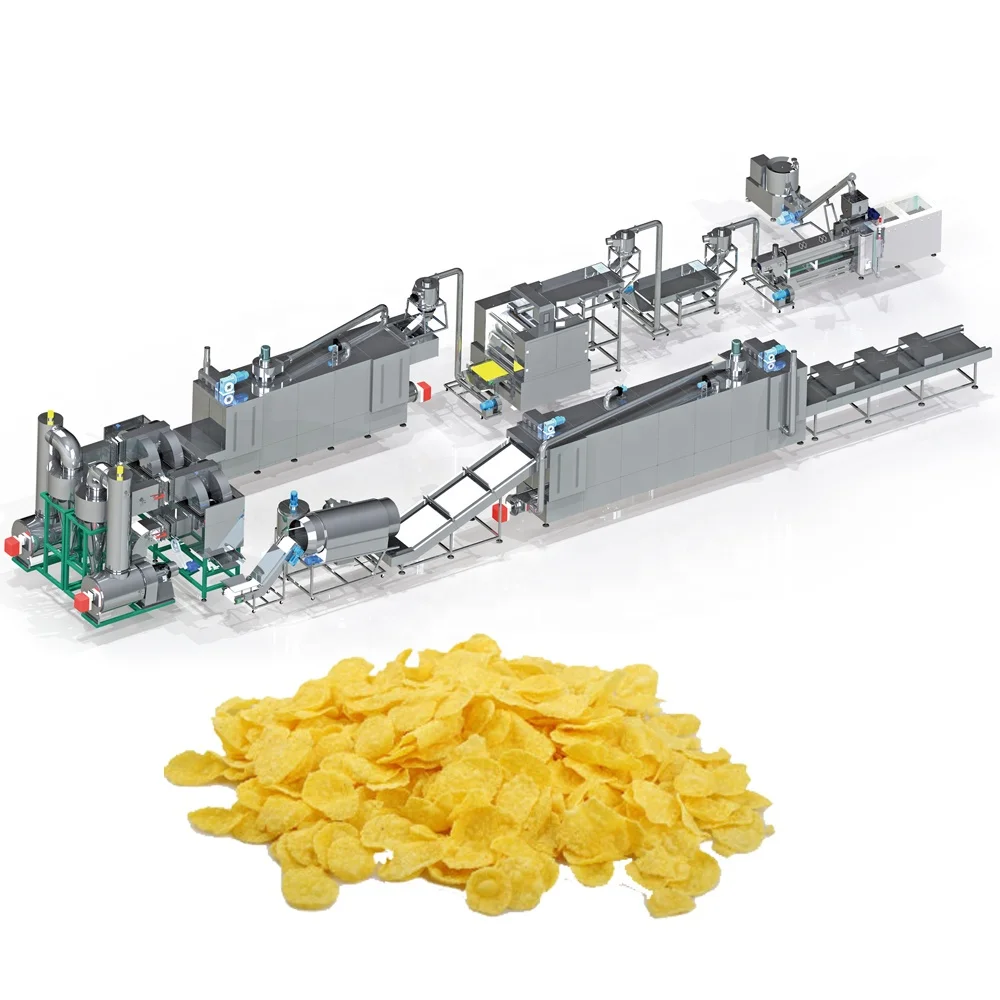
Screw Geometry Matched to Grit — Twin-screw extrusion parameters configured to your corn formulation and target flake density, validated through in-house trial runs before dispatch.
Technical Specifications
| Parameter | Value |
|---|---|
| Product Type | Corn Flakes Production Line |
| Output Capacity | 750 kg/hr (basis not stated in source — confirm raw material formulation / moisture / flake thickness) |
| Product Range | Natural corn flakes, sugar-coated flakes, various shaped breakfast cereals |
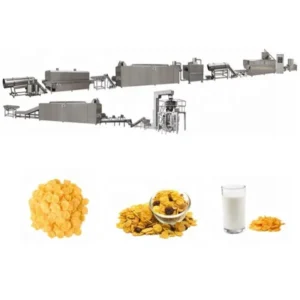
| Assembly State | Complete line configuration from batching to packing |
| Line Layout | Customizable engineered drawings tailored to factory size |
| Control System | PLC and MCC control (specification to be confirmed) |
| Voltage & Frequency | Configurable to destination market (specification to be confirmed) |
| Interface | Easy-to-operate control interface |
| Motor | Rated power to be confirmed against line configuration |
Application Suitability
| Application | Material or Output |
|---|---|
| Natural corn flakes for retail breakfast cereal | Degerminated corn grits at controlled moisture and particle size |
| Sugar-coated corn flakes | Extruded corn pellets with post-coating syrup application |
| Multi-shape extruded breakfast cereals | Corn-based formulations with alternative die geometries |
| Fortified breakfast cereal formats | Corn grit blended with vitamin and mineral premix |
Why a Generic Screw Build Fails on Corn Flakes Extrusion
The corn flakes extrusion technology must be calibrated to your specific corn grit formulation, not copied from a standard template.
A screw and die configuration designed for fine corn flour behaves entirely differently when fed degerminated corn grits with higher fat content and coarser particle distribution. The starch gelatinisation window shifts, expansion at the die exit becomes inconsistent, and the resulting flakes either shatter during flaking or fail to achieve the target bowl-life crunch. I have watched a line stop for two full days because the initial screw profile was specified against the wrong raw material assumption [NEED_CITE: raw material variability in corn grit sourcing and its effect on extrusion stability]. The corn flakes production line extrusion process demands that screw geometry, barrel temperature zones, and moisture addition are all locked to the buyer’s actual supply chain input.
Barrel Temperature Profile and Starch Gelatinisation
The corn flakes extrusion technology depends on a precise barrel temperature profile across multiple heating zones. Each zone governs a different stage of starch gelatinisation — from initial hydration and mixing through to the final melt temperature at the die face. If the barrel zones run too cool, the corn grit passes through without full gelatinisation, producing flakes that are dense and hard. Run too hot, and the melt fractures at the die, causing surface tearing and inconsistent flake thickness. Our configuration specifies each zone setpoint against the gelatinisation characteristics of your particular corn source.
Shear, Moisture, and Expansion Control at the Die
Moisture content entering the barrel and the shear energy applied by the screw elements together determine the expansion ratio as the melt exits the die. The corn flakes production line extrusion process requires these two variables to be balanced so that the extrudate expands to a predictable density before entering the flaking rolls. Too much shear with insufficient moisture causes over-expansion and fragile flakes. Too little shear leaves the extrudate undercooked, producing a raw centre that will not flatten correctly [NEED_CITE: relationship between shear energy and expansion ratio in twin-screw cereal extrusion]. We map the moisture-shear window during the trial run so the operating range is documented before the line ships.
Reading the Specs That Actually Matter
The output capacity of 750 kg/hr is meaningful only when paired with the specific corn grit formulation, incoming moisture level, and target flake thickness — changing any one of these shifts the achievable throughput. The PLC and MCC control system governs barrel zone temperatures, screw speed, and feeder rates; confirm whether the interface language and alarm texts match your operator requirements before production begins. The customizable line layout means the footprint and station spacing are engineered to your building dimensions, so ceiling height, column spacing, and utility drop points must be surveyed early. Voltage and frequency are configurable, but the motor winding, heater elements, and control transformer must all be specified for the destination grid — a mismatch here delays commissioning by weeks.
What Happens When Extrusion Parameters Are Not Matched
When the screw configuration is not matched to the buyer’s corn grit, the consequences compound through every downstream station. The flaking rolls receive extrudate of inconsistent density, causing some pellets to shatter while others pass through unflattened. The toasting oven then dries an uneven product, producing a mix of burnt and under-dried flakes in the same batch. Packing weight checks fail because flake density varies, and the customer returns the shipment [NEED_CITE: downstream quality losses caused by upstream extrusion inconsistency in cereal lines]. These problems are invisible at the quotation stage and only surface during live production.
Why the Engineering Depth Matters Here
Complete line configuration from batching through extrusion, flaking, toasting, and packing means throughput is matched at every station — no single vendor’s bottleneck constrains the whole output. Screw configuration and die design are specified to the buyer’s corn grit particle size and moisture content rather than pulled from a generic library. The in-house machine testing workshop runs trial batches on customer-supplied raw material before shipment, so the screw profile and barrel zones are validated before the line leaves the factory. Twin-screw expertise across breakfast cereal applications means the die geometry and flaking roll gap are calibrated for the target flake thickness and surface texture. Pre-sales line layout engineering ensures the extrusion platform integrates with your existing or planned downstream equipment.
Documentation & Verification
- Line layout and capacity calculation matched to your corn grit formulation and target flake specification.
- Screw and die configuration record documenting geometry against your raw material trial results.
- Electrical schematic with voltage and frequency confirmation for your destination market grid.
- Trial run report on customer-supplied corn grit conducted in the testing workshop before dispatch.
- Operation and maintenance manual covering barrel zone calibration and screw element replacement procedures.
Installation, Commissioning & Support
- Foundation survey for extruder and flaking station alignment against your factory floor tolerance.
- Dedicated circuit sizing confirmed against total connected load of heaters and main drive motor.
- Barrel zone temperature calibration and screw speed ramp validated during first production run.
- Operator training on PLC interface covering recipe storage for natural and sugar-coated flake formats.
- Wear parts list identifying screw elements, die inserts, and flaking roll surfaces with replacement intervals.
What to Include in Your Technical Enquiry
Specify your corn grit source, particle size distribution, and typical moisture content so the screw configuration can be matched before quotation. Provide your factory ceiling height, column grid, and available floor area for the line layout engineering. Confirm your local voltage, frequency, and preferred control interface language so the electrical package is correct from the start.
Frequently Asked Questions
Q: How is screw configuration selected for different corn grit sizes and moisture levels?
A: The screw element sequence — conveying, kneading, and reverse elements — is arranged based on your corn grit particle size and incoming moisture. Coarser grits require longer residence in the kneading zone for full gelatinisation, while finer grits need shorter shear exposure to prevent over-cooking. We confirm the profile during a trial run on your supplied material.
Q: What barrel temperature profile achieves the target flake expansion and density?
A: Each barrel zone is set to progressively gelatinise the starch without causing melt fracture at the die. The typical profile rises from the feed zone to a peak at the metering section, then drops slightly before the die to control expansion. Exact setpoints depend on your corn variety and target flake density specification.
Q: Can the extrusion process be adjusted for sugar-coated versus natural corn flakes on the same line?
A: Yes. The extrusion parameters remain similar, but the die geometry and post-extrusion handling differ. Sugar-coated flakes require a slightly denser extrudate to withstand the coating drum without breaking. The PLC stores separate recipes for each format, and the flaking roll gap is adjusted accordingly.
Q: What moisture and shear conditions are required for consistent starch gelatinisation?
A: Incoming moisture and barrel-injected steam must bring the corn grit into the gelatinisation range before it reaches the die. Shear energy from the kneading elements provides the mechanical work needed to complete the starch transformation. Both variables are mapped during the pre-shipment trial so operators have a documented operating window.