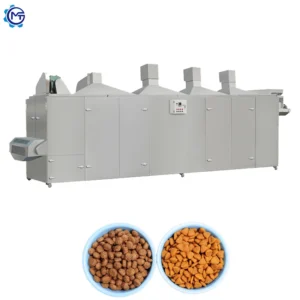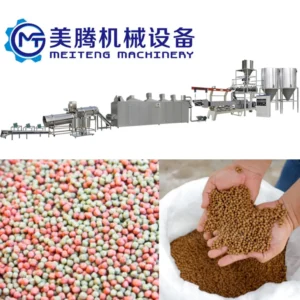
Extrusion Process Engineered to Formulation — Screw geometry and barrel temperature profiles are configured around the buyer’s specific ingredient blend to control starch gelatinisation and expansion.
Technical Specifications
| Parameter | Value |
|---|---|
| Product Type | Twin Screw Aquatic Fish Feed Extrusion Line |
| Extruder Type | Twin screw |
| Control System | Intelligent PLC automatic control system |
| Material of Construction | Food grade 304 stainless steel (machine body and material contact parts) |
| Pellet Types Supported | Floating and sinking fish feed pellets |
| Pellet Adjustability | Size, hardness, buoyancy adjustable per breeding requirements |
| Raw Materials | Fish meal, soybean meal, corn powder, compound additives |
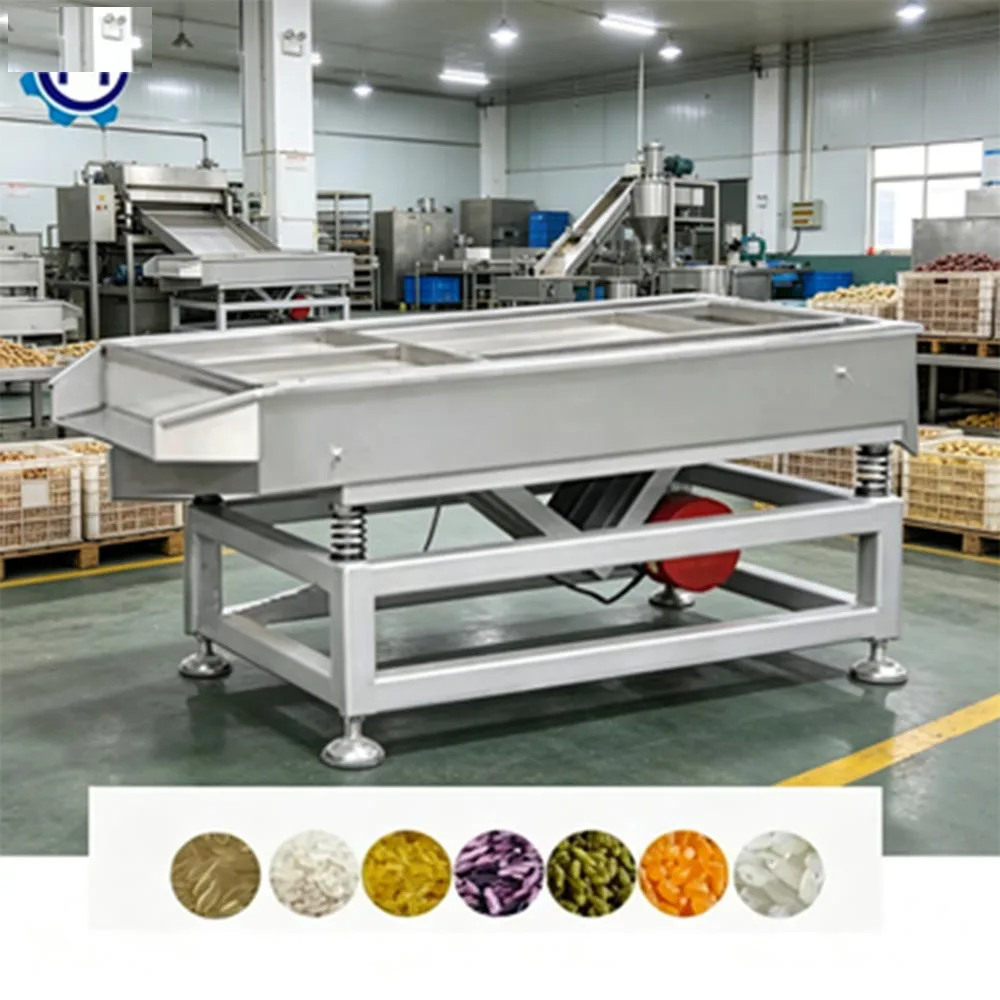
| Line Stations | Raw material mixer, extruder, dryer, seasoning coating machine, vibrating sieve, conveyor equipment |
| Automation Level | Full continuous automatic production from mixing through extrusion, drying, seasoning, screening to finished product discharging |
| Energy Features | Optimized energy saving transmission structure and heating system |
| Output Capacity | (basis not stated in source — confirm capacity based on specific raw material formulation and pellet size) |
| Overall Dimensions | (basis not stated in source — confirm line footprint) |
| Rated Power | (basis not stated in source — confirm total line power consumption) |
| Voltage & Frequency | (basis not stated in source — confirm target market voltage) |
| Certification | CE, ISO |
Application Suitability
| Application | Material or Output |
|---|---|
| Koi and goldfish ornamental feed | High-protein fish meal and corn powder blends requiring stable buoyancy |
| Tropical fish pellet production | Soybean meal and compound additive formulations with precise expansion control |
| Freshwater aquaculture mass production | Floating and sinking feed from mixed grain and protein sources |
| Continuous commercial feed processing | Medium to large scale uninterrupted aquatic feed manufacturing runs |
Why Pellet Density Fails the Market Specification
Floating feed sinking or pellet density falling outside the expected specification is rarely a machine fault — it traces back to screw configuration and thermal profile mismatched with the actual raw material blend.
The extruder must be configured around the formulation, not the other way around.
I have seen producers run a twin screw extrusion fish feed production line calibrated on standard fish meal, then switch to a high-proportion corn and soybean meal recipe on the floor, only to watch the pellets sink immediately upon water contact. The expansion ratio drops because starch gelatinisation behaviour shifts entirely when the ingredient matrix changes. Correcting this demands rethinking screw element sequencing and barrel zone temperatures together rather than adjusting one parameter in isolation [NEED_CITE: starch gelatinisation thresholds by ingredient composition].
Screw Element Sequencing for Shear and Residence Control
The twin screw extrusion fish feed production line achieves its mixing uniformity through modular screw elements arranged in specific sequences along the barrel. Conveying sections, kneading blocks, and reverse elements each govern how long material stays under mechanical shear and thermal exposure. A formulation heavy in soybean meal demands a different kneading block arrangement compared to one dominated by fish meal, because protein denaturation and starch activation windows diverge significantly between these matrices.
Barrel Temperature Profiles and Moisture Management
Each barrel zone operates under independent thermal control to build a temperature gradient that matches the gelatinisation curve of the specific starch source present in the blend. Moisture injection points work alongside these zones to regulate water activity inside the barrel, which directly determines expansion potential at the die face. Without precise coordination between thermal zones and moisture levels, pellets exit with inconsistent density — some floating, some sinking in the same production batch [NEED_CITE: moisture content influence on extrudate expansion ratio].
Die Geometry and Pellet Density Differentiation
The die plate governs not only pellet cross-section but also the pressure drop that triggers expansion at the moment of exit. Smaller die orifices generate higher backpressure and greater shear, which raises melt temperature and increases expansion for floating formats. Larger orifices reduce shear and produce denser, slower-sinking pellets suited for bottom-feeding species. Die thickness and land length further refine the surface finish and dimensional consistency of each pellet.
The Cost of Running Generic Screw Configurations
When screw elements and die formats are copied from a generic build rather than specified to the buyer’s raw material, the consequences surface during production rather than during commissioning. Pellet buoyancy drifts as ingredient batches vary slightly, forcing operators to manually compensate by adjusting feed rate or moisture — a reaction that introduces its own inconsistencies. Over time this produces off-spec product that accumulates as waste or triggers customer rejection at the farm level [NEED_CITE: feed pellet buoyancy specification tolerance in aquaculture].
Engineering the Line Around Your Formulation
Screw configuration and die design are specified to each buyer’s raw material formulation and target pellet specification rather than pulled from a standard library.
The in-house testing workshop runs trial production on the customer’s actual ingredient blend before the line ships, generating a documented trial run report that confirms buoyancy, expansion, and surface quality against agreed targets.
Line capacity calculations are based on the buyer’s specific formulation and pellet size, preventing the gap between quoted nominal throughput and achievable output on real materials.
PLC-controlled process parameters store recipe profiles so that operators can recall validated settings for each formulation rather than relying on manual adjustment from memory.
Electrical schematics and voltage specifications are confirmed against the buyer’s facility infrastructure before production begins, avoiding commissioning delays caused by mismatched power supply [NEED_CITE: industrial voltage and frequency standards by region].
Documentation & Verification
- Screw and die configuration record documented to your raw material blend and target pellet density
- Trial run report on your ingredient formulation confirming buoyancy and expansion before shipment
- Line layout drawing with capacity calculation based on your specific pellet size and recipe
- Electrical schematic with voltage and frequency confirmed to your facility power supply
- CE declaration of conformity and ISO certificate included with dispatch documentation
Installation, Commissioning & Support
- Foundation plan accounts for the full line footprint from mixer through dryer to packing station
- Electrical connection requires dedicated circuit matching confirmed voltage and frequency specifications
- PLC interface configured to operator language preference before commissioning begins on site
- Initial run parameters loaded from factory trial run report to accelerate first production validation
- Wear parts list identifies screw elements and die plates with reorder specifications for maintenance planning
- Barrel zone heating elements and thermocouples inspected during scheduled maintenance intervals
What We Need to Configure Your Line
To specify screw geometry and barrel profile correctly, we need your raw material formulation including the proportion of fish meal, soybean meal, corn powder, and any compound additives. Confirm your target pellet diameter range and whether you require floating, sinking, or both formats. Provide your facility voltage, frequency, and available floor space so the line layout can be matched to your installation conditions.
Frequently Asked Questions
Q: How is screw configuration specified to achieve floating versus sinking pellet density?
A: Floating pellets require higher shear and longer residence time in the barrel to achieve full starch gelatinisation and maximum expansion at the die. Sinking pellets need reduced shear with lower melt temperature to limit expansion. We arrange kneading blocks, conveying elements, and reverse screw sections in sequences that produce the thermal and mechanical profile your target density demands.
Q: What barrel temperature profile and moisture level are required for full starch gelatinisation?
A: The profile depends on your starch source — corn, wheat, and tapioca each activate at different temperature-moisture combinations. We map barrel zone temperatures and steam or water injection rates to your specific ingredient blend during the trial run, then document the validated settings in your operation manual so operators can reproduce the result consistently.
Q: How does die design affect pellet expansion and surface quality?
A: Die orifice diameter, land length, and plate thickness together determine the pressure drop at exit, which drives expansion ratio. Smaller orifices increase shear and produce greater expansion with smoother surfaces for floating feed. We select die geometry based on your target pellet size, density specification, and the rheological behaviour of your formulation under extrusion conditions.
Q: Can a trial run be performed on my exact raw material before shipment?
A: Yes. Our testing workshop runs your actual ingredient blend through the configured extruder before dispatch. The trial run report documents pellet buoyancy, expansion ratio, surface finish, and throughput achieved on your formulation. This lets you verify product quality against your market specification before the line arrives at your facility.
Q: How do I verify that the quoted capacity holds on my specific ingredient blend?
A: Nominal capacity figures assume reference materials that may not match your formulation. We calculate line throughput based on your specific recipe, pellet diameter, and target density, then confirm achievable output during the factory trial run. The trial run report records actual production rate so you can validate capacity before accepting the equipment.