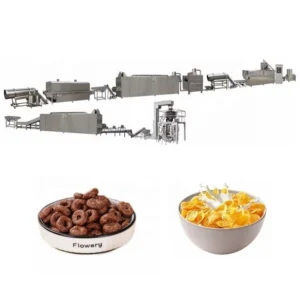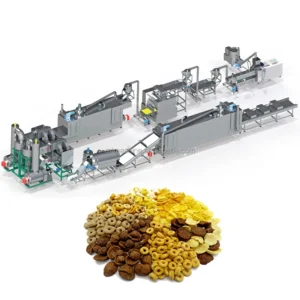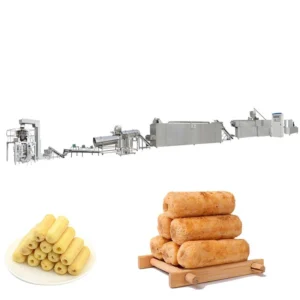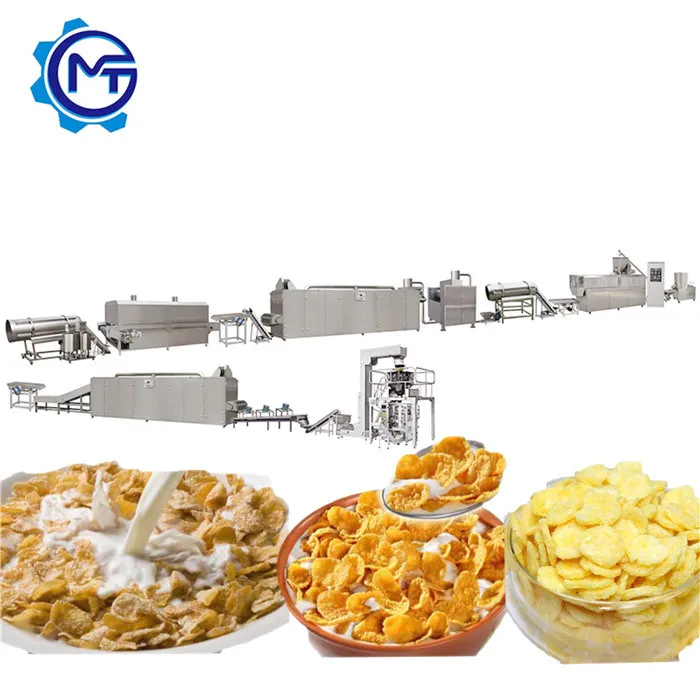
Customized screw profiles — Every MT70, MT85, and MT75 extruder ships with a screw and die setup matched to your actual corn, rice, or oat formulation, verified in our testing workshop before the crate is sealed.
Technical Specifications
| Parameter | Value |
|---|---|
| Model | MT70 / MT85 / MT75 |
| Product Type | Corn Flakes Making Machine |
| Screw Type | Twin-screw |
| Installed Power | 160 kW (MT70), 190 kW (MT85), 210 kW (MT75) |
| Power Consumption | 120 kW (MT70), 140 kW (MT85), 150 kW (MT75) |
| Capacity | 150-200 kg/h (MT70), 300-400 kg/h (MT85), 300-500 kg/h (MT75) (basis not stated in source) |
| Overall Dimensions | 41 x 1.5 x 2.2 m (MT70), 43 x 1.5 x 3.2 m (MT85), 45 x 1.5 x 3.5 m (MT75) |
| Control System | PLC control system, MCC |
| Heating Source | Gas, Electric (Dryer Machine) |
| Flaking Machinery Drive | Double motors for separate roller driving, hydraulic system |
| Temperature Control | Infrared sensor (Flaking), Precise control (Roasting oven) |
| Roasting Oven Features | Vibrating pan, high-temp spraying tubes, dual circulating fans, cyclone dust removal |
| Line Stations | Mixing, Extruding, Flaking, Drying, Hot Air Roasting, Sugar Spraying, Sugar Coating, Cooling, Packing |
| Standards | CE, ISO |
Application Suitability
| Application | Material or Output |
|---|---|
| Natural corn flakes production | Corn grits and corn powder |
| Sugar-coated breakfast cereals | Corn, rice, and wheat blends with syrup coating |
| Multi-grain flake formats | Oat, barley, and mixed grain powder formulations |
| Shaped cereal pieces | Ball, tube, ring, star, and fruit loop dies for corn and rice dough |
What "Nominal Capacity" Hides About Corn Flakes Extrusion Technology
A rated throughput figure means nothing if the screw profile cannot gelatinise your specific corn variety at your local moisture level.
I have watched lines run beautifully on one supplier’s test material and then choke on the buyer’s actual corn flour because the starch granule size was different. The extruder barrel could not build enough shear, the dough came out dense, and the flakes cracked instead of blistering in the roaster. When you evaluate corn flakes making machine extrusion technology, the conversation must start with your raw material certificate of analysis, not the brochure number [NEED_CITE: raw material variability in cereal extrusion processes].
How Screw Configuration Dictates Flake Texture
The twin-screw layout lets us rearrange conveying, kneading, and reverse elements along the barrel to match your grain blend. A high-amylose corn needs a longer gelatinisation zone with more kneading blocks, while a wheat-heavy mix requires gentler shear to avoid over-working the gluten network. This screw configuration is where the corn flakes extrusion technology either succeeds or fails before the dough ever reaches the die.
Barrel Temperature Profiles and Starch Gelatinisation
Each barrel section carries independent heating and cooling circuits managed by the PLC. We map a temperature ramp that brings moisture into the starch granules progressively — too fast and you get case-hardened pellets that refuse to flatten; too slow and the dough sticks to the screw flights. Getting this profile right is what separates a flake that blisters evenly in the roasting oven from one that shatters under the roller [NEED_CITE: starch gelatinisation temperature ranges in twin-screw extrusion].
Reading the Spec Sheet Like a Process Engineer
The installed power figures — 160 kW, 190 kW, and 210 kW across the three models — tell you how much thermal and mechanical energy the barrel can deliver. Higher installed power supports longer barrel sections with more temperature zones, giving you finer control over the gelatinisation window. The flaking machinery uses double motors driving each roller independently, which means you can adjust the nip gap and roller speed differential to control flake thickness without stalling the feed. The hydraulic system maintains consistent pressure between rollers even when dough viscosity fluctuates between batches. Infrared sensors at the flaking station monitor roller surface temperature in real time, preventing the dough from sticking or tearing. The roasting oven adds another layer: its vibrating pan keeps flakes moving through high-temperature spray tubes while dual circulating fans ensure even browning, and the cyclone dust removal device pulls fine particles out before they scorch and taint the batch.
The Cost of Skipping the Trial Run
When a buyer accepts a generic screw setup without a trial, the problems surface weeks after commissioning. Flakes come off the roller too thick and chewy, or too thin and brittle. The roasting oven cannot compensate for poor extrusion — it can only dry and colour what the extruder has already shaped. Operators end up running the line slower to chase acceptable quality, and the nominal capacity becomes irrelevant [NEED_CITE: extrusion trial run importance for cereal production lines].
Why Procurement Teams Specify This Line
The complete line runs from batching through extrusion, flaking, drying, roasting, sugar coating, and packing under one configuration responsibility, so throughput is matched across every station. Screw and die designs are specified to your exact raw material and target flake geometry rather than copied from a default build. The in-house testing workshop runs your shipped corn or grain blend before the equipment leaves the factory, producing a documented trial report. The PLC and MCC control architecture gives process engineers full visibility into barrel temperatures, screw speed, and roller gap from a single interface. Pre-sales engineering covers line layout and capacity calculation, and post-delivery support extends through installation, commissioning, and operator training.
Documentation & Verification
- Screw and die configuration record matched to your grain formulation
- Trial run report on your shipped raw material before dispatch
- Line layout drawing with station-by-station throughput calculation
- Electrical schematic confirming your local voltage and frequency
- Machine specification sheet with dimensional and utility requirements
- Operation and maintenance manual covering screw and roller service intervals
Installation, Commissioning & Support
- Foundation plan accounts for the full line footprint up to 45 m length on the MT75
- Dedicated electrical circuit sized to the model’s installed power rating up to 210 kW
- PLC and MCC panels configured for your local voltage, frequency, and operator language
- First-run parameter setting covers barrel temperature ramp, screw speed, and roller nip gap
- Operator training includes screw element replacement and hydraulic roller adjustment
- Wear parts list specifies screw segments, die inserts, and roller shell replacement intervals
What We Need to Configure Your Line
Send us your primary grain type, particle size distribution, and typical moisture content at receipt. Tell us the flake dimensions your market expects and whether you need sugar coating or plain output. Share your available floor space and ceiling height, along with local voltage and frequency. If you can ship a sample batch of your raw material, we will run it in the testing workshop and return a trial report with the proposed screw configuration.
Frequently Asked Questions
Q: How is screw configuration determined for different cereal formulations?
A: We start with your grain’s starch content, amylose-to-amylopectin ratio, and particle size. Based on that data, we select the sequence of conveying, kneading, and reverse screw elements and set the barrel zone count. The configuration is documented in a record that ships with the machine so your process team has a baseline for future adjustments.
Q: What barrel temperature profile is needed for proper starch gelatinisation?
A: Most corn-based formulations require a progressive ramp across the barrel zones, starting lower to hydrate the granules and rising through the gelatinisation window before a slight drop at the die to control expansion. The exact set points depend on your corn variety and moisture level, which we establish during the pre-shipment trial run.
Q: How do you verify capacity on my specific raw material before shipment?
A: You send us a sample of your actual grain blend, and we run it through the extruder and flaking station in our testing workshop. We measure throughput, flake integrity, and roller yield, then provide a trial report. This confirms what the line will produce on your material, not on a generic test flour.
Q: What die design options are available for different flake thicknesses?
A: The extruder die shapes the cooked dough into pellets before they reach the flaking roller. We offer multiple die geometries that produce pellets of varying diameter and cross-section, which directly influence the final flake thickness and surface area after rolling. The right die is selected based on your target flake specification.
Q: How does moisture content affect expansion and final product density?
A: Moisture determines how much steam generates inside the pellet at the die exit. Lower moisture gives less expansion and a denser, harder flake that may crack during roasting. Higher moisture increases expansion but risks sticking on the roller. We dial in the target moisture during the trial run and document the conditioning parameters for your operator.