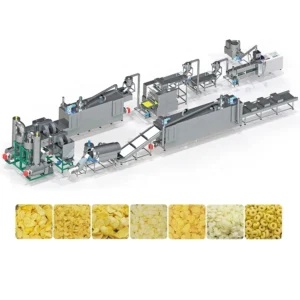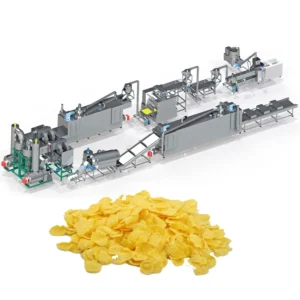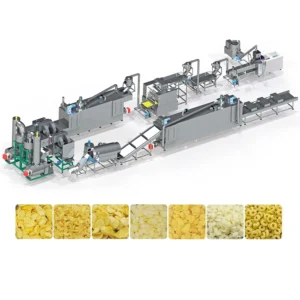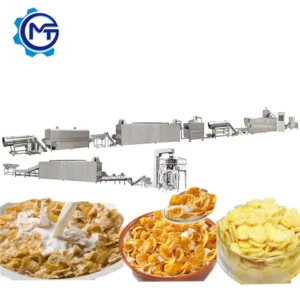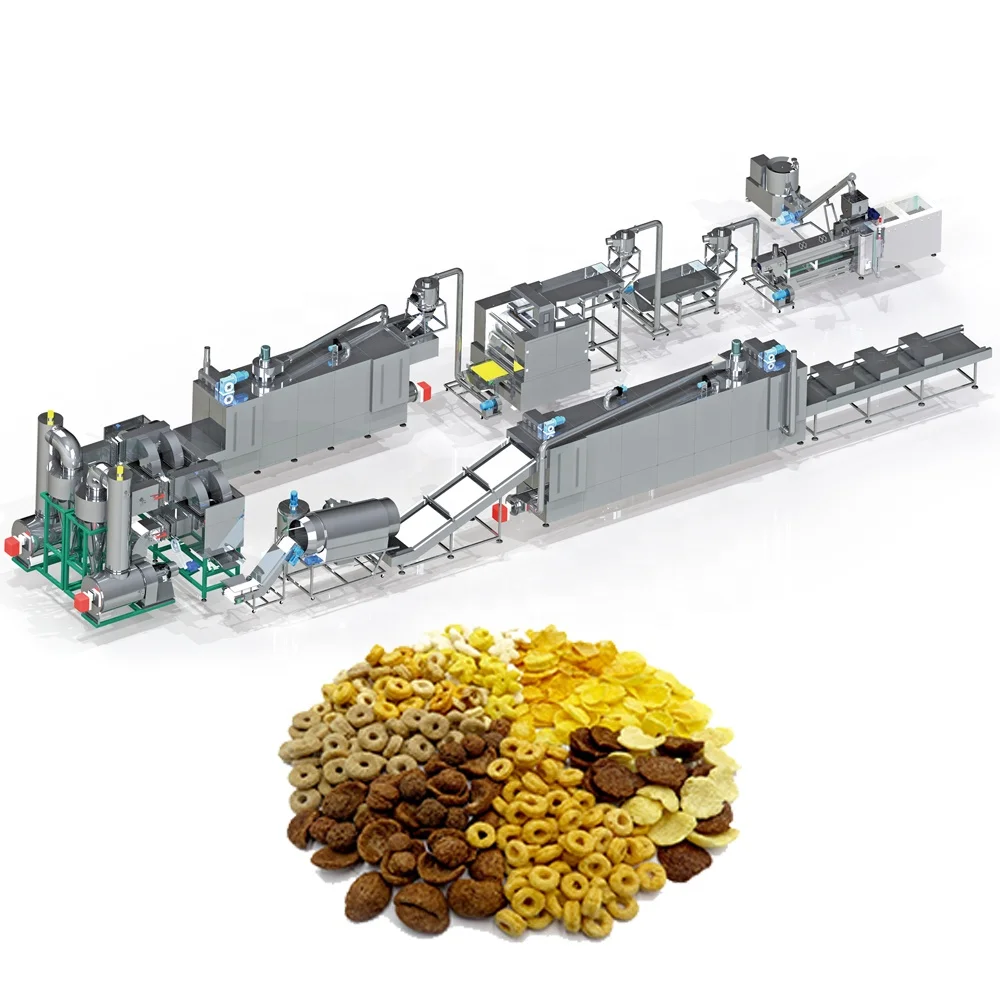
Screw configuration matched to your grain — We run your actual corn, rice or oat flour through our testing workshop to lock in the extrusion parameters before the line ships, so the first batch in your plant meets the same density and crunch targets as the trial.
Technical Specifications
| Parameter | Value |
|---|---|
| Product Type | Corn Flakes Breakfast Cereal Production Line |
| Models Available | MT70 / MT85 / MT75 |
| Extruder Type | Twin Screw |
| Raw Materials | Corn, rice, wheat, oat, barley powder |
| MT70 Installed Power | 160 kW |
| MT70 Power Consumption | 120 kW |
| MT70 Output Capacity | 150–200 kg/h (basis to be confirmed) |
| MT70 Overall Dimensions | 41 × 1.5 × 2.2 m |
| MT85 Installed Power | 190 kW |
| MT85 Power Consumption | 140 kW |
| MT85 Output Capacity | 300–400 kg/h (basis to be confirmed) |
| MT85 Overall Dimensions | 43 × 1.5 × 3.2 m |
| MT75 Installed Power | 210 kW |
| MT75 Power Consumption | 150 kW |
| MT75 Output Capacity | 300–500 kg/h (basis to be confirmed) |
| MT75 Overall Dimensions | 45 × 1.5 × 3.5 m |
| Control System | PLC control across flaking stations; MCC and PLC across the full line |
| Flaking Drive | Double motors for separate roller driving, hydraulic system |
| Flaking Temperature Control | Infrared sensor for even temperature pipe control |
| Dryer Heating Source | Gas or Electric |
| Roasting Oven | Hot air roasting with conciliation burner, dual circulating fans, cyclone dust removal |
| Coating System | Double tumble sugar melting, elevator, coating drum, spraying nozzle |
| Screw Material | Wear-resistant alloy, special treatment (verify against current material certificate) |
| Extruder Features | Automatic lubricating and cooling function |
| Final Product Shapes | Ball, tube, stick, ring, fruit loop, star, wheel, flower, heart |
| Certifications | CE, ISO |
Application Suitability
| Application | Material or Output |
|---|---|
| Natural corn flakes | Corn grits or corn flour, flaked and roasted to target crispness |
| Sugar-coated corn flakes | Corn base with sugar spray and tumble coating for glazed finish |
| Multi-grain breakfast cereal | Blends of rice, wheat, oat and barley powder extruded and flaked |
| Extruded shaped cereal | Rings, balls, stars and fruit loops from corn or rice formulations |
| Fortified cereal base | Vitamin and mineral premix blended into grain flour before extrusion |
Why Copied Extrusion Parameters Sink Your First Production Run
A screw profile borrowed from another grain formulation will give you flakes that shatter in the bowl or refuse to toast evenly.
I once watched a line built for standard corn grits try to run a buyer’s own rice-heavy blend. The starch gelatinisation window shifted, expansion dropped, and the flakes came off the roaster pale and dense. The buyer had paid for a corn flakes extrusion technology production line rated at a certain output, but on their raw material the texture was wrong from the first hour. This happens more often than machinery buyers expect [NEED_CITE: prevalence of extrusion line underperformance on non-standard raw materials]. The root cause is almost always a screw configuration and barrel temperature profile that were never validated against the actual flour the plant will process day after day.
Barrel Temperature Zones and Starch Behaviour
The corn flakes extrusion technology production line relies on precise thermal staging along the barrel. Each zone brings the dough through distinct phases: hydration, gelatinisation, and controlled expansion at the die face. If the profile is too aggressive early on, moisture flashes off before the starch matrix forms, leaving a flake that crumbles rather than cracks when bitten. Our approach is to map the gelatinisation onset temperature of your specific grain blend, then set the barrel heaters to hold a gradual ramp that keeps the melt viscosity within a narrow window right up to the die exit.
Shear Rate, Screw Pitch and Residence Time
Shear inside the twin-screw chamber determines how thoroughly the protein and starch networks interlock. A tighter pitch section increases mechanical energy input, driving deeper gelatinisation but also raising dough temperature. The balance between shear and residence time is what separates a flake that holds its bowl-life from one that turns to mush in milk within minutes. For corn-based formulations we typically stage a moderate-pitch feed section into a high-shear cooking zone, then transition to a metering section that stabilises pressure before the die [NEED_CITE: twin screw extrusion shear and residence time interaction in cereal processing]. This sequence is re-tuned whenever the raw material ratio changes.
Reading the Spec Sheet Beyond Installed Power
Installed power figures across the MT70, MT85 and MT75 models range from 160 kW to 210 kW, but the number that matters more on the floor is power consumption under load. The difference between installed and consumed power reflects how much headroom the motors carry during peak-torque events like cold startup or a moisture spike in the feed. A line with generous headroom handles formulation changes without tripping overcurrent protection. The twin-screw extruder’s automatic lubricating and cooling function also keeps barrel and bearing temperatures within limits during extended runs, which directly affects how consistent flake thickness stays over a full shift. Voltage and frequency must be confirmed against your local supply before the electrical panels are wired, because a motor rated for the wrong frequency will run at the wrong speed and alter every downstream parameter.
When Generic Configurations Fail at Commissioning
A generic screw and die setup may produce acceptable flakes during a factory test on standard corn grits, but the moment the line encounters a higher-fibre or higher-protein flour, expansion drops and the roller press cannot flatten the pellets to uniform thickness. The result is a product that toasts unevenly, with some flakes burning while others stay doughy inside. Buyers then spend weeks adjusting moisture and feed rate on the floor, burning raw material and missing delivery deadlines [NEED_CITE: cost of post-installation extrusion line troubleshooting on non-standard materials]. A trial run in the testing workshop before shipment catches these mismatches early, because the screw elements and die geometry can be swapped while the machine is still accessible on the factory floor.
What Sets This Engineering Approach Apart
Every corn flakes extrusion technology production line we configure starts with a raw material sample from the buyer, not a catalogue formula. The screw configuration and die design are specified to your grain blend and target flake density, not copied from a previous build. Our in-house testing workshop runs your actual flour through the twin-screw extruder before the line is finalised, so expansion, texture and roast behaviour are documented in a trial report. Complete stations from mixing through packing are sourced under one supplier, meaning throughput at the dryer, roaster and coater is matched to the extruder output rather than bottlenecked by a mismatched station. Electrical schematics carry confirmed voltage, frequency and control language for your market, and the PLC programme is written to match your operator’s language before dispatch.
Documentation & Verification
- Line layout and capacity calculation matched to your factory floor dimensions and target output
- Screw and die configuration record tied to your grain formulation and moisture range
- Trial run report on your raw material with expansion, density and flake thickness data
- Electrical schematic with confirmed voltage, frequency and PLC language for your market
- CE declaration of conformity and ISO certificate included in shipping documentation
Installation, Commissioning & Support
- Foundation plan accounts for the full 41–45 m line length and hydraulic flaking unit load points
- Power supply confirmed to match installed capacity of 160–210 kW with dedicated circuit breakers
- Twin-screw extruder barrel segments and screw elements assembled and aligned on site
- PLC and MCC panels tested for correct voltage and frequency before first material feed
- Operator training covers screw configuration changes, die swaps and flaking roller gap adjustment
- Wear parts list includes screws, dies and flaking roller surfaces with recommended replacement intervals
What We Need to Start Your Line Layout
To configure the right model and station sequence for your plant, share your primary grain formulation or flour blend, the target flake density and crispness level, and your planned daily output. We also need your workshop length and ceiling height so the layout fits, plus local voltage and frequency to size the electrical panels correctly. If you want a trial run before shipment, send a batch of your raw material to our testing workshop.
Frequently Asked Questions
Q: How is screw configuration selected for different grain formulations and target flake densities?
A: We test your actual grain blend in our workshop, measuring expansion and gelatinisation at several screw pitch combinations. The configuration that delivers your target density and bowl-life is locked in before the extruder ships, and the setup is documented so your team can replicate it on every production run.
Q: What barrel temperature profile and moisture range produce optimal starch gelatinisation for corn flakes?
A: The profile depends on your grain’s starch type and protein content. Corn typically requires a staged ramp from hydration through gelatinisation, with moisture held within a narrow band. We determine the exact zones and moisture setpoints during the raw material trial run.
Q: How does the die design affect flake expansion, thickness and final bowl-life?
A: Die orifice diameter and land length control the pressure drop at exit, which governs how much the extrudate expands before the flaking rollers compress it. A well-matched die gives uniform pellet size, so every flake toasts to the same colour and holds crispness in milk.
Q: Can a trial run on our raw material be performed before shipment?
A: Yes. We run your grain sample through the twin-screw extruder in our testing workshop, recording expansion, density and flake thickness. The trial report ships with the line, and any screw or die adjustments are made before dispatch so the first production day starts at target specification.