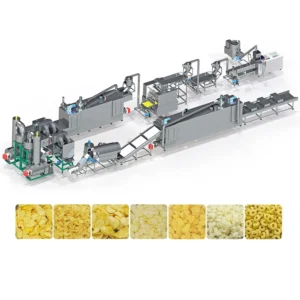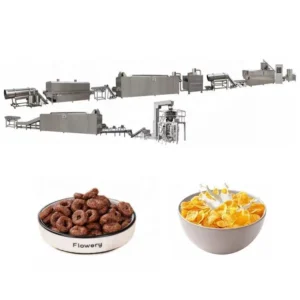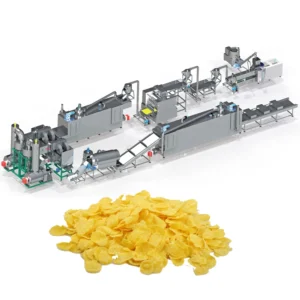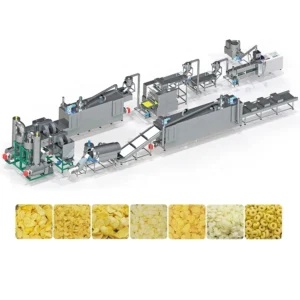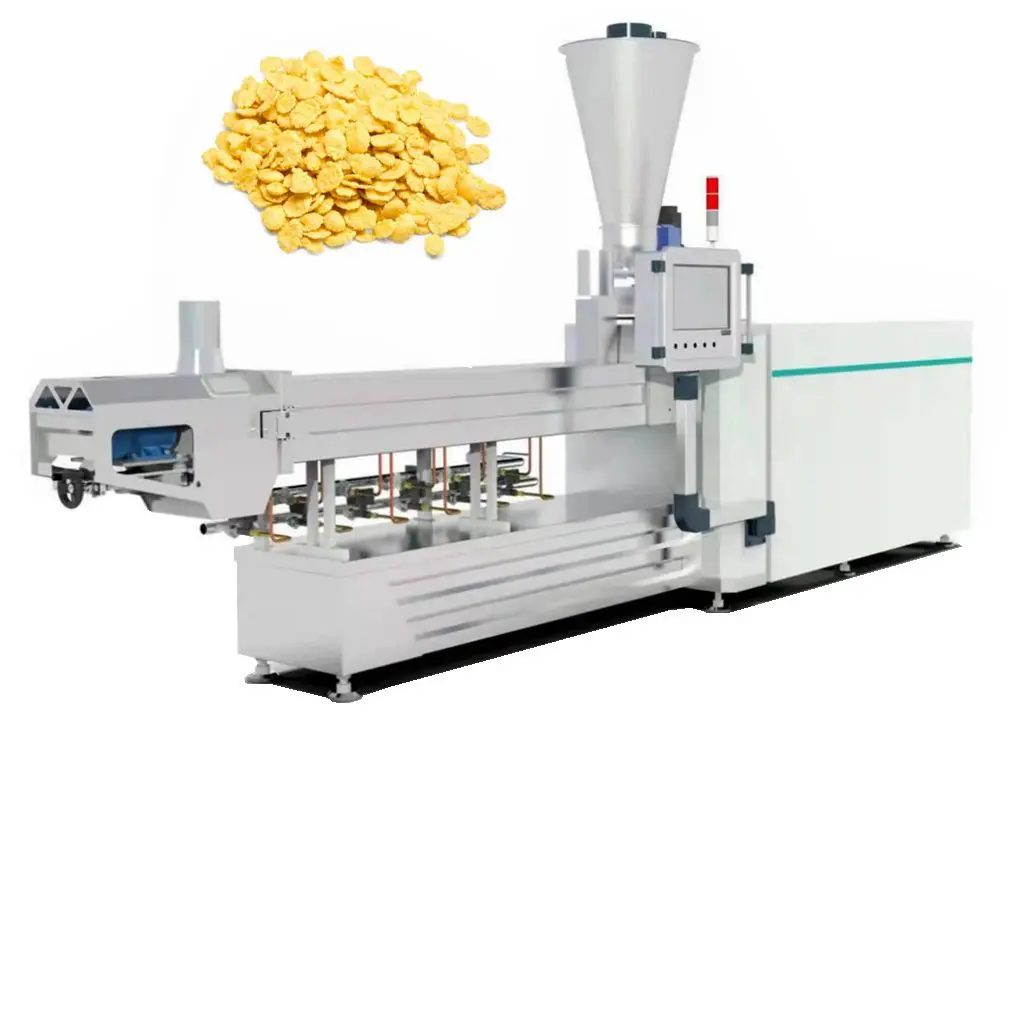
Configured for Your Material — Screw element arrangement, barrel zone profiling, and die geometry are matched to the buyer’s specific corn flour or grits blend rather than copied from a generic build, ensuring target starch gelatinisation and flake density.
Technical Specifications
| Parameter | Value |
|---|---|
| Product Type | Corn Flakes Production Line |
| Model | MT-65processing line / MT-70processing line / MT-85processing line / MT-75processing line |
| Extruder Design | Twin Screw |
| Extruder Construction | 3D software design with analogue simulation and computer-automated testing |
| Control System | PLC and MCC centralized control with real-time data storage and alarm monitoring |
| Installed Power | MT-65: 84 kW; MT-70: 132 kW; MT-85: 239 kW; MT-75: 186 kW |
| Real Power | MT-65: 59 kW; MT-70: 92 kW; MT-85: 167 kW; MT-75: 140 kW |
| Output Capacity | MT-65: 120–150 kg/h (basis to be confirmed); MT-70: 200–250 kg/h (basis to be confirmed); MT-85: 300–400 kg/h (basis to be confirmed); MT-75: 400–500 kg/h (basis to be confirmed) |
| Overall Dimensions (L×W×H) | MT-65: 21,000×1,200×2,200 mm; MT-70: 23,000×1,500×2,200 mm; MT-85: 28,000×3,500×4,300 mm; MT-75: 24,000×1,500×2,800 mm |
| Flaking Machine Roller Material | Cast iron rollers, 45# steel shaft, carbon steel frame |
| Flaking Machine Roller Gap | Adjustable |
| Flaking Machine Cooling | Water cooling system |
| Hot Air Roaster Max Temperature | 400 °C |
| Hot Air Roaster Heating Source | Electric or gas |
| Dryer Heating Method | Electric or gas |
| Dryer Layers | Three, five, or seven layers |
| Dryer Mesh Belt Speed | Adjustable |
| Sugar Spraying System Total Power | 28.75 kW |
| Sugar Spraying System Roller Size | Approx. Ø600×2,700 mm |
| Line Stations | Mixer → Screw Conveyor → Twin Screw Extruder → Air Conveyor → Dryer → Hoister → Flavouring Drum & Oil Sprayer → Cooling Machine → Packing Machine |
| Standards | CE (declared), ISO (declared) |
Application Suitability
| Application | Material or Output |
|---|---|
| Corn flakes breakfast cereal | Corn flour and corn grits |
| Oatmeal and multigrain flakes | Oat, barley, wheat, millet blends |
| Sugar-coated and honey-glazed flakes | Plain flakes post-roast through sugar spraying drum |
| Puffed cereal snacks (rings, loops, cocoa balls) | Rice, corn, and mixed grain flour via alternate die geometry |
What "Nominal Capacity" Actually Means on a Corn Flakes Twin Screw Extrusion Line
A rated output figure is meaningless without the raw material specification and moisture content that produced it.
When buyers evaluate a corn flakes extrusion technology line, they often see a single throughput number and assume it applies universally across corn, oat, or multigrain blends. In practice, the real output depends heavily on the feedstock’s fat content, particle size, and starch composition. A line running degemmed corn grits behaves very differently from one processing whole oat flour. Barrel temperature zones, screw speed, and moisture injection all shift when the raw material changes, and these adjustments directly affect how much material the extruder can process while maintaining the target gelatinisation degree [NEED_CITE: starch gelatinisation thresholds across cereal grain types]. I have seen lines quoted at a nominal capacity that could not hold that output once the buyer’s actual flour blend was introduced during commissioning.
Screw Element Arrangement and Barrel Zone Profiling
The twin-screw configuration in this corn flakes twin screw extrusion line allows screw elements to be rearranged along the shaft. Kneading blocks, reverse-flight segments, and conveying elements are positioned in a sequence calculated for the buyer’s specific grain blend. This controls residence time, shear intensity, and heat transfer across multiple barrel zones. Proper configuration ensures the starch reaches the required gelatinisation degree without over-degrading the melt, which would destroy the flake structure downstream.
Moisture Injection and Shear Rate Calibration
Water or steam injection is calibrated to the raw material’s absorption characteristics before the melt enters the die. The screw speed and element geometry together determine shear rate, which generates internal friction heat alongside the barrel heaters. Managing moisture and shear in balance is the core of corn flakes extrusion technology — too much shear with insufficient moisture produces a brittle, over-expanded pellet that shatters during flaking, while too little shear leaves ungelatinised starch cores that create hard spots in the final bowl.
How Roller Gap, Roasting Temperature, and Dryer Layers Shape the Final Flake
The cast iron flaking rollers compress extruded pellets into thin sheets, with the adjustable gap determining final flake thickness and the water cooling system preventing the dough from sticking or tearing. After flaking, the product passes through a multi-layer dryer available in three, five, or seven tiers where mesh belt speed and layer count control dwell time. The hot air roaster reaches up to 400 °C to create the characteristic surface blister and lock in crispness. Electric or gas heating is selected based on the buyer’s local utility infrastructure. The combination of roller compression, drying profile, and roasting temperature determines whether the flake maintains its structure and crunch through the bowl-life the market expects [NEED_CITE: thermal processing parameters for breakfast cereal surface blister formation].
Selecting the Wrong Screw and Die Configuration
When a corn flakes twin screw extrusion line ships with a generic screw build that was not matched to the buyer’s raw material, the problems appear sequentially down the line. The extruder may produce pellets with inconsistent density, causing the flaking rollers to crush some pieces and skip others. Uneven flake thickness then leads to irregular drying, where some flakes burn in the roaster while others remain doughy inside. The operator ends up constantly adjusting downstream stations to compensate for a problem that originated in the extruder barrel, and no amount of tuning can fully correct a melt that was never properly gelatinised [NEED_CITE: twin screw extrusion process variable interactions in cereal processing].
Why This Line Is Built Around the Buyer’s Material
Every corn flakes extrusion technology line from this facility is configured through in-house trial runs on the buyer’s actual raw material before shipment. The twin-screw expertise spans corn, oat, multigrain, and mixed cereal bases, with screw configuration and die design specified to each. Complete line throughput is matched from mixer through extruder to flaker, dryer, roaster, and packing, so no single station bottlenecks the output. The PLC and MCC centralized control system records and stores real-time processing data, enabling batch-to-batch consistency. Pre-sales engineering includes line layout and capacity calculation based on confirmed material parameters rather than generic estimates.
Documentation & Verification
- Line layout and capacity calculation based on your confirmed grain blend and target flake specification
- Screw and die configuration record documenting element arrangement matched to your raw material
- Trial run report on your actual corn flour or grits produced in the testing workshop before dispatch
- Machine specification sheet with matched throughput across extruder, flaker, dryer, and roaster stations
- CE declaration of conformity and ISO certificate for export compliance
- Electrical schematic with voltage and control language confirmed to your local utility standard
Installation, Commissioning & Support
- Foundation and utility planning based on the MT-85 line footprint of 28,000×3,500×4,300 mm or selected model dimensions
- Power circuit design for the selected model’s real power draw, from 59 kW to 167 kW
- On-site assembly sequencing across all stations from mixer to packing machine
- First-run parameter setting using the trial run report as the baseline for screw speed and barrel zones
- Operator training covering PLC interface navigation, alarm response, and recipe storage for different grain blends
- Wear parts list identifying screws, dies, and roller surfaces with recommended replacement intervals
What to Prepare Before Requesting a Quotation
To configure the screw arrangement and barrel profile accurately, share the specific grain type and whether the feedstock is flour or grits, along with any fat or fibre content data available. Confirm the target flake thickness, desired surface blister pattern, and whether the product will be sugar-coated or plain. Provide the local voltage, frequency, and preferred control language so the electrical system can be matched before production begins.
Frequently Asked Questions
Q: How is the screw configuration selected for different cereal bases like corn versus oat?
A: The screw element arrangement is determined by running the buyer’s actual raw material in the testing workshop. Corn grits and oat flour have different starch structures and fat levels, requiring distinct kneading block placement, barrel zone temperatures, and moisture settings to achieve proper gelatinisation without degrading the melt before the flaking stage.
Q: What barrel temperature profile is needed for proper starch gelatinisation in corn flakes?
A: The multi-zone barrel profile is set based on the specific corn variety and particle size. Each zone is tuned so the starch progressively gelatinises as material moves through the barrel, avoiding cold zones that leave raw cores or hot zones that cause premature expansion. The PLC system stores these zone settings for repeatable output.
Q: How does moisture input and shear rate affect the final flake density and bowl-life crispness?
A: Moisture and shear work together inside the barrel to control expansion. Higher shear with calibrated moisture produces a uniform cell structure that yields consistent flake density after rolling. If moisture is too low or shear too high, the pellet fractures during flaking, resulting in uneven roasting and reduced bowl-life crispness.
Q: Can I run a trial on my raw material before the line ships?
A: Yes. The in-house testing workshop runs the buyer’s actual corn flour or grits through the twin-screw extruder before dispatch. The trial documents screw speed, barrel temperature, moisture input, and resulting flake density, providing a verified baseline that the commissioning team uses during on-site installation.
Q: How are the flaking roller gap and roasting temperature tuned to achieve the target blister pattern?
A: The cast iron roller gap is adjusted to produce the specified flake thickness, with water cooling preventing dough adhesion. The roaster, operating up to 400 °C with electric or gas heating, is then set to a temperature and dwell time that creates the surface blister without over-drying the flake interior.