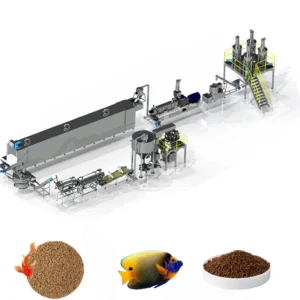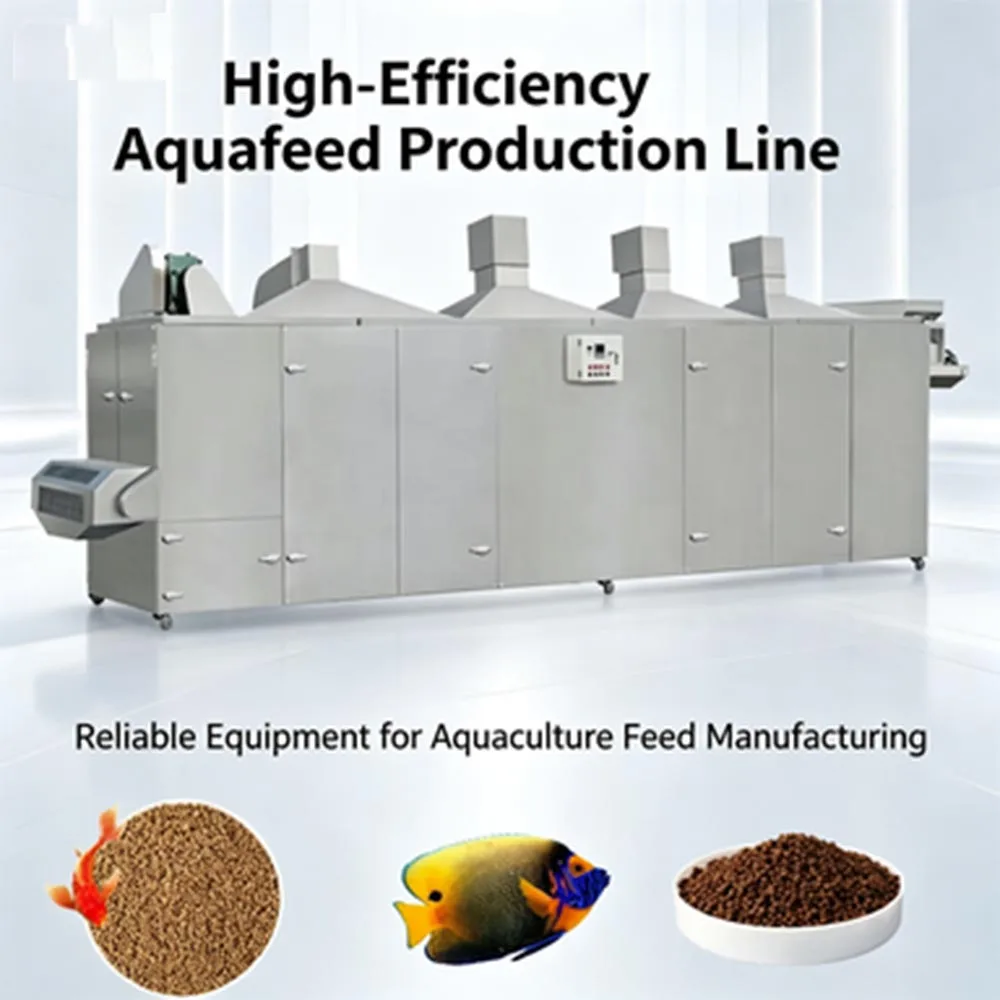
Matched Screw Geometry — Twin-screw aquatic feed extrusion with die and screw segments selected against the buyer’s actual formulation before the line ships.
Technical Specifications
| Parameter | Value |
|---|---|
| Product Type | Aquatic Feed Extrusion Production Line |
| Output Capacity | 500 kg/h on floating fish feed pellets (basis to be confirmed for sinking formulations) |
| Pellet Diameter Range | 0.5 mm to 12 mm via interchangeable die plates |
| Screw Configuration | Twin-screw, segment arrangement set to feed formula |
| Contact Material | Stainless steel across barrel, screws and die |
| Control Interface | Panel supplied per line scope — confirm PLC, MCC or manual at quotation |
| Automation Level | Continuous, fully automatic from feeding through packing |
| Line Stations | Feeding, mixing, extruding, pelletizing — dryer, cooler and packing scope to confirm at layout stage |
| Power Design | Low-energy profile; rated total kW confirmed once station list is locked |
| Assembly State | Integrated compact layout, modular for phased expansion |
| Conformity | CE, ISO certified manufacturing |
Application Suitability
| Application | Material or Output |
|---|---|
| Floating feed for warm-water species | Catfish, tilapia formulations with moderate starch and protein |
| Sinking feed for bottom feeders | Shrimp and benthic species requiring higher density pellets |
| Starter feed production | 0.5 mm–1.5 mm micro-pellets for fry and larvae stages |
| Grow-out feed production | 4 mm–12 mm pellets across juvenile to adult growth phases |
| Formula diversification | Lines producing both floating and sinking grades from the same extruder with die and screw changeover |
What "500 kg/h" Actually Means When Starch and Fat Vary
A twin screw aquatic feed extrusion technology line only holds its rated capacity when the screw configuration matches the real formulation running on the day.
I once watched a line quoted at a neat nominal figure lose half its throughput the moment the buyer switched to a high-fishmeal, high-fat recipe. The pellets also sank when the market expected floaters, because the generic screw profile could not deliver the shear and gelatinisation the new formula demanded [NEED_CITE: formulation impact on extruder throughput and pellet buoyancy]. The rated number on the brochure became irrelevant the first time the recipe changed. twin screw aquatic feed extrusion technology has to be validated on the buyer’s raw material, not assumed from a catalog curve.
How Screw Segments and Barrel Zones Control Pellet Buoyancy
Floating pellets need the starch in the formula to gelatinise fully inside the barrel so the pellet expands as it exits the die. The twin-screw assembly uses alternating conveying, kneading and reverse elements to control residence time and shear intensity. Each barrel zone is independently heated, so the temperature profile can be raised through the gelatinisation window and then cooled before the die to lock in density. Changing the ratio of kneading blocks to conveying segments is what shifts a line from floating catfish feed to sinking shrimp feed on the same hardware.
Shear, Moisture and the Gelatinisation Window
Starch gelatinisation typically begins around 60–70 °C in the presence of moisture and mechanical work. The extruder barrel must hold the mix inside that window long enough for the starch granules to rupture, but not so long that protein denatures and nutrient value drops. Barrel moisture, screw speed and zone temperatures together set this balance [NEED_CITE: starch gelatinisation temperature ranges in aquaculture feed processing]. Operators adjust preconditioner steam and barrel water injection to keep the mass inside the correct band as ambient humidity shifts through the season.
Reading the Parameter Table Against Your Recipe
The 0.5 mm to 12 mm die range covers fry starter through adult grow-out, but each diameter behaves differently. Small dies raise back-pressure, increasing shear and favouring expansion — useful for floating micro-pellets. Larger dies lower resistance and suit dense sinking pellets for shrimp. The stainless-steel contact surfaces resist the corrosive effect of fishmeal and added fats that would pit carbon-steel barrels within a season. The control interface governs screw speed, zone temperatures and feeder rates; confirming PLC, MCC or manual operation at quotation prevents a language or protocol mismatch on the factory floor [NEED_CITE: control system language and protocol confirmation before shipment].
The Cost of Skipping a Pre-Shipment Trial
Lines shipped without a trial run on the buyer’s raw material often reveal their real capacity only after installation. By then the screw profile is fixed, the die set is cut and the dryer is sized to a throughput the extruder cannot actually deliver. Sinking pellets that should float, or vice versa, mean reformulation work that delays market launch by months rather than weeks. Downstream bottlenecks — an undersized dryer, a coating drum that cannot keep up — compound the problem because each station was quoted against a capacity the extruder never achieved on that specific formula.
Why This Line Is Configured Before It Is Quoted
The screw configuration and die design are selected against the buyer’s raw material and target pellet density, not copied from a generic build. Throughput matching across feeding, extruding, drying, coating and packing prevents one station from becoming a bottleneck while another sits idle. The in-house testing workshop runs the buyer’s actual formula before the line ships, so capacity, pellet density and expansion ratio are verified on real product. Pre-sales engineering covers line layout and utility planning, while commissioning includes operator training on the specific control interface installed. Ongoing maintenance support and a documented wear-parts list keep replacement screws and dies available when the first changeover is due.
Documentation & Verification
- Trial run report on buyer’s actual aquatic feed formula before dispatch
- Screw and die configuration record matched to target pellet density
- Line layout with throughput calculation across every station
- Electrical schematic with voltage and frequency confirmed per destination
- Operation and maintenance manual covering twin-screw changeover procedure
- Packing photographs and customs documentation support
Installation, Commissioning & Support
- Foundation plan sized to extruder mass and motor vibration profile
- Dedicated power circuit rated to total line kW once station list is locked
- Modular assembly allowing phased installation if dryer and cooler arrive later
- First-run parameter setting for barrel zones, screw speed and feeder rates
- Operator training on die changeover between floating and sinking pellet diameters
- Wear-parts list covering screw segments, barrel liners and die plates
Before You Send an Inquiry
To size the screw configuration and die set correctly, the formulation matters more than the target hourly output. Share the raw material breakdown — fishmeal percentage, fat addition, starch source and moisture at the mixer — along with the pellet diameters and whether the end product must float or sink. Confirm the local voltage, frequency and preferred control language so the panel can be built to match. If you already run a dryer or cooler upstream or downstream, include their capacity so the new extruder is matched rather than oversized.
Frequently Asked Questions
Q: How is screw configuration chosen for floating versus sinking aquatic feed?
A: Floating feed requires a screw profile that maximises starch gelatinisation through extended kneading and controlled shear, producing an expanded, low-density pellet. Sinking feed uses fewer kneading blocks and a cooler barrel profile to limit expansion. The segment arrangement is finalised after a trial run on the buyer’s actual formulation.
Q: What barrel temperature profile supports starch gelatinisation?
A: The barrel zones are typically stepped from preconditioning temperatures up through the gelatinisation window, then reduced before the die to stabilise pellet structure. Exact set-points depend on the starch source and moisture level in the mix, and are recorded during the pre-shipment trial.
Q: How is pellet density verified before the line ships?
A: A sample run is conducted in the testing workshop using the buyer’s raw material. Pellets are collected at the die exit, cooled and measured for bulk density and water stability. Results are documented in a trial run report shared before dispatch.
Q: What die options cover different pellet diameters?
A: Interchangeable die plates span 0.5 mm to 12 mm, covering fry starter through adult grow-out sizes. Die hole count and land length are selected to match back-pressure requirements for each pellet diameter and whether floating or sinking density is targeted.
Q: How does extrusion shear affect nutrient retention in aquatic feed?
A: Excessive shear can denature heat-sensitive proteins and degrade added vitamins. The twin-screw layout allows shear intensity to be tuned through screw speed and segment arrangement, keeping mechanical work inside the range that gelatinises starch without compromising the nutritional profile.