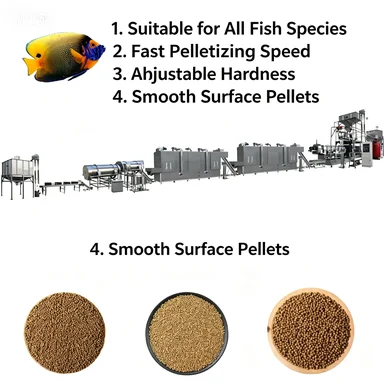
Screw Geometry Dictates Density — Pellet buoyancy is engineered into the screw profile and die layout, not adjusted on the fly after a failed run.
Technical Specifications
| Parameter | Value |
|---|---|
| Product Type | Twin Screw Aquatic Feed Extrusion Line |
| Screw Type | Twin Screw |
| Output Capacity | 500 kg/h (basis not stated in source — confirm raw material / moisture / pellet size) |
| Pellet Size Range | 0.5 mm – 12 mm |
| Control System | PLC |
| Structure Material | Stainless Steel (main parts) |
| Pellet Buoyancy | Floating and Sinking |
| Line Stations | Feeding, Mixing, Extruding, Pelletizing |
| Automation Level | Fully Automatic |
| Standards | CE, ISO |
Application Suitability
| Application | Material or Output |
|---|---|
| Floating catfish and tilapia pellets | Starch-rich formulations requiring high expansion and low bulk density |
| Slow-sinking shrimp feed | High-protein, low-starch mixes requiring controlled density and water stability |
| Starter crumble for fry | Fine die apertures producing 0.5 mm – 2.0 mm micro-pellets |
| Grow-out pellets for large species | Die inserts producing 8 mm – 12 mm pellets with uniform core gelatinisation |
| Fish-based aquatic-style kibble | Pet food formulations adapted to twin-screw extrusion parameters |
Why Buoyancy Fails Start at the Screw, Not the Dryer
Floating feed that sinks almost always traces back to an extrusion parameter mismatch, never to the dryer setting.
When a buyer specifies floating catfish pellets and the output sinks within seconds of hitting the water, the first instinct is to blame moisture content or drying temperature. In my experience on fish feed lines across aquaculture operations, the real cause usually sits inside the barrel: a screw configuration designed for a generic corn-soy blend running against a formulation that is heavy on fish meal and light on starch. The twin screw extrusion technology aquatic feed lines depend on relies on precise starch gelatinisation to trap steam and create the cellular structure that keeps pellets afloat. If the screw pitch and shear profile are not calculated for the actual raw material, the expansion never happens correctly [NEED_CITE: starch gelatinisation temperature thresholds in aquatic feed extrusion]. A twin-screw setup allows operators to adjust the screw element sequence — kneading blocks, reverse elements, conveying flights — to match the specific ratio of protein to starch in the customer’s formulation, which is exactly what the trial workshop is built to verify before the machine ships.
Mapping the Barrel Temperature Profile to Starch Behaviour
The barrel is divided into multiple heating and cooling zones, each managed independently by the PLC. For floating pellets, the temperature must climb gradually from the feed section through the metering zone, reaching the gelatinisation threshold of the dominant starch source — typically between 65°C and 80°C depending on whether the formulation uses corn, rice, or cassava flour. The twin screw extrusion technology aquatic feed processing demands in this zone is about holding the melt at that threshold long enough for complete starch conversion without scorching the protein fraction. If one zone overshoots, the pellet surface seals prematurely and traps unconverted starch inside, leading to pellets that crack and sink after a few hours in water.
Shear Rate, Die Geometry, and the Expansion Ratio
Once the melt reaches the die plate, the sudden pressure drop drives steam expansion inside each pellet. The die hole diameter and the land length — the thickness of the die plate the melt must pass through — directly set the expansion ratio. A short land length with a wide orifice produces rapid expansion, yielding a light, highly porous floating pellet suited to surface-feeding species like tilapia. A longer land length with a narrower orifice restricts expansion, producing a denser pellet designed to sink slowly through the water column for bottom-feeding shrimp [NEED_CITE: die land length and expansion ratio relationship in twin-screw extrusion]. The PLC records these parameters per recipe, so when the operator switches from a floating grow-out pellet to a sinking starter crumble, the system recalls the correct barrel profile and screw speed without manual guesswork.
Reading the Spec Sheet: What Capacity and Pellet Size Actually Mean
The rated output of 500 kg/h carries no stated raw material basis, which is the norm in aquatic feed line quotations but also the single biggest source of post-installation disputes. A formulation high in fish meal and oil will extrude at a lower mass throughput than a starch-dominant mix because the melt viscosity and residence time requirements differ. The pellet size range of 0.5 mm to 12 mm is achievable on one platform by swapping die plates and adjusting the cutter speed, but each die change requires a corresponding screw configuration review — running a 0.5 mm starter pellet on a screw profile optimised for 12 mm grow-out feed will produce uneven expansion and excessive fines. Stainless steel contact surfaces throughout the feeding, mixing, extruding, and pelletizing stations reduce contamination risk between formulation changeovers and simplify wash-down, which matters when a plant runs both fish-based and poultry-based aquatic-style kibble on the same line.
The Cost of Skipping the Screw Configuration Step
I have seen a line installed and commissioned where the screw elements were left in the factory-default arrangement. The buyer’s formulation used a higher fish meal ratio than the standard test recipe, and every pellet sank within thirty seconds. Reconfiguring the screw stack after installation meant a full barrel disassembly, new element ordering, and several days of re-trialling — a delay that could have been avoided with a pre-shipment trial run on the actual raw material [NEED_CITE: twin-screw extruder barrel disassembly and reconfiguration downtime]. The downstream dryer and coating drum were already sized for the target throughput, so the bottleneck sat entirely inside the extruder barrel, invisible until the first production run.
What This Line Delivers as a Complete Package
The entire production line — from feeding and mixing through extruding to pelletizing — comes under one supplier, which means throughput is balanced across every station rather than assembled from mismatched vendors. Screw configuration and die design are specified to the buyer’s actual raw material formulation, not copied from a generic build. An in-house testing workshop runs the customer’s material before shipment, generating a trial report that confirms buoyancy, pellet integrity, and output rate against the stated specification. PLC and MCC control architecture provides recipe storage and repeatability across production batches. Documentation including the screw and die configuration record, electrical schematic, and CE declaration of conformity ships with the machine, giving the buyer a complete technical baseline for maintenance and future line expansion.
Documentation & Verification
- Line layout drawing showing station spacing and utility connection points for your floor plan
- Screw and die configuration record matched to your submitted raw material formulation
- Trial run report from in-house testing workshop on your actual feed ingredients
- Electrical schematic with voltage and frequency confirmed to your destination market
- CE declaration of conformity and ISO certificate included with shipping documents
- Wear parts list with recommended replacement intervals for screws, dies, and cutter blades
Installation, Commissioning & Support
- Foundation pad leveled to tolerances specified in the line layout for stable extruder operation
- Dedicated electrical circuit matching confirmed voltage and frequency for the PLC and main drive motor
- Barrel reassembly and screw element stacking supervised on-site during first startup
- PLC parameter sets loaded and recipe trials run with operator present at the control panel
- Cutter speed and die plate alignment calibrated for each pellet size in your product range
- Spare screw elements and die plates staged on-site before the first scheduled changeover
What to Include in Your Inquiry
Send the raw material formulation with moisture percentages, the target pellet diameters and buoyancy type, and the daily production volume you need the line to sustain. Specify your facility voltage and frequency, the control language your operators require, and whether you want the trial workshop to run your exact ingredient mix before shipment.
Frequently Asked Questions
Q: How is pellet buoyancy controlled through screw configuration and barrel temperature?
A: Floating pellets require high starch gelatinisation and controlled steam expansion at the die, achieved by selecting kneading block sequences and barrel zone temperatures matched to the formulation. Sinking pellets use a screw profile that limits expansion and a die with longer land length. The PLC stores each recipe’s parameters for repeatable results across batches.
Q: What raw material moisture range does the twin-screw extruder require for consistent gelatinisation?
A: The required moisture range depends on the starch source and protein ratio in the formulation. Generally, twin-screw aquatic feed extrusion operates with preconditioned moisture levels that allow full starch conversion without excessive drying load downstream. The trial run on your specific material establishes the exact moisture target recorded in the configuration report.
Q: How is the die configuration selected for a specific pellet diameter and density target?
A: Die hole diameter sets the pellet cross-section, while land length controls expansion ratio and final density. A technical review of your target species and feeding behaviour determines the die specification. Multiple die plates can be supplied for one line, allowing production of different pellet sizes by swapping plates and adjusting the cutter assembly.
Q: Can the same line switch between floating and sinking pellet production?
A: Yes. Switching involves changing the die plate, adjusting the screw element configuration if the formulation differs significantly, and loading the corresponding PLC recipe. The time required depends on how many screw elements need repositioning, which is why the pre-shipment trial identifies all changeover scenarios your production schedule demands.
Q: How is the extruder’s output capacity verified against a specific aquatic feed formulation?
A: Output capacity is confirmed during the in-house trial run using the buyer’s actual raw material. The trial report records mass throughput, pellet quality, and buoyancy under controlled conditions. This approach avoids the common discrepancy between a quoted nominal capacity based on a standard test recipe and the real throughput achievable on a high-protein or high-fat formulation.