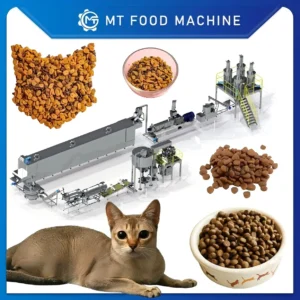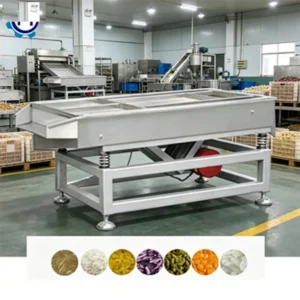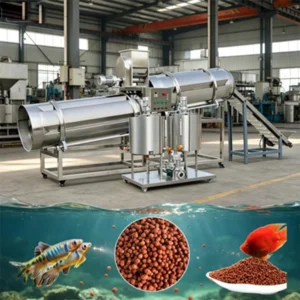
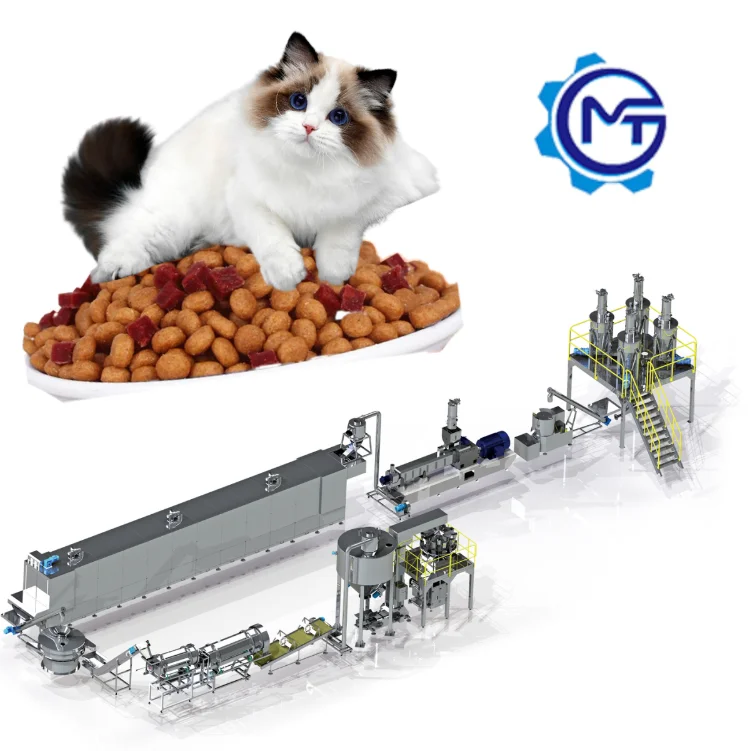
Screw geometry matched to recipe — The MT70 twin-screw pet food extrusion line specifies screw element arrangement and L:D ratio against the buyer’s actual formulation, not a generic build sheet.
Technical Specifications
| Parameter | Value |
|---|---|
| Model | MT70 |
| Product Type | Twin-Screw Pet Food Extrusion Line |
| Output Capacity | 200-250 kg/h (basis not stated in source — confirm raw material formulation, moisture content and kibble size) |
| Rated Power | 45 kW |
| Voltage & Frequency | 380V 50Hz Three Phase |
| Control System | PLC and MCC automated line control |
| Line Stations | Mixing → Extrusion → Drying → Packaging |
| Recipe Adaptability | Dry kibble, semi-moist pet food, pet treats |
| Contact Materials | Food-grade construction |
| Assembly State | Complete production line configuration |
| Standards | CE, ISO (verify certificate validity and scope) |
Application Suitability
| Application | Material or Output |
|---|---|
| Dry kibble production for dogs and cats | Corn, meat meal, fish meal, vitamin premix blends |
| Semi-moist pet food manufacturing | High-moisture protein formulations with humectants |
| Pet treat extrusion | Starch-protein mixes shaped through interchangeable dies |
| Multi-formula changeover | Recipe parameter storage for repeatable batch output |
Why Nominal Capacity Misses the Real Picture on Pet Food Lines
Actual throughput depends on the starch-to-protein ratio in your formulation, not just the barrel diameter.
A twin-screw pet food extrusion technology specifications sheet often quotes output based on a standard cereal-heavy recipe. When a buyer runs a high-protein, grain-free kibble formulation, the dough viscosity changes inside the barrel. Shear behaviour shifts, expansion drops, and the extruder cannot push the same mass through the die plate per hour. I have watched a line rated for a given hourly figure fall noticeably short once the customer’s actual meat meal percentage went into the hopper. The gap between brochure numbers and production reality is where most pet food extrusion disputes start [NEED_CITE: extrusion throughput variance with high-protein formulations].
Barrel Temperature Profiling and Starch Gelatinisation
The MT70 barrel is divided into multiple independently controlled heating zones. Each zone governs a different stage of the extrusion process — preconditioning, melting, cooking and metering. For dry kibble, achieving the correct degree of starch gelatinisation requires a specific temperature ramp from the feed section to the die plate. If the profile is too flat, the kibble exits undercooked and crumbles during drying. If the rear zones run too hot, the protein matrix denatures prematurely and the piece loses structural integrity. Precise thermal management across these zones is what separates a kibble that holds its shape in the bag from one that generates excessive fines at the bottom.
Screw Element Arrangement and Shear Control
Twin-screw extrusion technology specifications for pet food must address screw configuration in detail. The MT70 screw shaft accepts modular elements — conveying, kneading and reverse-flight sections — arranged in a sequence determined by the target formulation. A high-fat recipe needs a different kneading block layout than a lean, high-fibre diet. The arrangement controls residence time, shear intensity and the degree of mechanical energy input. Getting this wrong means the extruder either over-works the dough, destroying heat-sensitive vitamins, or under-processes it, leaving raw starch pockets that compromise digestibility [NEED_CITE: screw configuration impact on nutrient retention in pet food extrusion].
Reading the Specs That Actually Matter
The 45 kW main drive motor sets the mechanical energy ceiling available for shearing and cooking the dough inside the barrel. On a twin-screw pet food extrusion technology specifications sheet, this figure should be evaluated against the formulation’s viscosity range — high-protein, low-starch recipes demand more torque at the screw shaft than standard corn-based kibbles. The PLC control system stores process parameters per recipe, meaning moisture injection rates, screw speed and barrel zone temperatures are recalled rather than manually re-entered at each changeover. This repeatability matters when a producer runs three different kibble formats across a week. The 380V 50Hz three-phase electrical supply must match the buyer’s facility before the control cabinet is wired; reconfiguring a PLC and MCC panel after arrival adds commissioning delays that no production schedule absorbs easily.
What Happens When Extruder and Dryer Are Mismatched
An extruder running at its actual throughput pushes wet, expanded kibble into the dryer. If the dryer was sized for the nominal capacity figure rather than the real one, moisture removal falls behind. Kibble enters the packaging station above the safe moisture threshold, and shelf life shortens without visible warning. I have seen producers blame the extruder for inconsistent kibble quality when the bottleneck was actually a dryer that could not keep pace. Line station matching — extruder output, dryer residence time, cooler capacity — must be calculated as a single system, not assembled from independent vendor quotes [NEED_CITE: line throughput balancing in pet food processing].
Why Procurement Here Reduces Configuration Risk
The screw and die configuration for the MT70 is specified against the buyer’s raw material sample, not selected from a standard catalogue. An in-house testing workshop runs trial extrusion on the customer’s actual formulation before the line ships, confirming kibble density, texture and expansion behaviour. Line layout and capacity calculation documents show throughput matching across every station from batching through packaging, so no single unit bottlenecks the system. Electrical schematics and voltage confirmation are completed during the order stage, with control panel language set to the operator’s requirement. These steps address the configuration errors that typically surface only after installation.
Documentation & Verification
- Screw and die configuration record matched to your kibble formulation and target density
- Trial run report on your raw material confirming expansion ratio and piece weight before dispatch
- Line layout drawing with throughput calculation across mixing, extrusion, drying and packaging stations
- Electrical schematic with voltage, frequency and PLC control language confirmed to your facility
- CE declaration of conformity and ISO certificate for customs and regulatory submission
- Operation and maintenance manual with wear parts list specific to your screw configuration
Installation, Commissioning & Support
- Foundation plan provided based on the MT70 line footprint and 45 kW drive vibration requirements
- Dedicated three-phase 380V 50Hz circuit specified for the main extruder motor and heating zones
- Line arrives in modular station sections for sequential assembly from mixer through packaging unit
- First-run commissioning includes barrel temperature calibration and screw speed tuning on your recipe
- Operator training covers PLC recipe recall, moisture adjustment and die plate changeover procedures
- Wear parts list identifies screw elements, die plates and cutter blades with reorder intervals
What We Need to Size Your Line Correctly
To configure the MT70 for your production target, share your kibble formulation including protein, starch and fat percentages, along with the target piece size and bulk density. Confirm your facility’s available voltage, frequency and whether the control interface should run in a specific language. If you are integrating this extrusion line with existing upstream mixing or downstream packaging equipment, provide the connection point specifications so station throughput can be balanced from the start.
Frequently Asked Questions
Q: How is screw configuration determined for my specific pet food recipe and what documentation do I receive?
A: The screw element sequence is selected after reviewing your formulation’s protein, starch and fat ratios. A trial run on your raw material in the testing workshop validates the configuration before shipment. You receive a documented screw and die configuration record showing the element arrangement, die orifice pattern and the formulation each was designed for.
Q: Can I run a trial with my own raw material before the line ships, and what parameters are tested?
A: Yes. The in-house testing workshop processes your actual raw material through the configured extruder. Parameters tested include kibble expansion ratio, piece density, texture firmness and output rate. Results are compiled into a trial run report so you can confirm product quality before the line leaves the factory.
Q: How do barrel temperature zones and moisture injection affect kibble expansion and final density?
A: Each barrel zone controls a different stage of dough cooking. The temperature ramp combined with moisture injection determines the degree of starch gelatinisation, which directly governs how much the kibble expands at the die exit. Higher expansion yields lighter, more porous pieces; lower expansion produces denser kibble with higher caloric density per volume.
Q: What is the changeover procedure between dry kibble, semi-moist and treat production on the same extruder?
A: The PLC stores separate recipe profiles for each product format. Changeover involves recalling the correct recipe, adjusting the die plate if the piece shape differs, and confirming moisture and barrel zone settings. Documented changeover procedures specify the sequence so operators maintain batch-to-batch consistency without trial-and-error adjustments.