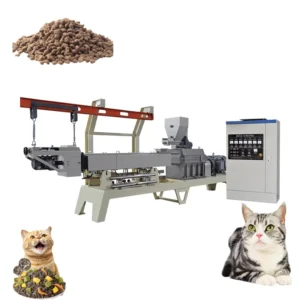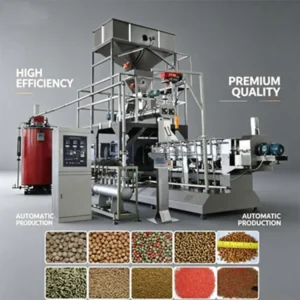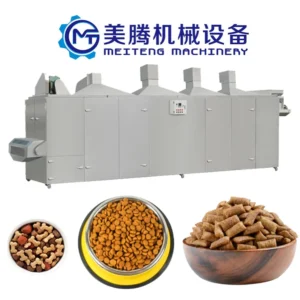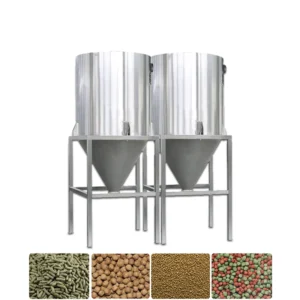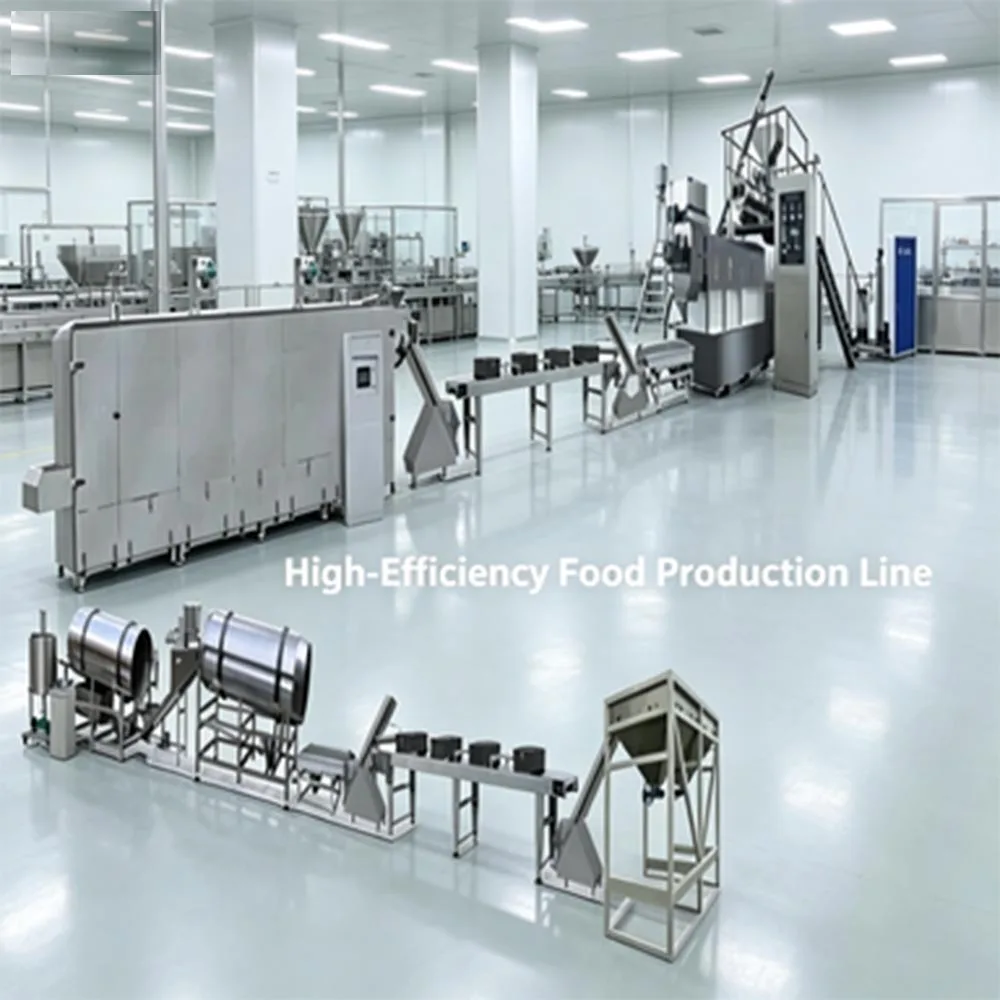
Application-Specific Screw Profiling — We configure screw elements and barrel zones to match the buyer’s ornamental or aquaculture formulation, not a generic build, ensuring target buoyancy before the extruder ships.
Technical Specifications
| Parameter | Value |
|---|---|
| Product Type | Twin Screw Floating Fish Feed Extrusion Production Line |
| Output Capacity | 500 kg/h (basis not stated in source — confirm raw material formulation / moisture / pellet size) |
| Screw Type | Twin Screw |
| Pellet Size Range | 0.5 mm – 12 mm |
| Control System | Simple control panel (PLC / MCC available on request) |
| Main Structure Material | Stainless Steel (food-grade contact zones) |
| Line Stations Integrated | Feeding, Mixing, Extruding, Pelletizing |
| Automation Level | Fully Automatic |
| Voltage & Frequency | Configurable (to be confirmed before commissioning) |
Application Suitability
| Application | Material or Output |
|---|---|
| Ornamental fish feed | Goldfish and koi pellets requiring stable buoyancy and precise colour retention |
| Aquaculture operations | Small to medium-scale production of floating pellets for various freshwater species |
| Multi-stage feed production | Diversified pellet specifications (0.5 mm – 12 mm) across fish growth stages on a single line |
Why "500 kg/h" Means Nothing Without the Formulation
Capacity is a function of your raw material behaviour, not a fixed machine attribute.
Many aquatic feed processors receive quotations based on trials run with standard corn starch, only to discover during commissioning that their high-protein ornamental mix behaves entirely differently under shear. The starch gelatinisation window shifts, expansion collapses, and half the pellets sink. We verify throughput against the buyer’s actual formulation and target pellet density before finalising the screw configuration [NEED_CITE: starch gelatinisation behaviour in high-protein aquatic feed formulations].
How Twin-Screw Configuration Controls Floatability
The twin screw extruder for aquatic feed relies on intermeshing screw elements to generate uniform shear and controlled residence time. For floating pellets, the configuration must balance starch gelatinisation with expansion at the die face. Forward-conveying elements establish throughput, while kneading blocks introduce the shear necessary to disrupt starch granules at the correct barrel zone temperature.
Barrel Temperature Profiling and Steam Injection
Each barrel zone operates under independent thermal control, typically progressing from preconditioning temperatures near the feed port through peak gelatinisation zones and a slight cooling step before the die. Steam or water injection at specific ports adjusts dough moisture content in real time. This profile must be matched to the formulation’s starch-to-protein ratio; a koi feed with 40% protein requires a different thermal curve than a standard carp feed [NEED_CITE: barrel temperature profiling for varying protein-to-starch ratios in aquafeed].
Pellet Size, Die Geometry, and Cutter Speed
The 0.5 mm to 12 mm pellet range is achieved by swapping die plates and adjusting the face cutter rotational speed. Smaller diameters demand higher die pressure and tighter moisture control to prevent die clogging, while larger pellets require sufficient expansion to maintain buoyancy without structural collapse. The die orifice length-to-diameter ratio directly influences the pressure drop at the exit, which governs final pellet density.
The Hidden Cost of Generic Screw Builds
A screw configuration copied from a reference build without adjustment for the buyer’s raw material leads to inconsistent expansion, off-spec density, and frequent die blockages. Processors then spend weeks re-profiling barrel zones on site, losing production time and raw material. The fix is specifying the screw and die record to the actual formulation before production [NEED_CITE: impact of generic screw configurations on aquafeed pellet density consistency].
Why Procurement Here Reduces Commissioning Risk
Our in-house testing workshop runs trial production on the buyer’s raw material before shipment, generating a trial run report that documents actual pellet buoyancy, density, and expansion ratio. Screw configuration and die design are specified to the target product rather than selected from a generic catalogue. Line layout calculations match throughput across feeding, mixing, extruding, and pelletizing stations to prevent bottlenecks. Electrical schematics confirm voltage and frequency alignment with the destination market before assembly begins.
Documentation & Verification
- Line layout and capacity calculation matched to your formulation and target pellet size
- Screw and die configuration record specific to your raw material and buoyancy requirement
- Trial run report documenting pellet density, expansion, and floatability on your material before dispatch
- Electrical schematic confirming voltage, frequency, and control language for your facility
Installation, Commissioning & Support
- Foundation and utility requirements specified based on the integrated line footprint and total connected load
- Voltage and frequency confirmed against your site supply before electrical panel fabrication begins
- Barrel zones and steam injection calibrated to your formulation during on-site commissioning
- Operator training covers die changeover procedures across the 0.5 mm – 12 mm pellet range
- Wear parts list identifies screw elements, die plates, and cutter blades for first replacement ordering
What We Need to Specify Your Line Correctly
To move from general inquiry to a line configuration proposal, we need the target fish species and life stage, the raw material formulation including protein and starch percentages, the required pellet diameter range, and your site voltage and frequency. If buoyancy stability is critical for ornamental applications, we also need the target water temperature range and expected immersion time before consumption.
Frequently Asked Questions
Q: How is floatability controlled through screw configuration and barrel temperature?
A: Floatability depends on achieving complete starch gelatinisation while trapping steam within the pellet matrix at the die face. The screw configuration establishes shear intensity and residence time in each barrel zone, while the temperature profile ensures the dough reaches gelatinisation temperature at the correct moisture level. Die geometry then controls the pressure drop that governs final expansion and density.
Q: How is the 500 kg/h capacity verified against my raw material?
A: We run a trial in our testing workshop using your actual formulation or a close proxy, measuring throughput at stable running conditions with target pellet density and buoyancy. The trial report documents the achieved output, moisture content, and expansion ratio, forming the basis for the final line specification.
Q: What screw and die setup is recommended for my target pellet size and species?
A: The screw element arrangement and die orifice dimensions are selected based on your formulation’s rheological behaviour and the target pellet diameter. Smaller ornamental pellets require tighter moisture control and higher die pressure, while larger aquaculture pellets prioritise expansion uniformity. We confirm the configuration during the pre-shipment trial.
Q: Can the line run a trial on my material before shipment?
A: Yes. We conduct trial runs in our testing workshop using the buyer’s raw material or a representative formulation. The trial produces a documented report covering pellet density, buoyancy behaviour, expansion ratio, and achievable throughput, which is shared before the line is crated for dispatch.
Q: How are barrel zones and steam injection set up for aquatic feed starch gelatinisation?
A: Each barrel zone has independent heating and cooling control, typically progressing from preconditioning near the feed port through peak gelatinisation zones before a controlled cooling step near the die. Steam or water injection points are positioned to adjust dough moisture at the stages where starch disruption requires specific hydration levels.