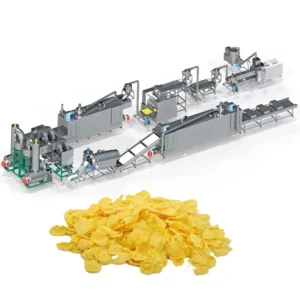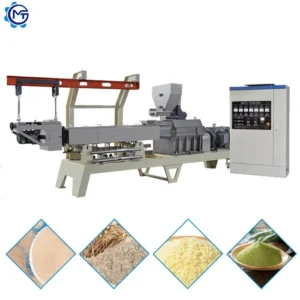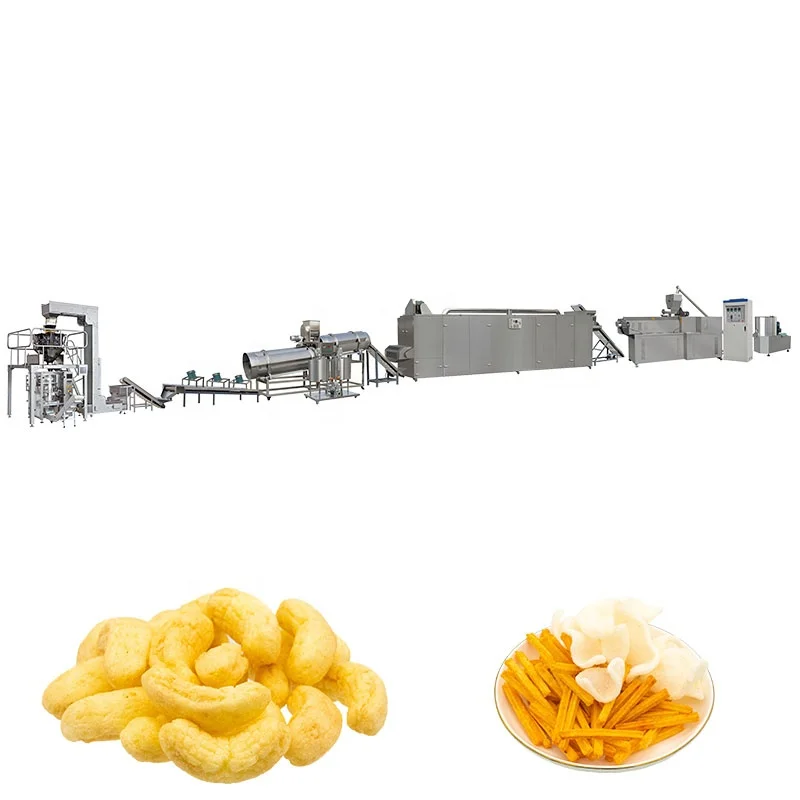
Extrusion Geometry Matched to Raw Material — Screw configuration and die geometry are engineered against your cereal blend and moisture target, not copied from a generic build.
Technical Specifications
| Parameter | Value |
|---|---|
| Model | MT70 / MT85 / MT75 |
| Product Type | Corn Flakes Extrusion Production Line |
| Screw Type | Twin-screw |
| MT70 Installed Power | 160 kW |
| MT70 Power Consumption | 120 kW |
| MT70 Output Capacity | 150–200 kg/h (basis not stated in source — confirm raw material type and moisture content) |
| MT70 Overall Dimensions | 41 × 1.5 × 2.2 m |
| MT85 Installed Power | 190 kW |
| MT85 Power Consumption | 140 kW |
| MT85 Output Capacity | 300–400 kg/h (basis not stated in source — confirm raw material type and moisture content) |
| MT85 Overall Dimensions | 43 × 1.5 × 3.2 m |
| MT75 Installed Power | 210 kW |
| MT75 Power Consumption | 150 kW |
| MT75 Output Capacity | 300–500 kg/h (basis not stated in source — confirm raw material type and moisture content) |
| MT75 Overall Dimensions | 45 × 1.5 × 3.5 m |
| Control System | PLC with MCC integration |
| Heating Source (Dryer) | Gas or Electric |
| Flaking Machinery Drive | Double motors with separate roller driving; hydraulic system |
| Temperature Control (Flaking) | Infrared sensor-controlled temperature pipe |
| Hot Air Roasting Oven | Vibrating pan, dual circulating fans, cyclone dust removal, conciliation burner chamber |
| Coating System | Double tumble sugar melting, elevator, coating drum, spraying nozzle |
| Certifications | CE, ISO |
Application Suitability
| Application | Material or Output |
|---|---|
| Natural corn flakes | Corn grits, corn flour, blended cereal grains |
| Sugar-coated corn flakes | Extruded corn pellets with sugar or syrup coating |
| Multi-shape breakfast cereals | Rice, wheat, oat, and barley powder blends formed as balls, tubes, rings, stars, fruit loops |
| Fortified breakfast cereals | Cereal base with nutritional additives retained through controlled extrusion and roasting |
What the Rated Capacity Figure Leaves Out About Your Cereal Blend
A throughput number means nothing until it is validated against your exact grain formulation and incoming moisture content.
Every corn flakes extrusion production line specifications sheet carries a capacity figure, but that figure is tied to a specific raw material profile. I once watched a line run flawlessly on standard corn grits in the factory, only to see it struggle when the buyer switched to a locally sourced corn variety with different starch characteristics. The gelatinisation temperature shifted, the flakes came out dense instead of blistered, and the roaster could not compensate. The extruder was not at fault — the screw profile had simply been configured for a different material. That is why the corn flakes extrusion production line specifications you compare must include a screw and die record matched to your grain, not a default setup [NEED_CITE: starch gelatinisation behaviour across corn varieties].
How Screw Geometry Controls Flake Blister Formation
Blister development on a corn flake surface starts inside the extruder barrel. The twin-screw configuration allows precise control over shear rate and residence time, which directly governs how thoroughly starch granules gelatinise before the material exits the die. When corn flakes extrusion production line specifications list screw type without detailing the element arrangement, you are missing the single most important variable for final texture. A forward-conveying screw profile yields lower shear and less expansion, suitable for dense flakes. Introducing kneading blocks at specific intervals increases mechanical energy input and creates the micro-void structure that becomes visible blisters during hot air roasting.
Barrel Temperature Profiling and Moisture Shear Balance
Temperature in a twin-screw extruder is not set to a single value. The barrel is divided into zones, each independently heated and cooled, creating a gradient that moves the material through distinct phases — hydration, gelatinisation, and controlled expansion. The moisture content entering the preconditioner interacts with barrel heat to determine how much mechanical energy the screws must supply. If incoming corn moisture fluctuates beyond a narrow range, the entire thermal balance shifts. PLC control across the corn flakes extrusion production line specifications allows real-time adjustment of barrel zone temperatures and screw speed to compensate, maintaining consistent dough rheology at the die face [NEED_CITE: barrel zone temperature profiling in twin-screw food extrusion].
Reading the Specification Sheet Beyond Installed Power
Installed power tells you the electrical capacity of the line, but power consumption reveals what the extruder actually draws during steady-state production. The MT70 draws 120 kW against a 160 kW installed base, leaving headroom for start-up surges and formulation changes. The MT75 consumes 150 kW from a 210 kW installation, indicating a heavier mechanical load across its larger screw diameter and longer barrel. This difference matters when planning your facility’s transformer capacity and dedicated circuit breakers. The flaking machinery uses a separate double-motor drive with hydraulic roller pressure, meaning its power draw is independent of the extruder and must be accounted for in your utility plan. The hot air roasting oven relies on dual circulating fans and a conciliation burner chamber, so gas or electric heating choice will significantly alter your total connected load.
The Cost of Generic Screw and Die Configuration
When an extruder ships with a screw profile copied from a standard build rather than matched to your cereal blend, the problems surface after installation. Flake density drifts outside the range your market expects — either too hard for the consumer bite or too fragile to survive packaging and transport. The roaster cannot correct what the extruder failed to deliver. Production slows as operators adjust parameters endlessly, and throughput never reaches the line’s rated capacity on your material [NEED_CITE: impact of screw configuration on extruded cereal density].
Why Buyers Source This Extrusion Line Here
Screw configuration and die design are documented against your specific raw material and target flake texture before production begins. The in-house testing workshop runs trial production on your actual corn blend, generating a trial run report that confirms capacity and flake quality prior to shipment. Every station — mixing, extruding, flaking, drying, roasting, coating, cooling, and packing — is supplied as a matched system, so throughput is balanced across the entire line rather than bottlenecked at the flaker or roaster. PLC and MCC control are integrated across all stations with language configurable to your operator requirements. Pre-sales consultation includes line layout and capacity calculation tailored to your facility footprint and utility conditions.
Documentation & Verification
- Line layout drawing showing throughput matching across extruder, flaker, dryer, and roaster stations
- Screw and die configuration record matched to your corn formulation and target flake density
- Trial run report generated on your raw material in the testing workshop before shipment
- Electrical schematic with voltage, frequency, and PLC language confirmed before production
- CE declaration of conformity and ISO certificate for customs and regulatory clearance
- Operation and maintenance manual covering extruder, flaking machinery, and roasting oven
Installation, Commissioning & Support
- Foundation plan based on line dimensions up to 45 m length for the MT75 configuration
- Dedicated electrical circuit sized to the model’s installed power ranging from 160 kW to 210 kW
- On-site assembly and alignment of hydraulic double-roller flaking machinery and infrared temperature sensors
- First-run parameter setting including barrel zone temperatures, screw speed, and roller pressure calibration
- Operator training covering PLC interface, die changeover for shape switching, and daily screw inspection
- Wear parts list with replacement intervals for screws, dies, and flaking roller surfaces
What to Prepare Before Requesting a Quotation
To configure a line that holds its rated output on your actual material, share your corn or cereal blend composition including particle size distribution and incoming moisture percentage. Specify your target flake dimensions, blister density expectation, and whether you require natural or sugar-coated output. Provide your facility’s available floor length and ceiling height, along with local voltage and frequency standards so the electrical system can be confirmed before production begins.
Frequently Asked Questions
Q: How can I confirm the stated capacity matches my raw material?
A: The capacity figures in corn flakes extrusion production line specifications are based on reference conditions that may differ from your grain blend and moisture content. A trial run using your actual raw material is conducted in the testing workshop before shipment. This generates a report documenting achievable throughput, flake density, and blister formation specific to your formulation, giving you verified numbers rather than generic estimates.
Q: How are screw configuration and die design matched to my cereal type?
A: The screw element arrangement and die geometry are selected based on your raw material’s starch composition, particle size, and target flake texture. Kneading block placement, compression ratio, and die aperture are all adjusted to control gelatinisation degree and expansion rate. A configuration record is provided documenting every parameter so replacements can be ordered with exact specifications.
Q: What voltage and control options are available for my market?
A: Voltage and frequency are confirmed during the specification stage to match your local electrical grid standards. The PLC control system supports multiple language options for the operator interface, and the MCC panel is configured with appropriate circuit protection for your region’s requirements. All electrical documentation is provided in your preferred language before commissioning.
Q: How is throughput balanced across the entire production line?
A: Each station — extruder, flaking machinery, dryer, hot air roasting oven, and coating system — is sized so that none becomes a bottleneck. The line layout and capacity calculation document shows the throughput rating at every station based on your product type, ensuring the flaker can handle extruder output and the roaster can process the full drying throughput without material backlog.
Q: What does the pre-shipment trial run actually test?
A: The trial run processes your supplied raw material through the extruder, flaker, and roasting oven at the testing workshop. It measures output rate, flake thickness uniformity, blister development, and crispness after roasting. The trial run report documents all processing parameters including barrel temperatures, screw speed, roller pressure, and roasting time so your team can replicate results during on-site commissioning.