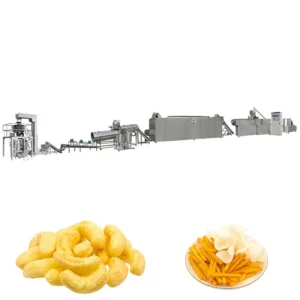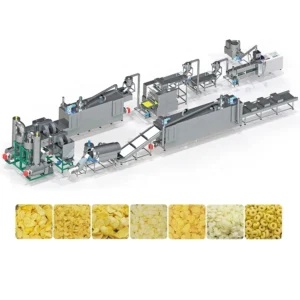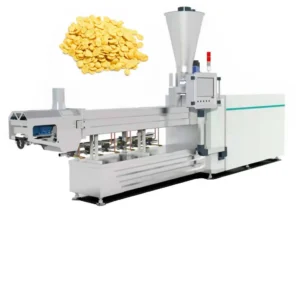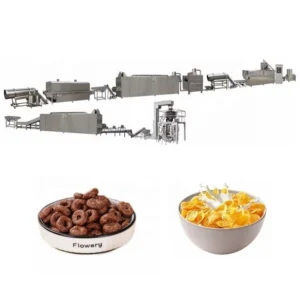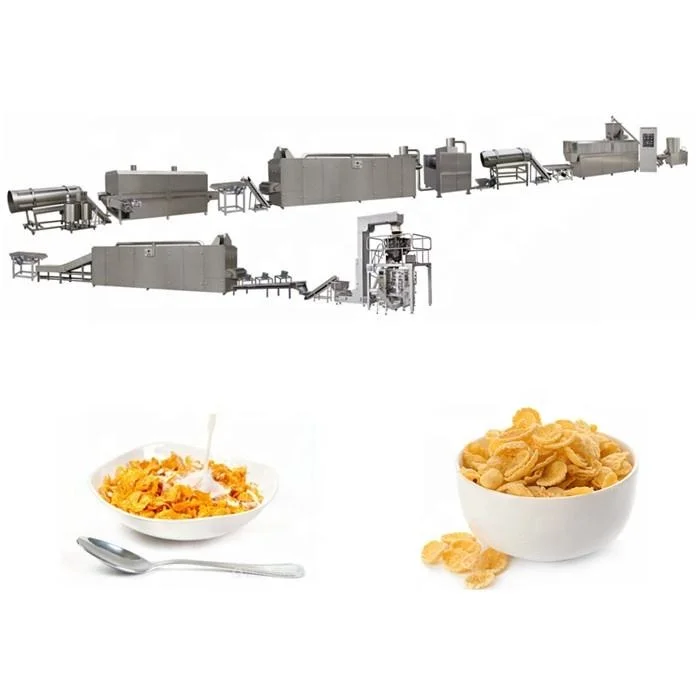
Extrusion-Focused Engineering — screw configuration, barrel temperature profile, and die geometry are specified to your cereal formulation, ensuring consistent starch gelatinisation and expansion across every production run rather than relying on generic builds.
Technical Specifications
| Parameter | Value |
|---|---|
| Model | MT70 / MT85 / MT75 |
| Product Type | Corn Flakes Production Line |
| Screw Type | Twin-screw |
| Installed Power | MT70: 160 kW; MT85: 190 kW; MT75: 210 kW |
| Power Consumption | MT70: 120 kW; MT85: 140 kW; MT75: 150 kW |
| Output Capacity | MT70: 150–200 kg/h (basis not stated in source); MT85: 300–400 kg/h (basis not stated in source); MT75: 300–500 kg/h (basis not stated in source) |
| Overall Dimensions | MT70: 41 × 1.5 × 2.2 m; MT85: 43 × 1.5 × 3.2 m; MT75: 45 × 1.5 × 3.5 m |
| Control System | PLC control (flaking machinery); MCC and PLC available across line |
| Flaking Drive | Double motors for separate roller driving; hydraulic system for double rollers |
| Flaking Temperature Control | Infrared sensor for even temperature pipe control |
| Dryer Heating Source | Gas / Electric |
| Hot Air Roasting Oven | Vibrating pan with high temperature spraying tubes; conciliation burner; two separate circulating fans; cyclone dust removal device |
| Coating System | Double tumble for sugar melting; elevator; coating drum; spraying nozzle |
| Die Configuration | Interchangeable moulds for ball, tube, stick, ring, fruit loop, star, wheel, flower, heart shapes |
| Screw Feature | Wear-resistant; automatic lubricating and cooling function |
| Raw Materials | Corn, rice, wheat, oat, barley powder |
| Voltage & Frequency | Customized to customer local voltage (to be confirmed at inquiry) |
| Certification | CE; ISO |
Application Suitability
| Application | Material or Output |
|---|---|
| Natural corn flake production | Corn grits and corn flour blends |
| Sugar-coated breakfast cereal | Corn, rice, and wheat-based formulations with sugar spray coating |
| Multi-grain cereal rings and loops | Oat, barley, and mixed grain powders |
| Fortified breakfast cereals | Grain blends with nutritional pre-mix integration |
| Varied-shape extruded cereals | Ball, tube, stick, ring, fruit loop, star, wheel, flower, heart formats |
Why the Corn Flakes Extrusion Production Line Capacity Claim Is Only Half the Story
Capacity must be verified against your specific flour blend and moisture content before any production commitment is made.
A producer I worked with ordered a twin-screw extruder based on brochure throughput for a standard corn recipe. Their actual formulation included a high-oat ratio that behaved completely differently under shear and heat. The extrudate failed to expand properly at the die, and the entire first batch was scrapped. Only after running their specific blend through a test workshop — adjusting screw element sequencing and moisture conditioning — did the line achieve stable output. A corn flakes extrusion production line rated for a given throughput on one recipe may behave entirely differently on another [NEED_CITE: raw material variability in extrusion capacity verification]. That gap between nameplate capacity and real-world throughput is where most cereal projects stall during commissioning.
How Screw Configuration Controls Flake Expansion
The twin-screw extruder at the heart of this corn flakes extrusion production line relies on modular screw elements that can be sequenced to match your grain formulation. The arrangement of conveying, kneading, and reverse-screw elements determines residence time and shear intensity inside the barrel. For a high-corn recipe, aggressive kneading blocks drive thorough starch gelatinisation, while an oat-heavy blend may require gentler shear to prevent over-working the dough. Automatic lubricating and cooling functions built into the screw assembly maintain thermal stability during extended runs, reducing the risk of barrel hot spots that cause uneven expansion at the die face.
Barrel Temperature Profile and Die Geometry
Each barrel zone operates under a controlled temperature profile that directly governs how starch granules absorb moisture and swell before reaching the die. The die geometry — whether producing ring, ball, or fruit loop shapes — determines the pressure drop and expansion rate as extrudate exits. A corn flakes extrusion production line producing thin, crisp flakes needs a different die land length and orifice diameter than one targeting thick, dense cereal pieces. The interchangeable die moulds on this platform allow format switching without replacing the extruder, but the barrel temperature zones must be recalibrated for each shape to maintain consistent density and surface blistering [NEED_CITE: die geometry impact on extrudate expansion and density].
Spec Interpretation: Power, Flaking, and Roasting in Practice
The installed power range across the three models reflects the mechanical work needed to drive twin screws through viscous cereal dough at sustained throughput. Higher installed power supports the shear energy required for dense multi-grain formulations. The flaking machinery uses hydraulic double rollers with independent motor drives, allowing precise gap adjustment that controls flake thickness — a parameter that directly affects final crispness after roasting. Infrared temperature regulation on the flaking rolls ensures the dough sheet enters the rollers at a consistent temperature, preventing uneven compression. The hot air roasting oven employs a conciliation burner with dual circulating fans and a cyclone dust removal device, delivering uniform surface blistering that defines the characteristic corn flake texture. These three subsystems — extrusion power, flaking precision, and roasting uniformity — must be matched; an undersized roaster bottlenecking a high-capacity extruder is a common imbalance that degrades product consistency.
The Hidden Cost of Generic Screw and Die Builds
A screw configuration copied from a generic cereal template often produces extrudate with the wrong density for the target market. If the kneading block sequence is too aggressive for a barley-based formulation, the starch over-gelatinises and the flakes emerge tough rather than crisp. A die with incorrect land length causes uneven expansion, leading to flakes that fracture during the roasting stage. These defects do not appear during a dry factory run — they surface only when your specific raw material meets the production environment [NEED_CITE: extrusion screw configuration matching to raw material formulation]. By then, the line is already installed, and re-engineering the screw profile on-site costs both time and material.
Why Procurement Should Center on Extrusion Engineering
Every corn flakes extrusion production line from this facility is configured around the buyer’s raw material and target product rather than assembled from a fixed catalogue. The screw element sequence and die specification are documented and matched to your formulation before production begins. An in-house testing workshop allows trial runs on your actual grain blend, so expansion behaviour and flake density are validated before the line ships. The complete line — from batching through extrusion, flaking, drying, roasting, coating, and packing — is supplied under one supplier, ensuring throughput is balanced across every station. Pre-sales engineering consultation covers layout design, utility planning, and voltage confirmation, and on-site installation is followed by operator training and ongoing wear parts support.
Documentation & Verification
- Line layout and capacity calculation matched to your grain blend and target flake density
- Screw and die configuration record specifying element sequence for your cereal formulation
- Trial run report on your raw material conducted in the testing workshop before dispatch
- Electrical schematic with voltage, frequency, and control language confirmation for your facility
- CE declaration of conformity and ISO certificate for export compliance
Installation, Commissioning & Support
- Foundation planning based on overall line dimensions up to 45 m length with utility routing for gas or electric dryer heating
- Dedicated electrical circuits sized for installed power up to 210 kW with voltage and frequency confirmed before production
- Twin-screw extruder with automatic lubricating system commissioned on-site with barrel zone temperature calibration
- Hydraulic flaking roller gap set and infrared temperature sensor validated against your target flake thickness
- Hot air roasting oven burner and dual circulating fan balancing verified during first production run
- Wear parts list covering screws, dies, and roller surfaces with replacement intervals documented in the operation manual
What to Include in Your Inquiry
To move from inquiry to line configuration, share your target cereal formulation including grain types and ratios, desired moisture content at extrusion, and whether the end product is natural or sugar-coated. Specify your local voltage and frequency, preferred control language for the HMI, and available workshop floor space including ceiling height. If you have existing upstream batching or downstream packing equipment, note the interface requirements so the line can be matched to your current infrastructure.
Frequently Asked Questions
Q: How is output capacity verified against my specific grain blend and moisture level?
A: Before shipment, your raw material is run through the in-house testing workshop where screw configuration, barrel temperature, and moisture conditioning are adjusted until the extrudate achieves target expansion and density. A trial run report documents the verified throughput on your actual formulation, so the capacity figure you receive reflects your recipe rather than a generic benchmark.
Q: How are screw configuration and die geometry selected for different cereal formulations?
A: The screw element sequence — conveying, kneading, and reverse elements — is chosen based on the shear sensitivity and gelatinisation behaviour of your grain blend. Die orifice diameter and land length are matched to the target shape and expansion rate. Corn-heavy recipes typically require different screw profiles than oat or barley-dominant formulations.
Q: What barrel temperature profile is used to control starch gelatinisation and expansion?
A: Each barrel zone is set to a specific temperature that progressively conditions the dough toward the die. The profile is determined during the trial run, accounting for your formulation’s starch content and moisture level. Too low a temperature leaves starch under-gelatinised; too high causes premature expansion and surface defects before the flaking stage.
Q: Can the extrusion platform switch between natural and sugar-coated flake production?
A: Yes. The line configuration includes a sugar coating variant with a double tumble melting system, coating drum, and spraying nozzle, as well as a natural variant that bypasses the coating stations. The extrusion and flaking stages remain the same, so format changeover involves engaging or bypassing the coating and sugar drying sections.
Q: How do I arrange a trial run on my raw material before the line ships?
A: Send a representative sample of your grain blend to the testing workshop. The application engineering team will run it through the extruder with various screw and die configurations, document expansion behaviour and flake density, and share the trial run report before you approve the final build specification for production.