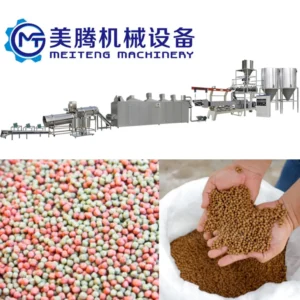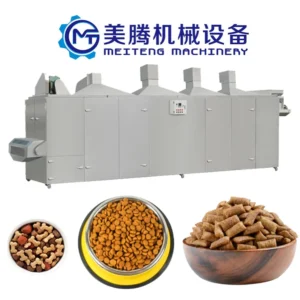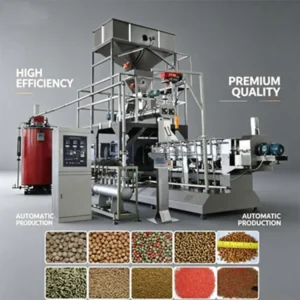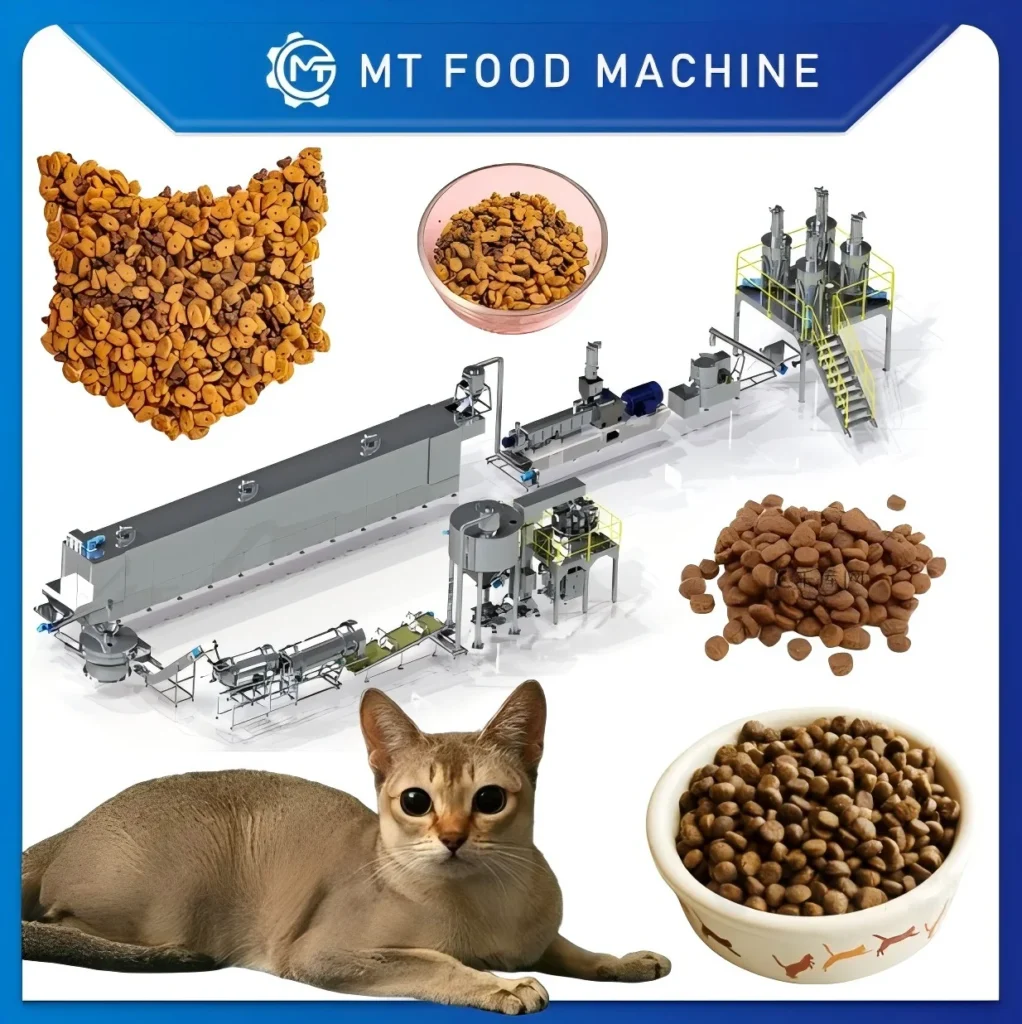
Screw profile matched to formulation — extrusion parameters are developed on the buyer’s actual raw material in our testing workshop before the twin screw extrusion cat food processing line leaves the factory.
Technical Specifications
| Parameter | Value |
|---|---|
| Product Type | Cat Food Extrusion Production Line |
| Extruder Type | Twin-screw |
| Control System | PLC Controlled |
| Automation Level | Full Automation |
| Output Capacity | 100-200 kg/h (basis not stated in source — confirm raw material formulation, moisture content, kibble size) |
| Supported Formats | Dry kibble, semi-moist, treats |
| Target Species | Multi-species (cat and other pets) |
| Line Stations | Batching, extrusion, drying, coating, cooling, packing |
| Energy Design | Energy-saving configuration |
| Interface | User-friendly control interface (language options to be confirmed) |
| Certification | CE, ISO |
Application Suitability
| Application | Material or Output |
|---|---|
| Dry kibble production for cats | High-protein meat meal, poultry by-product, corn, rice blended formulations |
| Semi-moist pet food manufacturing | Higher moisture formulations with humectants and palatant coatings |
| Pet treat extrusion | Dense, low-expansion doughs for dental chews and functional treats |
| Multi-species companion animal feed | Recipe flexibility across cat, dog and small pet formulations on one platform |
What "100–200 kg/h" Really Means on a Cat Food Extruder
Capacity ratings on paper collapse the moment your protein ratio climbs. A twin screw extrusion cat food processing line quoted at a nominal throughput often assumes a standard starch-heavy formulation; when a buyer switches to a premium recipe with elevated meat meal and fat content, expansion drops, die pressure shifts and the extruder can no longer hold its rated output without intervention.
I have stood on a factory floor in the Gulf region watching a line stall at roughly half its quoted capacity because the commissioning recipe was rich in animal protein and the screw profile had been copied from a cereal application. The barrel temperature zones were misaligned for the thermal behaviour of that formulation, and we spent days reconfiguring shear sections and adjusting moisture injection points. [NEED_CITE: raw material formulation impact on extrusion throughput]
Barrel Temperature Zones and Starch Gelatinisation
Cat kibble demands precise control over starch gelatinisation to achieve the crunch and density that feline palatability studies expect. The PLC-controlled barrel on this twin screw extrusion cat food processing line allows independent temperature profiling across multiple heating zones, so the operator can stage gelatinisation progressively rather than shocking the dough with a single heat input. This matters particularly when formulations contain mixed carbohydrate sources — rice flour gelatinises at a different threshold than corn or potato starch, and the automated profile keeps each batch consistent.
Screw Configuration Dictated by Formulation, Not Template
A generic screw build treats every recipe as interchangeable, which works until a buyer introduces a high-fat or high-fibre formulation that demands different compression and shear characteristics. On this line, the screw element sequence — feed sections, kneading blocks, reverse elements and metering zones — is specified against the buyer’s actual ingredient list and target kibble density before production begins. The die geometry is paired to that screw profile so that expansion ratio and final particle weight stay within the band the market expects, rather than drifting outside specification during a production run. [NEED_CITE: screw element configuration for pet food extrusion]
Reading the Specs That Actually Matter
The distinction between single-screw and twin-screw extrusion becomes critical in pet food: single-screw designs handle uniform, low-fat cereal masses efficiently, while the intermeshing counter-rotating action of a twin-screw platform self-cleans and manages the sticky, high-protein, high-fat formulations typical of cat food. Long-diameter ratio — the relationship between screw length and barrel diameter — governs residence time inside the barrel; a longer ratio gives more dwell for complete gelatinisation of complex starch blends but requires careful moisture management to prevent over-cooking. Die aperture and land length together determine the pressure drop at the exit, which directly controls expansion and therefore the final kibble density — too open and the product over-expands into a hollow, brittle piece; too restricted and the extruder surges. The PLC system ties these mechanical variables together: barrel temperature, screw speed, feed rate and moisture injection are all logged per recipe, so a changeover from dry kibble to semi-moist treats is a parameter recall rather than a manual recalibration from scratch.
The Hidden Cost of a Mismatched Line Layout
An extruder that performs perfectly in isolation becomes a liability when the downstream dryer cannot remove moisture fast enough to keep pace, or when the coating drum is undersized for the volume of palatant slurry the recipe requires. [NEED_CITE: throughput bottlenecks in extrusion line design] Bottlenecking at any single station forces the extruder to idle or surge, which introduces density variation across the batch and accelerates wear on screw elements and die plates. We specify throughput across every station — batching, extrusion, drying, coating, cooling and packing — so the rated capacity is a line-level figure, not an extruder-only number that falls apart when the full sequence runs.
Why This Line Is Built Around Your Formulation
Screw configuration and die geometry are documented to your raw material specification, not pulled from a standard library. The in-house testing workshop runs your actual ingredients through the extruder before shipment, generating a trial run report that confirms expansion, density and texture against your target. Line layout and capacity calculation match throughput at every station so no single component bottlenecks the sequence. Electrical schematics, voltage confirmation and control language are finalised against your facility specification before production begins, eliminating on-site commissioning delays. CE and ISO documentation accompanies the line, and an operation and maintenance manual with a wear parts list ensures your team can manage screw and die replacement on schedule.
Documentation & Verification
- Line layout and capacity calculation matching throughput across batching, extrusion, drying, coating and packing stations
- Screw and die configuration record tied to your raw material formulation and target kibble density
- Trial run report generated on your actual ingredients in the testing workshop before dispatch
- Electrical schematic with voltage, frequency and control language confirmed to your facility
- Operation and maintenance manual with wear parts list and replacement intervals
Installation, Commissioning & Support
- Foundation plan sized to the full line footprint including dryer and cooling conveyor length
- Dedicated power circuit specified to the PLC-controlled extruder motor rating and heating zone load
- Modular station delivery with assembly sequence mapped to your workshop access constraints
- On-site commissioning with barrel temperature profile calibration against your production formulation
- Operator training covering recipe recall, screw changeover and die plate replacement procedures
- Wear parts inventory recommendation covering screw elements, die plates and barrel liners
What We Need to Move Forward
To configure the twin screw extrusion cat food processing line accurately, share your target kibble size, ingredient formulation including protein and fat percentages, and daily production volume. Confirm your facility voltage, frequency and preferred control interface language. If you operate existing upstream batching or downstream packing equipment, provide model details so the line layout integrates without modification.
Frequently Asked Questions
Q: How are screw configuration and die design matched to my raw material and target kibble density?
A: We review your full ingredient list — protein sources, starch types, fat levels and fibre content — then select screw element sequences and die aperture dimensions that generate the correct shear, compression and expansion for your target kibble weight and texture. This configuration is documented and provided with the machine.
Q: How is capacity verified on my actual formulation rather than a nominal rating?
A: Before shipment, your raw material runs through the extruder in our testing workshop. The trial produces a report recording throughput, expansion ratio, kibble density and moisture content, so the capacity figure you receive reflects your recipe, not a generic benchmark.
Q: What extrusion parameters control starch gelatinisation, expansion and texture for different pet food formats?
A: Barrel temperature profile, screw speed, moisture injection rate and die geometry collectively determine gelatinisation completeness and expansion behaviour. The PLC system stores these parameters per recipe, enabling consistent changeover between dry kibble, semi-moist and treat formats.
Q: Can I run a trial on my raw material in the testing workshop before the line ships?
A: Yes. We encourage buyers to send their actual formulation for a pre-shipment trial. The resulting report confirms product quality and throughput, and any screw or die adjustments are completed before the machine leaves the workshop.
Q: How do I confirm voltage, frequency and control language match my facility before commissioning?
A: During the specification confirmation stage, we finalise electrical schematics against your facility power supply and confirm the PLC interface language. This documentation is reviewed and approved before production begins, so the line arrives ready to connect.