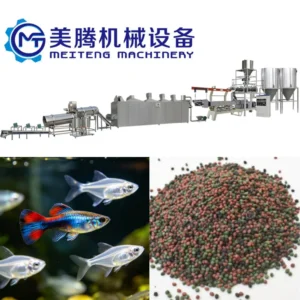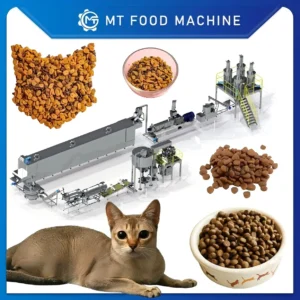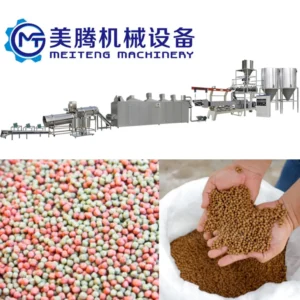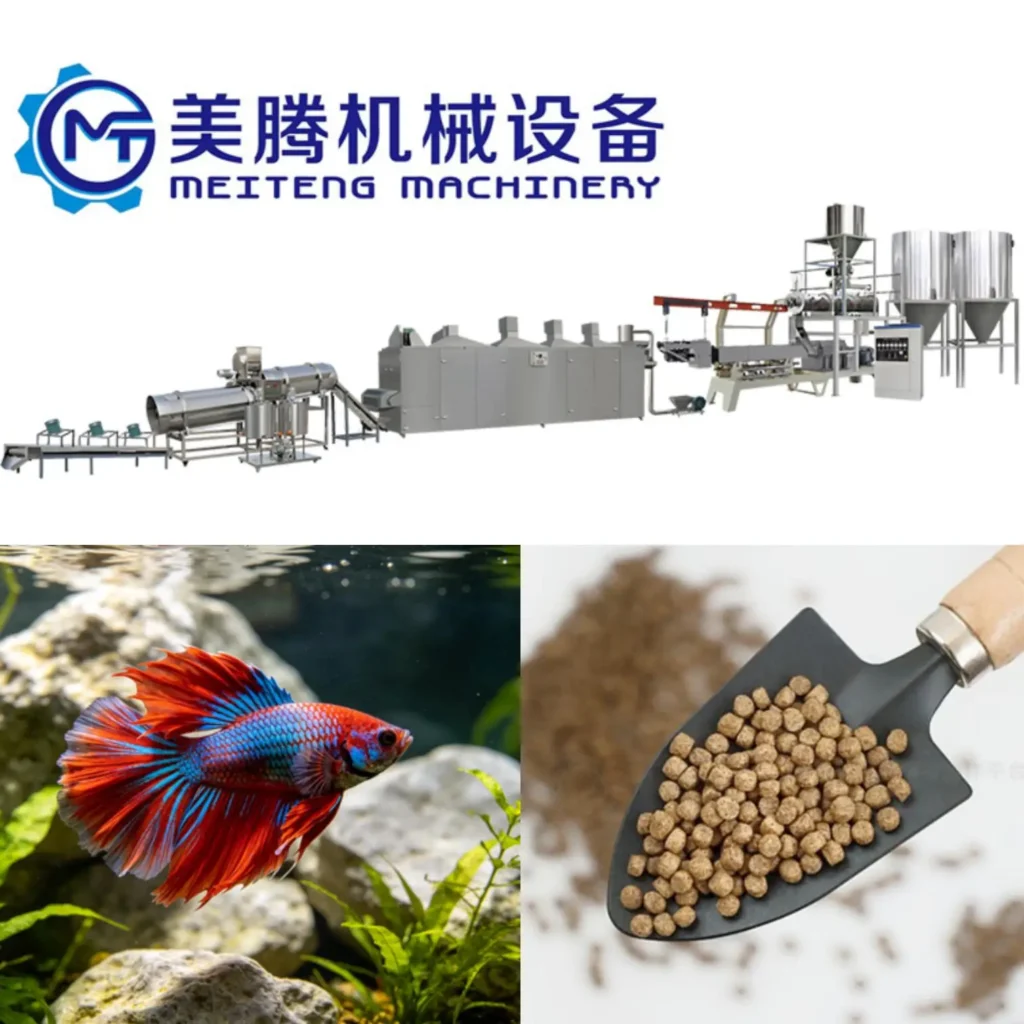
Screw Configuration Matched to Formula — every barrel section and die bore is specified against the buyer’s actual fish meal ratio and target pellet density before metal is cut.
Technical Specifications
| Parameter | Value |
|---|---|
| Product Type | Twin-Screw Fish Feed Extrusion Line |
| Output Capacity | Up to 1.2 t/h (basis not stated in source — confirm raw material formulation, moisture content, pellet size) |
| Screw Type | Twin-screw extruder with configurable elements |
| Construction Material | 304 stainless steel contact parts |
| Control System | PLC or MCC (to be confirmed per installation site) |
| Voltage & Frequency | Configurable to target market (to be confirmed) |
| Certifications | CE; ISO |
| Line Stations | Mixing, extrusion, drying, coating, cooling, packing (scope to be confirmed) |
Application Suitability
| Application | Material or Output |
|---|---|
| Floating trout and salmon pellets | High fish meal and starch formulations requiring controlled expansion |
| Sinking catfish feed pellets | Dense formulations with lower expansion ratios |
| Multi-species aquaculture ration switching | Same line producing both floating and sinking grades via screw and moisture adjustment |
| Aquaculture feed mill scale-up | Continuous production maintaining pellet durability and water stability |
Why "1.2 Tons per Hour" Means Nothing Without the Formula
Capacity is a function of your raw material, not a sticker on the nameplate.
I have watched lines quoted at nominal throughput choke the moment the buyer switched to a higher fish meal percentage. The screw shear was never matched to that formulation, so starch gelatinisation dropped, expansion collapsed, and half the pellets sank when they were supposed to float [NEED_CITE: starch gelatinisation thresholds in aquatic feed extrusion]. A twin-screw fish feed extrusion line technology worth investing in starts with the question: what exactly are you feeding into the hopper?
Barrel Temperature Staging and Gelatinisation Control
Each barrel zone on this twin-screw fish feed extrusion line technology operates under independent heating and cooling, letting the process engineer build a temperature gradient that matches the raw material’s starch and protein behaviour. Early zones hydrate the mix without premature gelatinisation, while later zones apply the shear heat needed for full expansion at the die face. Getting this profile wrong means pellets that look right on the outside but carry a raw, ungelatinised core that dissolves too fast in water.
Die Geometry and the Floating-Sinking Toggle
Die bore diameter, land length, and face pattern govern how much the extrudate expands the instant it leaves the barrel. A shorter land lets steam flash-expand the pellet into a floating grade; a longer land restricts expansion for a dense sinking pellet. The twin-screw fish feed extrusion line technology allows operators to swap die plates between runs rather than replacing entire barrel assemblies, keeping changeover downtime within a single shift [NEED_CITE: die land length effect on extrudate bulk density].
Reading the Parameters That Actually Matter
The L:D ratio determines how long material stays inside the barrel—longer ratios give high-fat, high-fish-meal formulations the residence time they need for complete cooking, while shorter ratios suit starch-heavy mixes that gelatinise quickly. Barrel zone count dictates how finely you can stage temperature; more zones mean tighter control over the transition from hydration to expansion. Motor power must be read against screw speed and configuration: a high-torque, low-RPM setup handles viscous aquatic formulations far better than a high-RPM motor sized for cereal doughs. Moisture range and steam or water injection capability directly influence expansion ratio—too little moisture and the pellet fractures; too much and it collapses after cutting.
The Hidden Cost of Skipping the Trial Run
When a line ships without a trial run on the buyer’s actual formulation, the first week of production becomes an expensive experiment. Screams from the dryer because pellets are too wet, coating drums that cannot keep up, and feed mills rejecting entire batches because water stability falls outside specification [NEED_CITE: pellet durability index standards in aquaculture]. I have seen producers lose an entire production window before the screw combination was reworked to match what was really in the silo.
What We Do Differently on This Line
Every screw element arrangement is documented against the buyer’s raw material sheet before assembly begins. Our in-house testing workshop runs your formulation for multiple shifts to confirm density, throughput, and pellet durability before the line is crated. Electrical schematics are confirmed to your site voltage and frequency so the first power-on does not trip a breaker or fry a VFD. PLC or MCC panels are programmed in the operator’s language, and the control screen labels match the training your team receives on-site.
Documentation & Verification
- Screw and die configuration record listing every element position matched to your fish meal ratio
- Trial run report on your raw material confirming floating and sinking pellet density targets
- Electrical schematic with voltage, frequency, and motor ratings locked to your installation site
- Machine specification sheet documenting barrel zones, L:D ratio, and motor power against the quoted premise
- CE declaration of conformity and ISO certificate for customs and regulatory filing
Installation, Commissioning & Support
- Foundation plan sized to the twin-screw extruder weight and vibration profile for your floor slab
- Dedicated electrical circuit specification matching confirmed voltage and total connected load
- Barrel and screw assembly verification on-site before first material run
- PLC parameter upload and HMI language set to operator preference during commissioning
- Wear parts list covering screws, dies, and cutter blades with reorder lead times noted
- Preventive maintenance schedule tied to barrel liner and screw element inspection intervals
What to Include in Your Inquiry
Send us your raw material formulation with fish meal percentage, starch source, and target moisture content. Specify which pellet diameters you need and whether each is floating or sinking. Confirm your site voltage, frequency, and preferred control language so the electrical package is built right the first time.
Frequently Asked Questions
Q: How is the 1.2 t/h output capacity verified for my formulation?
A: The stated figure is a reference point, not a guarantee. We run your actual raw material in our testing workshop over multiple shifts, measuring throughput at the pellet cutter and adjusting screw speed until we confirm a stable rate. The trial report you receive documents the exact formulation, moisture level, and pellet size that produced that output.
Q: How do you switch between floating and sinking pellets on one extruder?
A: The changeover relies on screw element rearrangement, moisture adjustment, and die plate selection rather than hardware replacement. Floating pellets need higher expansion at the die face, achieved with shorter die lands and specific shear profiles. Sinking pellets use longer die lands and reduced moisture to limit expansion and increase bulk density.
Q: What barrel temperature profile is needed for high fish meal formulations?
A: High fish meal mixes require a gradual temperature ramp across barrel zones to avoid protein denaturation before starch fully gelatinises. Early zones stay moderate to hydrate the blend, while later zones increase heat and shear. The exact profile is determined during the trial run and saved in the PLC recipe for repeat production.
Q: Can the preconditioner handle steam injection for aquatic feed?
A: Steam or water injection capability depends on the line configuration you specify. Preconditioning with steam raises moisture and temperature before material enters the barrel, improving gelatinisation and pellet water stability. We confirm injection requirements during the line design phase based on your target pellet specification.