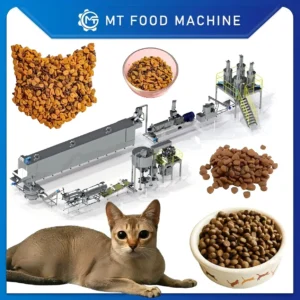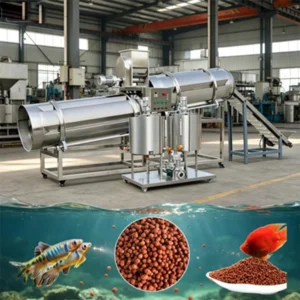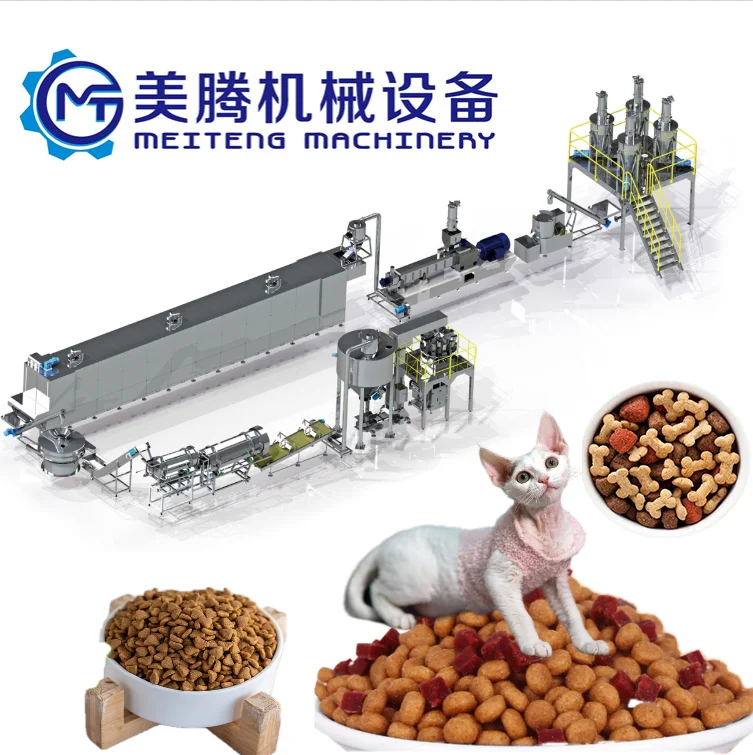
Matched screw geometry — Every barrel section and die orifice on the MT70 is selected against the buyer’s actual protein and starch ratio, verified in the testing workshop before crating.
Technical Specifications
| Parameter | Value |
|---|---|
| Model | MT70 |
| Product Type | Twin-Screw Pet Food Extrusion Line |
| Output Capacity | 100-200 kg/h (basis not stated in source — confirm raw material type, moisture content and kibble size) |
| Screw Configuration | Twin-screw, profile matched to formula |
| Control System | Automated PLC and MCC |
| Voltage & Frequency | 380V 50Hz Three Phase |
| Contact Materials | Food-grade stainless steel throughout product zone |
| Line Integration | Batching, extrusion, drying, packaging |
| Standards | CE, ISO |
Application Suitability
| Application | Material or Output |
|---|---|
| Dry kibble for dogs and cats | Corn, rice, meat meal, poultry by-product blends |
| Semi-moist pet food | High-moisture meat slurry with starch binder |
| Pet treats and bite-size formats | Extruded shapes cut or formed at the die face |
| Aquatic-adjacent companion feed | Fish meal and plant protein concentrates |
Why Nominal Capacity Figures Mislead Pet Food Buyers
The MT70 twin-screw pet food extrusion line specifications are validated on your formula, not a generic starch blend.
Quoted throughput numbers often come from a standard corn or rice test that never touches the buyer’s actual meat-heavy recipe. When a kibble line arrives on site and the real formula runs, expansion collapses, density drifts, and the stated capacity becomes unreachable. Twin-screw pet food extrusion line specifications mean very little if the screw elements and die land length were chosen for a different material behaviour [NEED_CITE: material-specific extrusion throughput variance in pet food production]. I have watched lines sit idle for days while technicians swapped screw flights and reprofiled barrel heaters because the factory test used a convenience formula instead of the customer’s own high-fresh-meat mix.
Barrel Temperature Profiling Across the Feed to Die Transition
The MT70 barrel is divided into independently heated and cooled zones, each managed through the PLC. Starch gelatinisation in a pet food extruder demands a controlled ramp from the feed section through the compression and metering zones. If the first zone runs too hot, premature gelatinisation blocks the screw channel; too cool, and the melt reaches the die under-cooked. The twin-screw pet food extrusion line specifications include the full temperature map so the operator can reproduce the exact thermal curve from trial to production.
Screw Element Sequencing for Kibble Density Control
Forward-flighting elements, kneading blocks, and reverse-flight sections are arranged in a sequence specific to the target kibble. A high-protection dog food with a dense bite needs more shear and a longer residence path than a lightweight puppy kibble designed for rapid expansion. The screw configuration record documents every element position, so replacement sets arrive identical to the validated build [NEED_CITE: screw element arrangement influence on extrudate density].
Reading the Core Parameters Against Your Process Target
The 380V 50Hz three-phase supply drives the main motor at the torque required for viscous meat-starch melts; sites running on 60Hz grids must confirm motor rewinding before production begins. The PLC logs barrel temperatures, screw speed, and feeder rates in real time, giving batch-to-batch traceability that matters when a retailer audits your HACCP records. Food-grade contact materials in the barrel liners and die plate prevent metallic migration into high-fat formulas where oxidation risk is elevated. Twin-screw geometry allows the operator to adjust the L/D working length by repositioning elements, a flexibility that single-screw machines simply cannot offer. The MCC panel separates high-power drives from low-voltage signals, reducing electromagnetic interference on temperature sensors.
The Hidden Cost of an Unmatched Extruder Configuration
A screw build copied from a catalogue recipe produces kibble that either sinks in the bowl or shatters during drying, forcing the producer to run the dryer slower and lose throughput. Dies with the wrong land length generate uneven expansion, and the packing station receives an out-of-spec product that triggers weight check rejects. I have seen producers discard entire shift outputs because the extruder and dryer were never balanced as one system [NEED_CITE: throughput loss from extruder-dryer mismatch in pet food lines]. These losses compound quietly until a customer complaint forces a full line audit.
Reasons Producers Source This Line from Meiteng
Complete line stations from batching through packaging are engineered under one supplier, so conveyor speeds and dryer residence times align with the extruder’s actual output rather than a nameplate figure. The in-house testing workshop runs the buyer’s raw material before shipment, generating a trial report that becomes the commissioning baseline. Screw and die configurations are documented per order, not copied from a generic template. The PLC and MCC architecture is specified to the buyer’s local voltage and control language, reducing on-site wiring disputes. CE and ISO documentation ships with the machine, satisfying import and food-safety audits without delay.
Documentation & Verification
- Screw and die configuration record matched to your kibble formula
- Trial run report on customer raw material before shipment
- Electrical schematic confirming voltage and control language
- Line layout showing throughput balance across every station
- CE declaration and ISO certificate for customs clearance
- Operation manual with wear parts list and replacement intervals
Installation, Commissioning & Support
- Foundation pad leveled to MT70 footprint with anchor bolt template
- Dedicated 380V three-phase circuit with isolated earth for PLC stability
- Barrel heaters and MCC panel wired on site per supplied schematic
- First production run supervised to lock in screw speed and temperature map
- Operator training on PLC alarms, die changes, and screw pull procedures
- Wear parts inventory covering screws, barrel liners, and die plates
What We Need to Configure Your Line
Share the target kibble size, shape, and bulk density along with the full ingredient list and moisture range of your formula. Provide your local voltage, frequency, and preferred HMI language so the electrical package is built correctly the first time. If you have existing upstream mixers or downstream dryers, send their throughput data so the MT70 twin-screw pet food extrusion line specifications can be balanced to the complete system.
Frequently Asked Questions
Q: How is the 100-200 kg/h output capacity verified?
A: Capacity is confirmed during the in-house trial run using your actual raw material, moisture level, and kibble size target. The trial report documents the achievable throughput under those exact conditions, and this figure becomes the baseline for commissioning. Generic starch-based numbers are not used as the contractual output guarantee.
Q: How are screw configuration and die design selected for my formula?
A: The engineering team reviews your ingredient ratios, protein and fat content, and target kibble density. Screw elements are sequenced and die orifices sized accordingly. A configuration record is generated, reviewed with you, and locked before production so replacement sets remain identical.
Q: What barrel temperature profile is applied during extrusion?
A: Each barrel zone is set to a specific temperature that matches the gelatinisation window of your starch source and the melt viscosity of your protein blend. The PLC logs these values continuously, and the trial report captures the validated profile for your operator to reference during routine production.
Q: Can voltage, frequency, and control language be confirmed before build?
A: The electrical schematic and PLC program are specified to your site’s power supply and preferred language during the quotation stage. The MCC panel and motor ratings are then manufactured to that confirmed standard, avoiding costly rewiring or component swaps after delivery.
Q: What does the in-house trial run cover?
A: The trial uses your raw material to produce kibble at the target size and density. Measurements cover expansion ratio, bulk density, moisture after drying, and visual inspection. Results are compiled into a report that guides installation, commissioning, and the first production shifts on your factory floor.