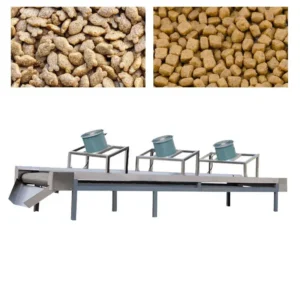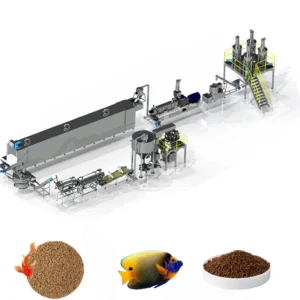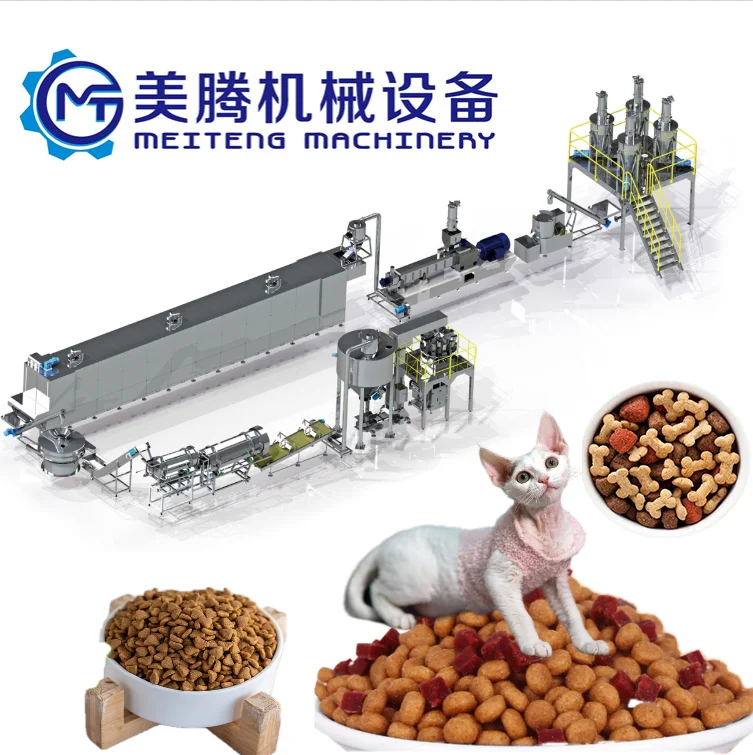
Precision-Engineered Extrusion — The MT70 twin-screw line matches screw configuration and die geometry to your specific raw material blend, ensuring kibble density and expansion meet market expectations from day one.
Technical Specifications
| Parameter | Value |
|---|---|
| Model | MT70 |
| Product Type | Pet Food Extrusion Processing Line |
| Screw Type | Twin-screw |
| Output Capacity | 100-200 kg/h (basis not stated in source — confirm raw material type, moisture content and kibble size) |
| Control System | Fully automated PLC-controlled |
| Voltage & Frequency | 380V 50Hz Three Phase |
| Line Stations | Raw material mixing, extrusion, drying, packaging |
| Recipe Adaptability | Dry kibble, semi-moist pet food, treats |
| Assembly State | Complete production line |
| Material | Food-grade contact materials throughout |
| Customization | Layout and capacity configurable to factory size |
| Standards | CE, ISO |
Application Suitability
| Application | Material or Output |
|---|---|
| Dry Kibble Production | Corn, meat meal, wheat, soy, vitamin premixes |
| Semi-Moist Pet Food | High-protein blends, glycerin, moisture-retaining agents |
| Pet Treat Extrusion | Starch-heavy or meat-based treat formulations |
| Capacity Expansion | Manufacturers scaling from batch to continuous extrusion |
Why Your Kibble Density Fails Market Specs — And How Screw Configuration Fixes It
Density and expansion are determined before the extruder ships, not during commissioning.
When a twin-screw pet food extrusion technology MT70 arrives with a generic screw build, the barrel shear profile rarely aligns with your actual raw material. I have seen lines spend weeks on-site trying to correct uneven expansion or kibble that sinks when it should float, because the L:D ratio and die land length were copied from a different product category [NEED_CITE: twin-screw extrusion parameter interaction with raw material composition]. The configuration must be specified at the engineering stage.
Barrel Temperature Profiling and Moisture-Shear Balance
The twin-screw pet food extrusion technology MT70 allows independent control across barrel zones, which is critical when formulations shift between high-starch and high-protein recipes. Moisture injection combined with shear heat determines the degree of starch gelatinisation, directly affecting both digestibility and the final kibble structure.
Die Geometry and Expansion Control
Die orifice size and land length govern the pressure drop at the barrel exit. A die designed for dense, slow-sinking aquatic feed produces entirely different expansion behaviour than one specified for light, porous dog kibble. The twin-screw pet food extrusion technology MT70 die configuration is selected based on the buyer’s target product specification before manufacturing begins.
Interpreting the Core Process Parameters
The rated output of 100-200 kg/h must be validated against your specific recipe, as moisture content and fat levels significantly influence throughput. The 380V 50Hz three-phase supply requires dedicated circuit capacity and voltage confirmation for your local grid before the electrical schematic is finalised [NEED_CITE: voltage and frequency standards by export market]. PLC control ensures that mixing ratios, barrel temperatures, and dryer residence times remain consistent across production runs, eliminating batch-to-batch variation that manual operation introduces. Food-grade contact materials throughout the product zone meet hygiene standards required for pet food certification in most export markets.
The Cost of Skipping the Trial Run
When an extruder ships without a trial on your declared raw material, the first weeks of production become an expensive development exercise. Screw segments may need replacement, die inventory expanded, and dryer throughput re-balanced — all costs that fall on the buyer after installation [NEED_CITE: cost of post-installation line reconfiguration in food processing]. A pre-shipment trial run eliminates these variables.
Engineering Accountability, Not Just Machine Supply
The line is specified as a complete system from mixing through packaging, so throughput at each station is matched rather than bottlenecked. Screw and die records are documented against your raw material declaration, providing a baseline for future recipe adjustments. The in-house testing workshop conducts trial runs on customer-supplied material before crating, delivering a report with actual expansion and density data. Electrical schematics include confirmed voltage and control language for your target market, preventing commissioning delays. Layout calculations account for your factory footprint and utility connection points.
Documentation & Verification
- Line layout and capacity calculation matching throughput across mixing, extrusion, drying, and packing stations
- Screw and die configuration record specified to your declared raw material blend
- Electrical schematic with confirmed voltage, frequency, and PLC interface language
- Trial run report on customer raw material showing actual expansion and density results
- Factory test record documenting operational parameters before dispatch
- CE declaration of conformity and ISO certificate for market entry compliance
Installation, Commissioning & Support
- Foundation planning based on line layout and station weight distribution
- 380V 50Hz three-phase dedicated circuit with isolator and earth leakage protection
- Modular station delivery allowing phased positioning within existing factory layouts
- PLC parameter upload and recipe configuration during on-site commissioning
- Operator training covering screw wear monitoring and die changeover procedures
- Wear parts inventory list specifying screw segment, die, and cutter part numbers
- Maintenance schedule aligned with production hours and local spare parts availability
Requesting a Line Configuration Proposal
To move from inquiry to a firm quotation with lead time, provide your target kibble format, primary raw material blend with typical moisture content, and required hourly throughput. Confirm your factory’s available voltage and frequency, plus the control interface language for your operators. Specify whether the line must integrate with existing upstream mixing or downstream packing equipment.
Frequently Asked Questions
Q: How is the screw configuration matched to a specific raw material blend and target kibble density?
A: The screw profile is selected based on your declared ingredient ratios and the required degree of starch gelatinisation. Different formulations — high-meat versus high-grain — demand distinct shear and residence time characteristics. The configuration is documented and validated during the pre-shipment trial run on your actual material.
Q: What barrel temperature profile and moisture range support proper gelatinisation on pet food formulas?
A: Barrel zones are typically staged to progressively increase temperature, with moisture injection calibrated to your recipe’s baseline water content. Insufficient moisture limits expansion; excess moisture requires extended drying. The specific profile is established during the trial run and stored in the PLC as a baseline recipe.
Q: Can the MT70 extrusion parameters produce both floating and sinking feed as well as kibble?
A: Yes, provided the die configuration and screw profile are adjusted for each product type. Floating feed requires higher expansion and lower density than sinking feed, which demands different die land lengths and barrel shear settings. Multi-product capability depends on specifying the correct die inventory and screw segments at the order stage.
Q: How does the PLC control system manage process variables across multiple line stations?
A: The PLC coordinates mixing ratios, extruder barrel temperatures, screw speed, dryer temperature and residence time, and coating drum parameters as an integrated system. Recipe changes are stored digitally, allowing operators to recall validated parameter sets rather than manually adjusting each station, which reduces batch variation.
Q: What does the in-house trial run on customer raw material cover, and what data is delivered?
A: The trial run uses your supplied raw material through the complete extrusion, drying, and coating sequence. The delivered report documents actual throughput, expansion ratio, kibble density, starch gelatinisation level, and any screw or die adjustments made during the test, providing a verified production baseline before shipment.