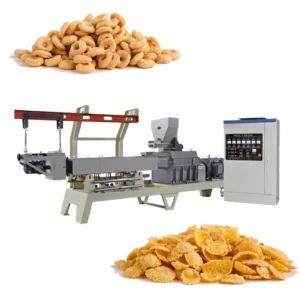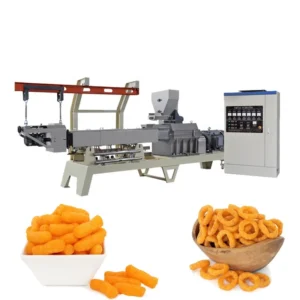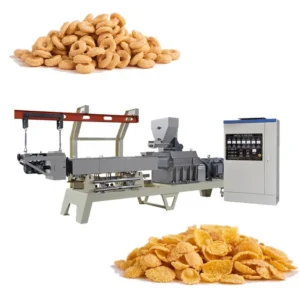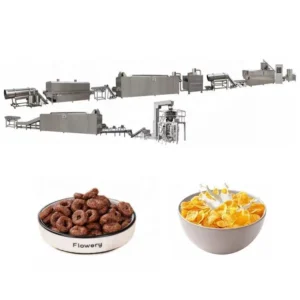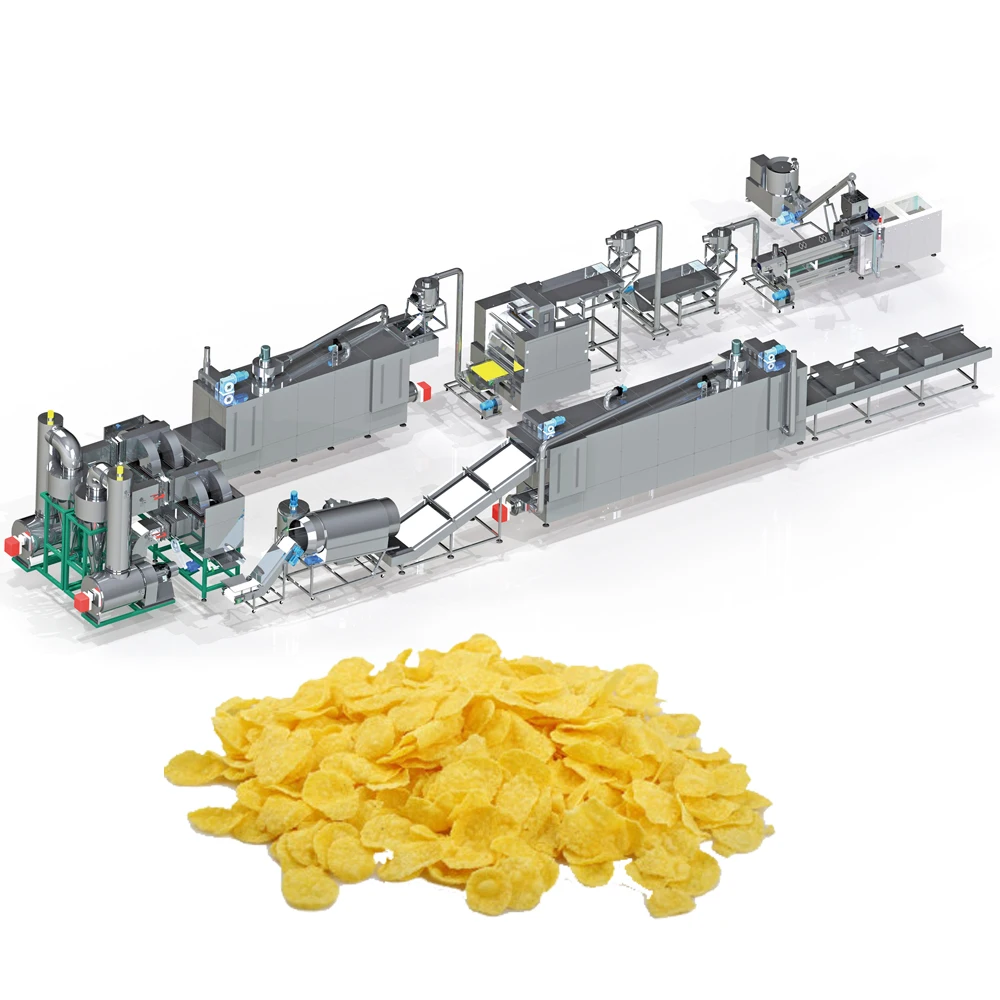
Matched screw and die configuration — Every MT75 build starts with the buyer’s actual cereal powder and target flake density, not a generic screw stack pulled from a previous job.
Technical Specifications
| Parameter | Value |
|---|---|
| Model | MT75 |
| Product Type | Twin Screw Extruder for Corn Flakes Production Line |
| Screw Type | Twin Screw |
| Installed Power | 210 kW |
| Power Consumption | 150 kW |
| Output Capacity | 300–500 kg/h (basis not stated in source — confirm raw material type, moisture content and product format) |
| Overall Dimensions (L×W×H) | 45 × 1.5 × 3.5 m |
| Control System | PLC control (extruder and flaking machinery); MCC and PLC at line level |
| Screw Feature | Automatic lubricating and cooling function; wear-resistant screw treatment |
| Flaking Machinery | Hydraulic double rollers; separate dual-motor roller drive; infrared sensor temperature control |
| Dryer Heating Source | Gas or Electric |
| Roasting Oven | Hot air roasting with vibrating pan, high-temperature spraying tubes, two circulating fans, cyclone dust removal |
| Coating System | Double tumble for sugar melting, elevator, coating drum, spraying nozzle |
| Basic Raw Materials | Corn, rice, wheat, oat, barley powder |
| Standards | CE, ISO |
Application Suitability
| Application | Material or Output |
|---|---|
| Natural corn flakes | Corn grits or corn flour at controlled moisture for direct flaking and roasting |
| Sugar-coated corn flakes | Same corn base with downstream double-tumble sugar melting and spray coating |
| Multi-grain breakfast cereals | Blends of rice, wheat, oat, and barley powder requiring adjusted screw profiles |
| Shaped cereal formats | Fruit loops, rings, stars, balls, tubes, and wheels via die change on the same extruder |
Why Corn Flake Density Fails Before the Line Even Ships
Density is set in the screw stack, not fixed on the roasting oven.
When a corn flakes twin screw extruder extrusion technology setup is copied from a generic build, the barrel temperature zones and compression ratio never match the buyer’s specific corn flour particle size. I saw this firsthand when a customer’s actual corn powder was noticeably coarser than the sample they sent. The generic screw combination produced flakes that shattered under the roller press — four days of reconfiguring the screw elements and moisture feed before the flake held together through roasting. A trial run on your real raw material before the machine leaves the factory is the only way to catch this [NEED_CITE: starch gelatinisation requirements by cereal grain type].
Barrel Temperature Profile and Starch Gelatinisation
Corn flakes demand a precise gelatinisation window inside the barrel. Too cool and the starch remains raw, producing a gritty flake that cracks during pressing. Too hot and the dough loses the elasticity needed for a clean roller gap pass. The MT75 barrel is segmented into multiple heating zones, each set to match the gelatinisation curve of the specific corn variety and moisture content in your recipe. This is where corn flakes twin screw extruder extrusion technology separates a line that runs on day one from one that needs weeks of adjustment.
Screw Element Stacking and Shear Control
The screw configuration determines how much mechanical shear the dough receives between the feed zone and the die face. High shear with aggressive kneading blocks works for high-moisture wheat blends but tears corn-based dough apart. For corn flakes, the element stack typically uses moderate-pitch conveying screws through the melting zone and lighter kneading discs near the die. This keeps the dough cohesive enough to sheet cleanly between the hydraulic double rollers downstream.
Die Design and Flake Geometry
The die opening shapes the extrudate strand before it enters the flaking machinery. A round die produces the traditional corn flake pellet, while slotted dies create ribbon formats for specialty cereals. Die land length controls back-pressure inside the barrel, which in turn influences expansion at the die face. Getting this wrong means the flake either puffs too much and crumbles under the roller, or stays too dense and roasts unevenly [NEED_CITE: die land length effect on extrudate expansion in cereal processing].
Reading the Key Numbers on the Spec Sheet
The 210 kW installed power and 150 kW running consumption on the MT75 reflect the energy needed to maintain barrel heat and drive the twin screws through a viscous cereal dough at production throughput. The overall line footprint of 45 metres long accounts for the full station sequence — mixing, extruding, flaking, drying, roasting, coating, and cooling — each spaced to prevent bottlenecking. The hydraulic flaking rollers with separate dual-motor drives let you set different surface speeds on each roller, which controls sheet tension and prevents edge tearing. Infrared temperature sensors on the roller surfaces catch hot spots that would otherwise cause uneven flake thickness across the web. The PLC system logs barrel zone temperatures, screw speed, and feeder rate, giving you a repeatable recipe file for every SKU the line produces.
What a Mismatched Extruder-Dryer Pair Costs You Downstream
If the extruder runs at a rate the dryer cannot match, partially dried flakes pile up on the conveyor and absorb moisture from the workshop air before they reach the roasting oven. The result is a batch with inconsistent surface bubbles and a soft centre that fails the bowl-life crunch test buyers expect. On the other side, an oversized dryer wastes energy and over-dries the flake surface before the core moisture equalises. Neither problem shows up on a spec sheet comparison — they appear only when throughput across stations is actually calculated for your target output [NEED_CITE: moisture equilibrium requirements in cereal drying operations].
Why Buyers Source This Line Here
The MT75 is configured as a complete line from batching through packing, so every station’s capacity is matched to the extruder’s output rather than assembled from separate vendors. Screw configuration and die design are specified to your raw material and target flake format, not carried over from a previous customer’s build. Before the line ships, your actual cereal powder runs through the in-house testing workshop — I will not sign off on dispatch until the flake density and roller behaviour match the target spec. Electrical schematics and voltage are confirmed to your facility before production starts, avoiding the commissioning delays that happen when a 400 V line arrives at a 380 V plant. Wear parts like screws, dies, and roller surfaces are documented and stocked so the first replacement does not become an emergency sourcing problem.
Documentation & Verification
- Line layout with throughput calculation across all stations from mixer to packer
- Screw and die configuration record matched to your cereal powder and target flake
- Trial run report on your raw material from the in-house testing workshop
- Electrical schematic with voltage and frequency confirmed to your facility
- Operation and maintenance manual covering PLC parameters and roller calibration
- CE declaration of conformity and ISO certificate on file
Installation, Commissioning & Support
- Foundation plan accounts for the 45-metre line length and vibrating pan load on the roasting oven
- Dedicated electrical circuit sized for the 210 kW extruder plus dryer and roasting oven draw
- Extruder, flaking unit, and roasting oven ship as separate modules and are aligned on-site
- First-run commissioning includes barrel zone tuning and roller gap setting for your recipe
- Operator training covers PLC recipe management and hydraulic roller pressure adjustment
- Wear parts list with reorder intervals for screw elements, die inserts, and roller surfaces
What We Need From You to Configure the Line
Send us the exact cereal powder or blend you plan to run — particle size distribution and typical moisture content matter more than a generic "corn flour" label. Let us know your target daily output and whether you need both natural and sugar-coated formats on the same line. Confirm your facility voltage, frequency, and the control language your operators prefer. If you have existing upstream batching or downstream packing equipment, share the interface specs so the line throughput calculation accounts for them.
Frequently Asked Questions
Q: How is screw configuration selected for different cereal raw materials and target flake density?
A: The screw element stack is built around your specific grain type, particle size, and target flake density. Corn flour requires a different compression ratio and kneading intensity than an oat-barley blend. We run your actual raw material in the testing workshop and adjust element spacing and pitch until the extrudate sheets cleanly through the flaking rollers.
Q: What barrel temperature profile and moisture range are needed for proper starch gelatinisation in corn flakes?
A: Corn starch gelatinises within a specific temperature band that shifts with moisture content. The PLC-controlled barrel zones are set to hold each segment inside that band. Typical feed moisture for corn flakes sits in a narrow window — too dry and the starch stays granular, too wet and the dough loses cohesion before the die face.
Q: How is output capacity verified on the buyer’s actual raw material before shipment?
A: We run a batch of your cereal powder through the MT75 in our testing workshop. The trial run produces actual flake samples that we measure for density, thickness, and roasting behaviour. Only when the output matches your target specification do we sign off for dispatch.
Q: How does die design affect flake expansion, thickness and final product shape options?
A: Die opening geometry controls extrudate strand shape, while land length sets back-pressure and expansion at the die face. Round dies produce standard corn flake pellets; slotted or shaped dies create rings, stars, or tubes. Switching dies on the same extruder lets one line cover multiple cereal SKUs.
Q: What is the difference between natural and sugar-coated corn flakes line configurations?
A: Both share the same extrusion, flaking, and roasting stations. The sugar-coated line adds a double-tumble sugar melting unit, an elevator, and a coating drum with spray nozzles downstream of the roaster. The extruder screw configuration and barrel profile remain the same for both formats.