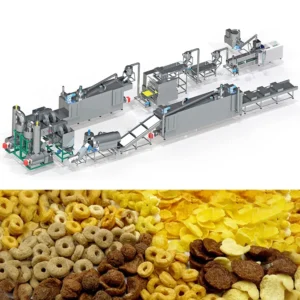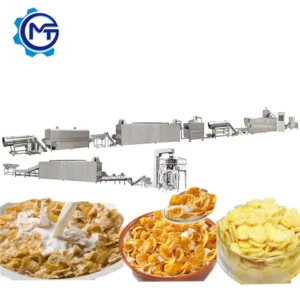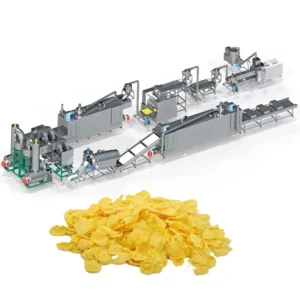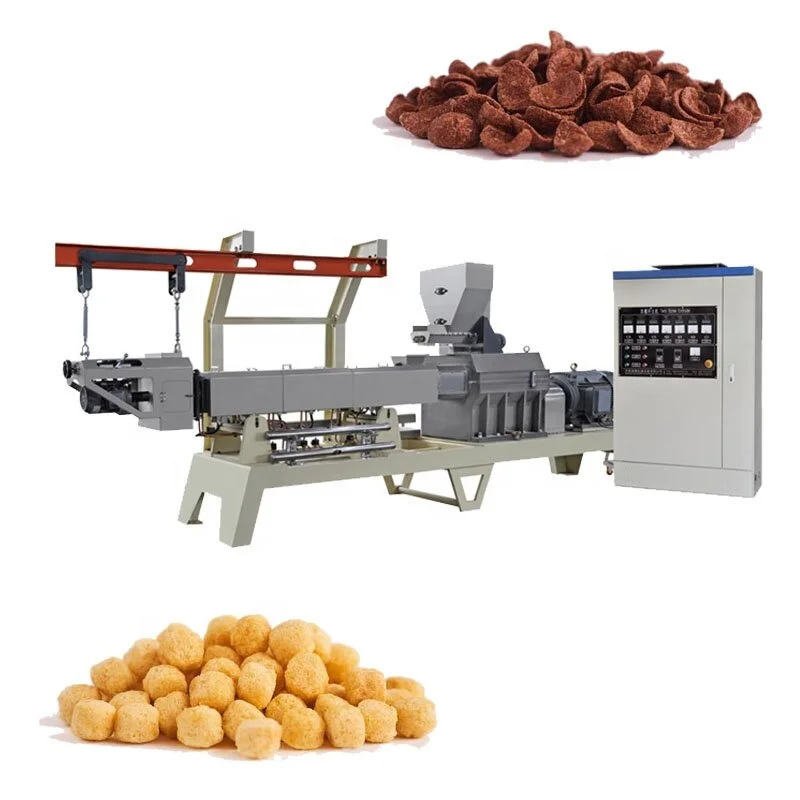
Screw Geometry First — Every die profile and screw flight in this corn flakes extrusion production line turnkey is configured against your actual flour blend before the barrel is ever assembled.
Technical Specifications
| Parameter | Value |
|---|---|
| Model | MT70 / MT85 / MT75 |
| Product Type | Corn Flakes Breakfast Cereal Production Line |
| Screw Type | Twin Screw |
| Installed Power (MT70 / MT85 / MT75) | 160 kW / 190 kW / 210 kW |
| Power Consumption (MT70 / MT85 / MT75) | 120 kW / 140 kW / 150 kW |
| Output Capacity (MT70) | 150–200 kg/h (basis not stated in source — confirm raw material type, moisture content, and flake thickness) |
| Output Capacity (MT85) | 300–400 kg/h (basis not stated in source — confirm raw material type, moisture content, and flake thickness) |
| Output Capacity (MT75) | 300–500 kg/h (basis not stated in source — confirm raw material type, moisture content, and flake thickness) |
| Overall Dimensions (MT70) | 41 × 1.5 × 2.2 m |
| Overall Dimensions (MT85) | 43 × 1.5 × 3.2 m |
| Overall Dimensions (MT75) | 45 × 1.5 × 3.5 m |
| Control System | PLC (flaking machinery); MCC and PLC (line integration) |
| Flaking Roller Drive | Double motors for separate roller driving |
| Flaking Roller Pressure | Hydraulic system for double rollers |
| Flaking Temperature Control | Infrared sensor for even temperature pipe control |
| Dryer Heating Source | Gas / Electric |
| Hot Air Roasting Oven | Vibrating pan with high-temperature spraying tubes, conciliation burner, two circulating fans, cyclone dust removal |
| Coating System | Double tumble for sugar melting, elevator, coating drum, spraying nozzle |
| Extruder Working Principle | Feeding system, extruding system, cutting system, heating system, gearing system, controlling system |
| Key Features | Automatic lubricating and cooling function; screw made by special wear-resistant technology |
| Assembly State | Complete turnkey production line |
| Voltage & Frequency | Customized to buyer’s local standard (source value — verify against manufacturer catalog) |
| Standards | CE; ISO |
Application Suitability
| Application | Material or Output |
|---|---|
| Natural corn flakes | Corn grits, corn flour, whole corn meal |
| Sugar-coated corn flakes | Corn base with sugar syrup, honey, or malt coating |
| Multi-shape breakfast cereal | Rice, wheat, oat, and barley powder blends formed into ball, tube, stick, ring, fruit loop, star, wheel, flower, or heart shapes via extruder mould adjustment |
Why "Rated Capacity" Means Nothing Without Your Raw Material
A corn flakes extrusion production line turnkey quoted at a single output number often fails the moment it meets a buyer’s actual corn supply — because the starch-to-protein ratio and residual oil content of local grain shift the entire extrusion window.
Capacity is only meaningful when tied to a specific flour blend, moisture percentage, and target flake thickness.
I once watched a line run flawlessly on the supplier’s standard corn grits during a factory demo. Three weeks later, the buyer switched to a local supplier’s high-germ corn flour and the flakes blistered during pressing, then turned bitter after roasting. The whole batch was scrapped. The extruder was not wrong — the screw profile simply had not been configured for that material’s gelatinisation curve. [NEED_CITE: starch gelatinisation behaviour in high-germ corn flour]
Barrel Temperature Profiling Across Five Zones
Each barrel section on the twin-screw extruder is independently heated and monitored. The feed zone holds a lower temperature to prevent premature starch activation, while the metering and high-shear zones climb into the range where corn starch fully gelatinises. The die zone then stabilises the melt before cutting. This staged profile is what gives the extruded pellet its uniform internal structure — the foundation every downstream station depends on. A corn flakes extrusion production line turnkey without this zoned control will produce pellets that flake unevenly and roast with dark spots.
Screw Configuration Matched to Grain Behaviour
The screw elements are not a fixed catalogue part. Flight depth, kneading block angle, and element spacing are all selected after running the buyer’s corn supply through the in-house testing workshop. High-fat germ material needs a gentler shear profile to avoid oil release that causes surface blistering during roasting. Lean degerminated grits tolerate tighter kneading blocks for more complete gelatinisation. This is where a generic screw build silently fails — it produces acceptable-looking pellets that only reveal density and texture problems once they hit the flaking rollers and roasting oven. [NEED_CITE: twin-screw element selection for varying starch-fat ratios]
Reading the Numbers That Actually Matter
The twin-screw design across all three models (MT70, MT85, MT75) is the core extrusion decision. Twin screws provide positive conveying for the sticky, high-moisture dough that corn flakes require, where a single screw would stall or surge. Installed power ranges from 160 kW to 210 kW across the three frames, and the actual consumption under load is roughly 70–75% of that figure — meaning the MT75 draws around 150 kW continuously during production. The flaking stage uses hydraulic pressure on double rollers driven by separate motors, which allows each roller to be adjusted independently for precise gap control. Infrared temperature monitoring on the flaking pipes keeps the pellet surface at the exact pliability window needed for clean, flat pressing without cracking.
The Hidden Cost of a Mismatched Dryer
When a line is assembled from separate vendors, the extruder is often specified first and the dryer is sized after. If the dryer capacity falls short of the extruder output, wet flakes pile up on the conveyor, cool below the pressing window, and then shatter under the flaking rollers instead of flattening. The same mismatch happens at the coating drum: if sugar-coated flakes enter the drum faster than the tumble cycle can coat and discharge them, the syrup builds up in clumps and the final product sticks together in the packaging bag. These bottlenecks do not show up on a spec sheet — they appear on the first production day, when the buyer discovers the line cannot hold the quoted throughput end to end. [NEED_CITE: throughput balancing between extruder, dryer, and coating stations]
Why Procurement Here Eliminates Integration Risk
The complete corn flakes extrusion production line turnkey — from batching through mixing, extruding, flaking, drying, hot air roasting, coating, and packing — is engineered under one roof so that every station’s throughput is calculated against the others before the first drawing is released. Screw configuration and die geometry are documented in a build record tied to your flour sample. The in-house testing workshop runs your actual raw material and delivers a trial report covering extrusion pressure, pellet density, and flake colour before the line ships. Hot air roasting oven design uses a conciliation burner with dual circulating fans and cyclone dust removal to produce the surface blistering and crispness that cereal markets expect. Electrical schematics are drawn to your local voltage and frequency, and the PLC language is set to your operators’ requirement before the control cabinets are wired.
Documentation & Verification
- Line layout and capacity calculation showing throughput balance across all stations from mixer to packer
- Screw and die configuration record documenting the element build specified for your corn blend
- Trial run report on your raw material covering pellet density, flake thickness, and roast colour
- Electrical schematic with confirmed voltage, frequency, and PLC language for your site
- Factory test record photographing the assembled line running under load before crating
- CE declaration of conformity and ISO certificate included in the shipping documentation pack
Installation, Commissioning & Support
- Foundation drawing accounts for the MT75’s 45 m length and 210 kW installed load with dedicated circuits
- Voltage and frequency confirmed against local grid before control panels are built and shipped
- Line arrives in sections — extruder, flaker, dryer, roaster, coater — for phased assembly on site
- First commissioning run uses your raw material to dial in screw speed, barrel zones, and hydraulic roller gap
- Operator training covers PLC interface navigation, hydraulic pressure adjustment, and infrared sensor calibration
- Wear parts list includes twin-screw elements, die plates, and flaking roller shells with reorder intervals
What to Prepare Before Sending an Inquiry
To configure a corn flakes extrusion production line turnkey that actually holds its capacity, share the following with your inquiry. Specify the corn variety and whether you are using degerminated grits or whole-grain flour with germ content. State your target flake thickness and whether you need natural, sugar-coated, or multi-shape cereal output from the same platform. Confirm your workshop voltage, frequency, and the language your operators will use on the PLC screen. If you can send a representative sample of your raw material, the testing workshop will run it and return a trial report before any commercial commitment is made.
Frequently Asked Questions
Q: How is line capacity verified on my specific corn supply before I commit?
A: Your raw material is run through the in-house testing workshop on a twin-screw extruder configured with a preliminary screw profile. The trial covers extrusion pressure, pellet density, flake thickness after pressing, and roast colour. A full report is issued before the final screw and die build is locked in for production.
Q: How do you prevent the dryer or coating drum from bottlenecking the extruder?
A: Throughput is calculated station by station during layout design. The dryer belt length, roasting oven volume, and coating drum tumble cycle are all sized against the extruder’s confirmed output on your material, so wet flakes never queue between stations during continuous production.
Q: What does the turnkey project scope cover beyond the equipment itself?
A: The scope includes line layout design, utility planning for your 150–210 kW load, phased installation scheduling, on-site commissioning with your raw material, operator training on the PLC interface, and a wear parts list with reorder intervals for screws, dies, and roller shells.
Q: How are the screw elements and die chosen for my target flake texture?
A: After the trial run, the screw element sequence — flight depth, kneading block angle, spacing — is adjusted to match your flour’s gelatinisation behaviour. The die aperture is then matched to the pellet size that produces your required flake thickness after hydraulic pressing.