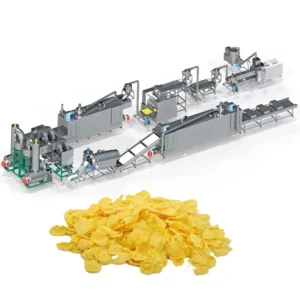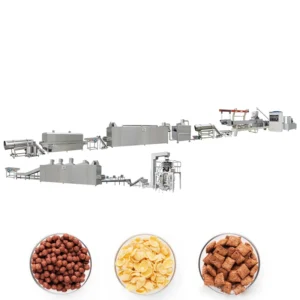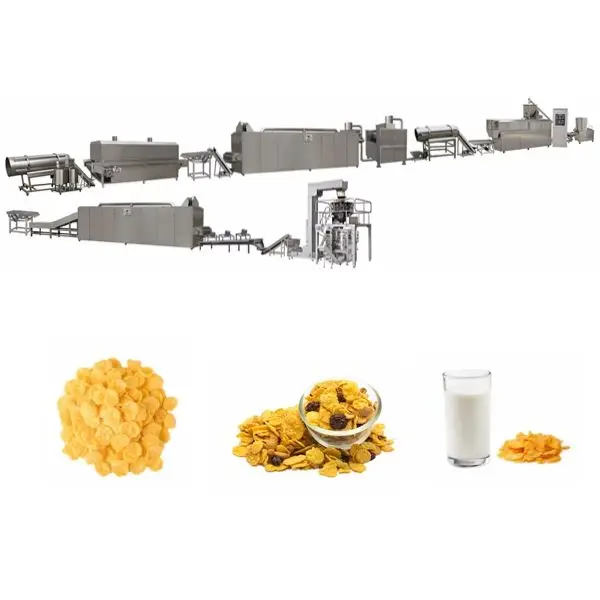
Twin-Screw Extrusion Technology for Corn Flakes — screw configuration, barrel temperature profile and die geometry are specified to the buyer’s actual cereal raw material and target flake density rather than copied from a generic build.
Technical Specifications
| Parameter | Value |
|---|---|
| Model | MT70 |
| Product Type | Corn Flakes Production Line |
| Screw Type | Twin Screw |
| Installed Power | 160 kW |
| Power Consumption | 120 kW |
| Output Capacity | 150–200 kg/h (basis not stated in source — confirm raw material and moisture) |
| Overall Dimensions | 41 × 1.5 × 2.2 m |
| Control System | PLC (flaking machinery); MCC/PLC for complete line |
| Basic Raw Material | Corn, rice, wheat, oat, barley powder |
| Flaking Machinery Feature | Hydraulic double-roller system, double motors for separate roller driving, infrared sensor temperature control |
| Dryer Heating Source | Gas / Electric |
| Hot Air Roasting Oven | Vibrating pan, high-temperature spraying tubes, conciliation burner, two circulating fans, cyclone dust removal |
| Coating System | Double tumble sugar melting, elevator, coating drum, spraying nozzle |
| Extruder Working Principle | Feeding, extruding, cutting, heating, gearing and controlling systems |
| Extruder Screw Feature | Wear-resistant screw manufactured by special technology, automatic lubricating and cooling |
| Assembly State | Complete turnkey line |
| Standards | CE (certified since 2014), ISO |
Application Suitability
| Application | Material or Output |
|---|---|
| Natural corn flakes production | Corn grits or corn flour at controlled moisture |
| Sugar-coated corn flakes | Corn flakes base with sugar syrup coating |
| Multi-grain breakfast cereals | Blends of rice, wheat, oat and barley powder |
| Shaped cereal formats | Ball, tube, ring, star, heart via die adjustment |
| Cereal-based puffed snacks | Same extrusion platform with modified screw and die configuration |
What "Rated Capacity" Really Means for Corn Flake Extrusion
A capacity figure is only honest when tied to the raw material and moisture content it was measured on.
I watched a Southeast Asian producer commission a corn flakes line last year where the supplier had quoted a nominal throughput number based on a standard corn grit specification. The buyer’s actual corn flour had a coarser particle size, and the generic screw combination could not achieve sufficient gelatinisation. Expansion dropped, flake integrity fell apart, and nearly half the output crumbled before it even reached the flaking rolls [NEED_CITE:]. That line was not broken — it was simply specified to the wrong material. For process engineers evaluating breakfast cereal extruder screw configuration, the real question is whether the capacity was measured on your raw material, not a laboratory reference.
Screw Configuration Specified to Your Cereal Material
Different cereal raw materials demand different shear, residence time and compression profiles inside the barrel. Corn requires higher shear to achieve full starch gelatinisation at the moisture levels typical for flake production, while oat and barley blends need gentler handling to prevent over-gelatinisation and sticky dough behaviour. The breakfast cereal extruder screw configuration is therefore not a fixed template — element sequencing, kneading block angle and pitch spacing are adjusted to match the buyer’s flour particle size, fat content and target expansion ratio. This is where corn flakes extrusion technology separates a line that performs on paper from one that performs on the factory floor.
Barrel Temperature Profile and Moisture Control
Consistent flake quality depends on maintaining a precise temperature gradient across the barrel zones while controlling steam or water injection at the feed point. Too much moisture at the first zone causes premature gelatinisation and dough balling; too little at the die zone reduces expansion and produces dense, hard flakes. The PLC-controlled barrel heating system allows independent zone adjustment so that the gelatinisation front moves predictably through the screw length [NEED_CITE:]. Infrared temperature sensing on the downstream flaking rolls then ensures the cooked pellet enters the nip at the correct surface temperature for uniform sheet thickness.
Reading the Specification Sheet with a Process Engineer’s Eye
Installed power of 160 kW on the MT70 indicates the mechanical energy available for shear and compression — a critical variable when switching from corn to harder multi-grain blends that demand higher torque. The hydraulic double-roller flaking system with separate motor drives allows independent speed adjustment of each roll, which directly affects flake thickness uniformity and surface integrity. Die geometry determines the pellet cross-section before flaking, and for shaped cereals like rings or stars, the die must be matched to the dough viscosity at the target moisture to hold definition through the hot air roasting stage. The hot air roasting oven uses a vibrating pan with high-temperature spraying tubes and two independent circulating fans, which controls surface blistering and final crispness — parameters that define bowl-life for the end consumer.
The Hidden Cost of Generic Screw and Die Selection
When an extruder ships with a screw combination designed for a reference material rather than the buyer’s actual flour, the problems compound downstream. Poor expansion produces dense pellets that crack under the flaking rolls instead of compressing into intact sheets. The dryer then over-dries the fractured pieces, and the sugar coating drum breaks them further [NEED_CITE:]. By the time the product reaches packing, the yield loss is significant and the bowl-life specification cannot be met. The cost is not just wasted raw material — it is the production time, energy consumption and labour spent running a line that was never configured correctly.
Why This Extrusion Platform Earns Its Place on the Floor
Screw and die configuration is specified to the buyer’s raw material and target flake density before production begins, not borrowed from a generic catalogue. Every line goes through a trial run in the in-house testing workshop using the customer’s actual cereal flour, so expansion behaviour and flake integrity are verified before the machine leaves the factory. Throughput is matched across every station — extruder, flaker, dryer, roaster and coater — so that no single unit bottlenecks the line. The flaking stage uses hydraulic pressure control with infrared temperature feedback to maintain consistent sheet thickness across the roll face. Pre-sales engineering consultation covers line layout, utility planning and phased installation scheduling rather than ending at the quotation.
Documentation & Verification
- Screw and die configuration record matched to your cereal raw material and target flake density
- Trial run report on your actual corn or multi-grain flour before shipment
- Line layout and capacity calculation confirming throughput across every station
- Electrical schematic with voltage and frequency confirmation for your facility
- CE declaration of conformity and ISO certificate included with dispatch documents
Installation, Commissioning & Support
- Foundation and floor space planning based on 41 × 1.5 × 2.2 m line footprint and utility routing
- Power supply specification confirming 160 kW installed load with dedicated circuit and local voltage match
- MCC/PLC control system language and interface configured to operator requirements before dispatch
- On-site commissioning with barrel temperature profiling and screw speed tuning on your raw material
- Flaking roller pressure and infrared sensor calibration for target flake thickness
- Wear parts list covering screws, dies and roll surfaces with recommended replacement intervals
Before You Request a Quotation
To configure the screw combination and die geometry correctly, we need the specific cereal raw material you intend to process, including particle size distribution and typical moisture content. Share your target flake density, final crispness expectation and whether sugar coating is part of the production plan. Confirming local voltage, frequency and preferred control language early prevents commissioning delays.
Frequently Asked Questions
Q: How is screw configuration selected for different cereal raw materials?
A: Element sequencing, kneading block angle and pitch spacing are adjusted based on the buyer’s flour particle size, starch content and target expansion. Corn typically requires higher shear than oat or barley blends, and the screw combination is validated in the testing workshop using the actual raw material before final build.
Q: How is output capacity verified against the buyer’s raw material?
A: A trial run is conducted in the testing workshop using the customer’s cereal flour at the intended moisture level. Expansion ratio, pellet integrity and flake thickness are measured and documented. The trial run report accompanies the shipment so the buyer has a verified baseline for commissioning.
Q: What barrel temperature profile is used for corn versus multi-grain formulations?
A: Corn typically runs with a progressive temperature rise across barrel zones to achieve full gelatinisation without premature dough balling. Multi-grain blends with oat or barley often require a flatter profile to prevent sticky behaviour. Zone setpoints are adjusted during the pre-shipment trial and documented for commissioning.
Q: How does die design affect expansion ratio and final flake texture?
A: Die geometry controls the pellet cross-section and exit pressure, which directly influence expansion behaviour. A larger die opening at lower pressure produces a more open structure, while a restricted die at higher pressure creates a denser pellet. The choice depends on the target flake density and crispness specification.
Q: Can the same extrusion platform produce both corn flakes and shaped cereals?
A: Yes. Switching from flakes to shaped formats like rings or stars requires a die change and potentially a screw element adjustment to match the dough viscosity to the new shape definition. The hot air roasting oven and coating system remain in the line without modification.