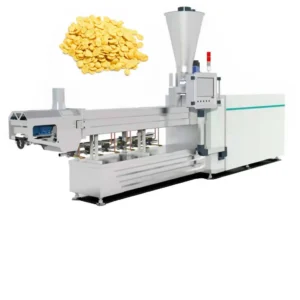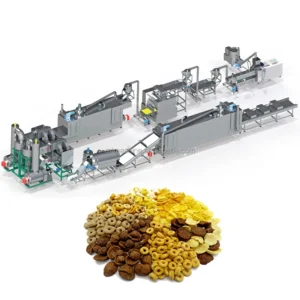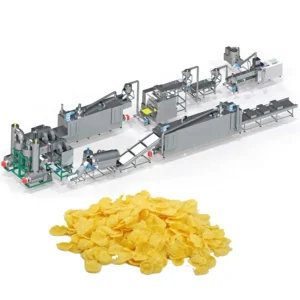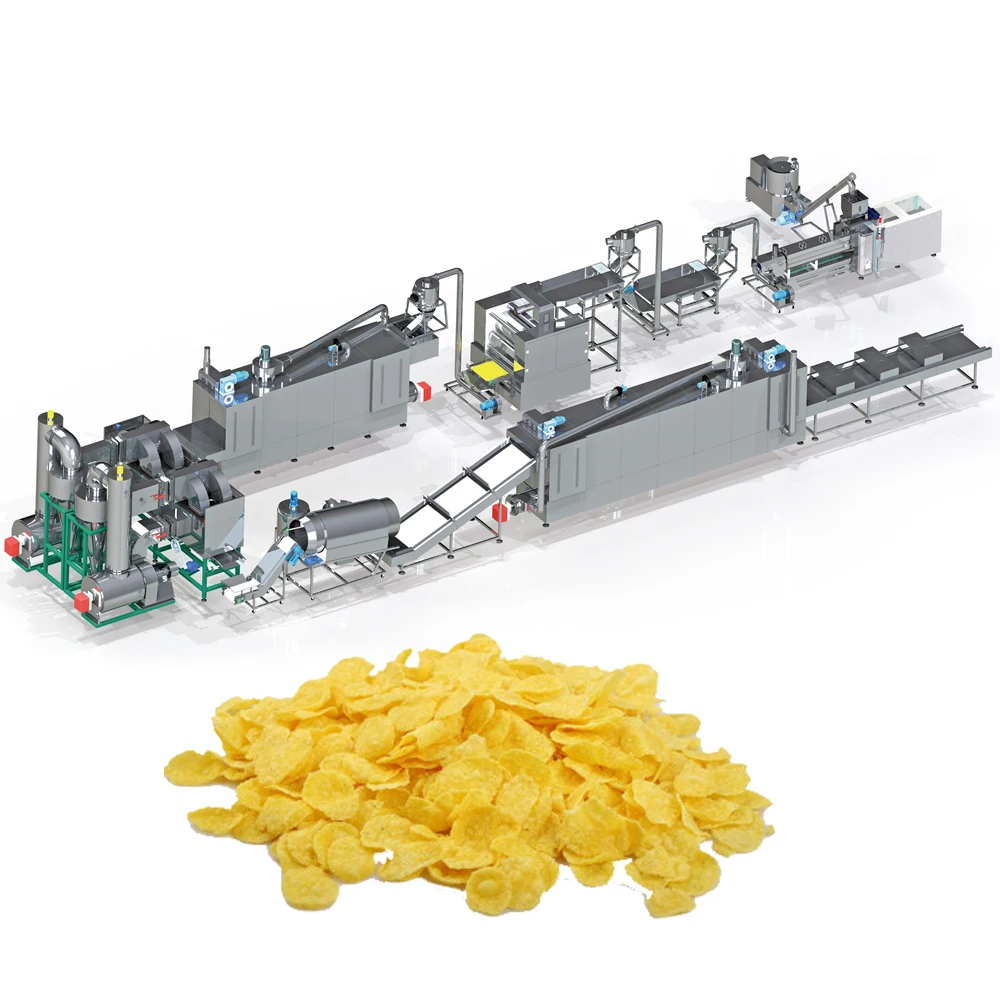
Screw Configuration Matched to Raw Material — Sectional twin-screw modules and die geometry specified to your actual corn, rice, or oat formulation, not a generic build copied across product types.
Technical Specifications
| Parameter | Value |
|---|---|
| Product Type | Twin Screw Corn Flakes Extrusion Line |
| Available Models | MT-65 / MT-70 / MT-75 / MT-85 |
| Screw Type | Co-rotating twin screw, sectional modules |
| Installed Power | 84 kW (MT-65) / 132 kW (MT-70) / 186 kW (MT-75) / 239 kW (MT-85) |
| Real Power Consumption | 59 kW (MT-65) / 92 kW (MT-70) / 140 kW (MT-75) / 167 kW (MT-85) |
| Output Capacity | 120–150 kg/h (MT-65, basis not stated in source); 200–250 kg/h (MT-70); 300–400 kg/h (MT-75); 400–500 kg/h (MT-85) |
| Overall Line Dimensions | 12×1.2×2.2 m (MT-65) up to 28×1.5×2.8 m (MT-85) |
| Mixer Tank | φ600×500 mm, 4 kW |
| Corn Flakes Press Machine | 16.12 kW, roller 510×310×1050 mm, stainless steel with cooling system |
| High-Temperature Oven | 4.5×1.4×1.8 m, 3.75 kW, gas-fired, both-side baking |
| Sugar Spraying System | 28.75 kW, 4.0×1.9×1.88 m, includes melting tank and temperature keeping roller |
| Control System | Separate controller box for flaker; line-level control available with PLC or MCC |
| Certifications | CE, ISO |
Application Suitability
| Application | Material or Output |
|---|---|
| Traditional corn flakes | Corn grits and corn flour at controlled moisture for bowl-ready breakfast cereal |
| Multi-grain breakfast flakes | Rice flour and wheat flour blends requiring adjusted barrel temperature profiles |
| Oat-based flake cereal | High-oat formulations demanding extended residence time for complete starch gelatinisation |
| Fortified breakfast cereal | Grain-soya-walnut blends with added nutritional premix before extrusion |
| Sweetened coated flakes | Sugar-coated corn flakes passing through the spraying system after oven drying |
Why Nominal Throughput Fails When Raw Material Changes
A capacity number without a material basis is not a capacity — it is a guess.
I have watched a breakfast cereal line shut down for three days because the screw configuration was set for standard corn grits while the customer was running a high-oat formulation. The starch simply would not gelatinise at the preset barrel temperatures, and every flake that came off the press crumbled on contact. The extruder was rated for a certain throughput, but that rating meant nothing once the raw material shifted. When evaluating corn flakes extrusion line specifications, the first question should never be "what is the maximum output" — it should be "what is the output on my specific formulation at my target moisture content" [NEED_CITE: starch gelatinisation temperature thresholds for corn versus oat matrices].
Barrel Temperature Zones and Starch Gelatinisation Control
The MT-series extruder uses a multi-zone barrel heating layout that allows independent temperature control along the screw length. Corn grits typically gelatinise between 62 and 72 degrees Celsius, while oat starch requires higher thermal input and longer residence time to reach the same degree of cook. Sectional screw modules let the process engineer adjust the conveying, mixing, and cooking balance within the barrel to match each grain type. Getting this wrong means undercooked dough that flakes unevenly or overcooked material that burns at the die face. The corn flakes extrusion line specifications should always be reviewed against your target grain composition before the screw build is locked in.
Die Design and Flake Density After Pressing
Die geometry controls the shape and moisture distribution of the extruded pellet before it reaches the flaker. A pellet that exits too wet will stick to the press rollers; one that exits too dry will crack instead of flattening. The press machine on this line features adjustable roller distance and an integrated cooling system to manage flake thickness and prevent adhesion. Roller dimensions of 510×310×1050 mm provide a working width that matches the throughput range of the MT-series extruders. Die selection is not a one-time decision — it changes when you move from corn to rice to multi-grain recipes [NEED_CITE: die land length influence on pellet moisture uniformity in breakfast cereal extrusion].
Reading Power Draw Against Real Operating Conditions
Installed power and real power consumption tell different stories. The MT-65 draws 84 kW installed but operates at approximately 59 kW under typical load, while the MT-85 sits at 239 kW installed against 167 kW real consumption. The gap between these numbers reflects motor sizing headroom — enough reserve to handle viscous dough at start-up without tripping overloads. When planning utility supply for a corn flakes extrusion line, always size your electrical infrastructure around the real power figure plus a safety margin, not the installed peak. The gas-fired oven adds further utility demand at 3.75 kW for drives and fans, plus the gas supply itself.
What Happens When Line Stations Are Mismatched
An extruder running at full throughput means nothing if the flaker cannot keep pace or the oven cannot dry the output fast enough. I have seen operations where the press became the bottleneck because roller throughput was never cross-checked against extruder output — the result was dough backing up in the conveyor, cooling unevenly, and producing flakes with inconsistent texture. The sugar spraying system adds another station that must be balanced: if coating capacity falls behind, flakes pile up and absorb moisture from the air, losing the crispness the oven just created. Every throughput claim in the corn flakes extrusion line specifications should be verified station by station, not just at the extruder [NEED_CITE: line balancing principles in multi-station food processing].
Why Procurement Starts With Your Actual Formulation
This line is supplied as a complete sequence from mixer through sugar coating, meaning throughput matching across every station is the supplier’s responsibility rather than a problem left to the buyer. Screw configuration and die design are specified to your raw material and target flake density, not pulled from a generic template. The in-house testing workshop runs trial production on your actual formulation before shipment, so you see the flake quality before the machine leaves the factory. Technical documentation covers screw and die configuration records, electrical schematics with confirmed voltage, and trial run reports on your material. CE and ISO certifications are maintained across the product range, supporting import compliance in regulated markets.
Documentation & Verification
- Screw and die configuration record matched to your grain type and target flake thickness
- Trial run report produced on your raw material formulation before shipment
- Electrical schematic with voltage and frequency confirmed for your destination market
- Line layout drawing showing station spacing and utility connection points
- CE declaration of conformity and ISO certificate in electronic format
- Operation and maintenance manual with wear parts list for screw modules and rollers
Installation, Commissioning & Support
- Foundation must support line length up to 28 m and accommodate oven gas supply routing
- Dedicated electrical circuit sized to real power draw of the selected model plus oven load
- Separate flaker controller box requires independent calibration during commissioning
- First-run parameter setting covers barrel zone temperatures, screw speed, and roller gap
- Operator training addresses screw module changes when switching between grain formulations
- Wear parts inventory includes sectional screw elements and press roller surfaces
What to Prepare Before Requesting a Quote
Share your target grain formulation with approximate ratios — corn, rice, oat, or blends — along with the moisture content you plan to run at the mixer. Confirm your factory floor length and ceiling height so the line layout can be drawn to fit, especially for the MT-75 and MT-85 models that extend beyond 24 metres. Specify your local voltage, frequency, and preferred control language so the electrical design matches your site before production begins. If you have existing upstream mixing or downstream packing equipment, provide interface details so the conveyor heights and transfer points align.
Frequently Asked Questions
Q: How is output capacity verified against a specific raw material formulation?
A: The testing workshop runs your actual grain blend at your target moisture through the selected model. Throughput is measured over a sustained run, and the screw configuration is adjusted until flake density and texture meet your specification. The trial run report documents the confirmed output so you have a verified figure, not a catalogue estimate.
Q: What screw configuration works for corn versus oat versus rice flakes?
A: Corn grits use a shorter cooking zone with moderate shear, while oat formulations need extended residence time and higher barrel temperatures to achieve full gelatinisation. Rice flour falls between the two. Sectional screw modules are rearranged for each grain type, and the die land length is adjusted to control pellet moisture at the press entry point.
Q: How are voltage and control language confirmed before production?
A: The electrical schematic is reviewed with you during the specification stage. Your local voltage, frequency, and preferred HMI language are locked in before the control panel is wired. This prevents commissioning delays caused by mismatched motor ratings or unreadable operator interfaces at start-up.
Q: What factory footprint does each model require?
A: The MT-65 fits within approximately 12 metres of line length, while the MT-85 extends to 28 metres. Ceiling clearance of at least 2.8 metres is needed for the larger models due to oven height. Floor space must also allow access on both sides for maintenance of the flaker rollers and oven interior.
Q: How does the flaker match throughput with the extruder?
A: Roller speed and gap on the press machine are set during the trial run to match the extruder output rate. If the flaker runs slower than the extruder, dough accumulates and cools unevenly. The adjustable roller distance and integrated cooling system allow fine-tuning to keep both stations balanced across your production range.