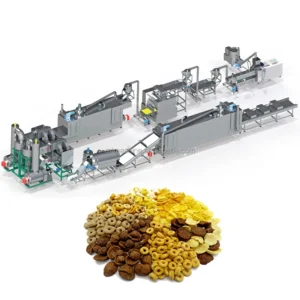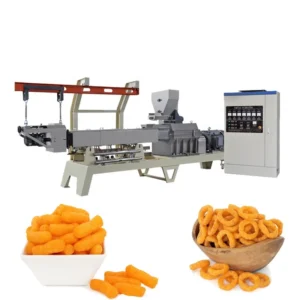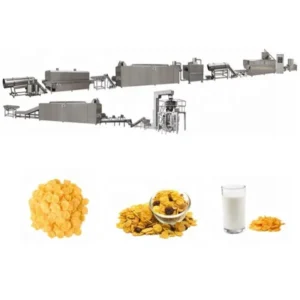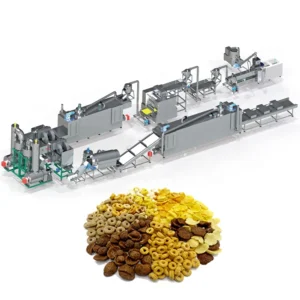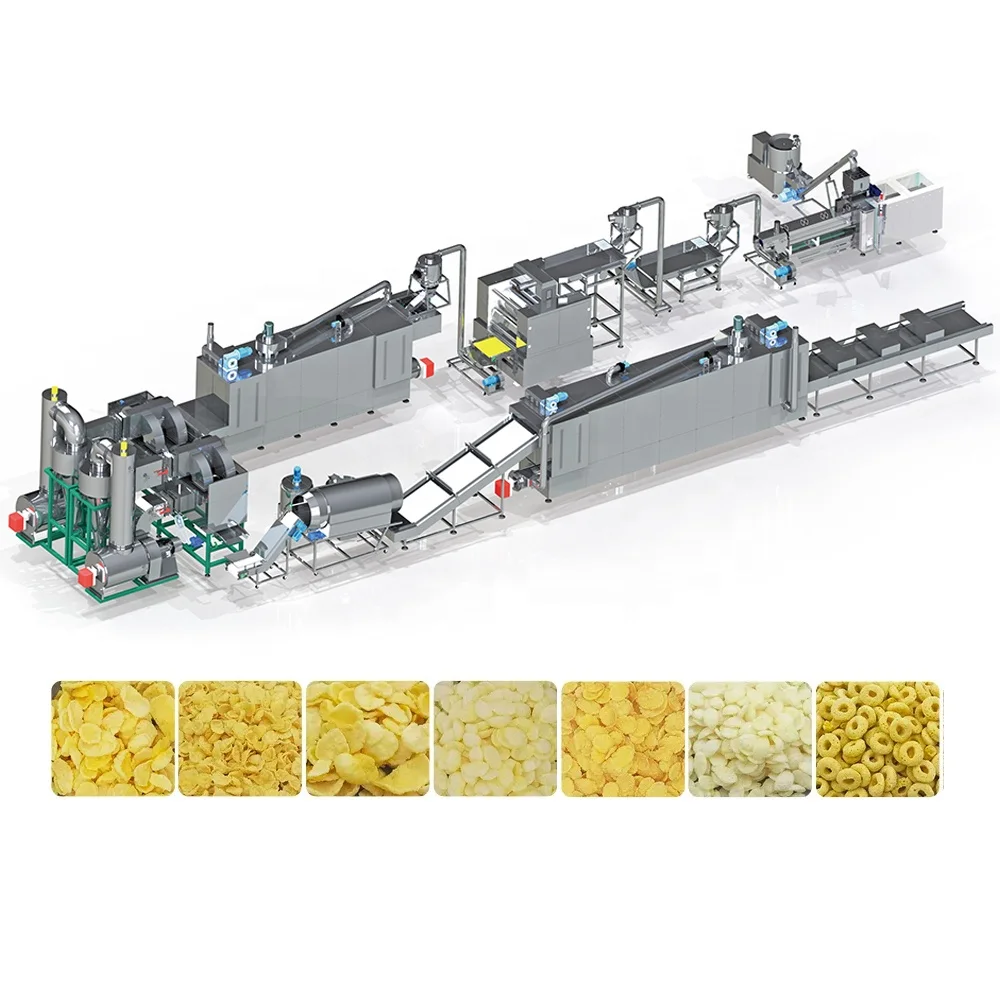
Starch Gelatinisation Control — screw modules and barrel zones specified to the buyer’s grain blend so expansion and flake density match the target market.
Technical Specifications
| Parameter | Value |
|---|---|
| Product Type | Breakfast Cereal and Corn Flakes Extrusion Production Line |
| Extruder Model | MT-75 Double Screw Extruder |
| Screw Type | Twin screw, co-rotating, sectional modules |
| Extruder Functions | Forward/backward transport, mixing, de-gassing, cooking, forming |
| Mixer Output | 10–30 kg/load |
| Mixer Power | 4 kW |
| Mixer Tank Size | φ600 × 500 mm |
| Mixer Dimensions | 1000 × 800 × 1200 mm |
| Screw Conveyor Power | 0.75 kW |
| Screw Conveyor Dimensions | 2700 × 500 × 2400 mm |
| Corn Flakes Press Machine Power | 16.12 kW |
| Corn Flakes Press Machine Roller Size | 510 × 310 × 1050 mm |
| Press Machine Features | Big roller, cooling system, adjustable roller distance |
| High-Temperature Oven Dimensions | 4.5 × 1.4 × 1.8 m |
| High-Temperature Oven Power | 3.75 kW |
| Oven Heating | Gas-fired, dual-side baking |
| Sugar Spraying System Power | 28.75 kW |
| Sugar Spraying System Dimensions | 4000 × 1900 × 1880 mm |
| Sugar Spraying Roller Size | Ø600 × 2700 mm |
| Contact Materials | Stainless steel, food-grade |
| Voltage & Frequency | Customizable (e.g. 3ph 380V 50Hz, 3ph 415V 60Hz) |
| Control System | Basis not stated in source (basis to be confirmed) |
| Output Capacity | Basis not stated in source (basis to be confirmed) |
| Certification | CE |
Application Suitability
| Application | Material or Output |
|---|---|
| Corn flake production | Maize, corn grain, corn flour |
| Whole grain cereal rings and hoops | Wheat flour, oat flour, multi-grain blends |
| Coated breakfast snacks | Post-extrusion sugar syrup, honey, chocolate |
| Fortified breakfast cereal | Grain flour with vitamin and nutritional additives |
| Multiple cereal shapes | Ring, ball, star, stick via interchangeable dies |
What Generic Screw Builds Do to Flakes
Corn flake extrusion parameters must be matched to your grain formulation before the machine is built, not adjusted on the shop floor after delivery.
I have seen lines where the screw configuration was pulled from a standard template and applied to a high-fiber oat blend without any adjustment. The result was uneven gelatinisation across the barrel — some material cooked, some raw — and the flakes coming off the press cracked instead of holding their shape. Breakfast cereal corn flakes extrusion technology demands that the screw profile, barrel temperature zones, and moisture input are all calculated against the specific starch behaviour of the buyer’s raw material [NEED_CITE: starch gelatinisation temperature ranges by grain type]. A rice flour recipe behaves very differently from a corn-and-oat blend under the same screw shear, and copying a setup across formulations is the most common cause of density problems on cereal lines.
Barrel Temperature Profiling Across Grain Formulations
The MT-75 uses co-rotating twin screws with sectional modules, which means each segment of the barrel can carry a different screw element — mixing, kneading, or conveying — in sequence. This is the core of how breakfast cereal corn flakes extrusion technology controls the cooking curve. Corn flour requires a different thermal ramp than a multi-grain recipe with vitamin additives, because the starch granules in each grain rupture at different temperatures and moisture thresholds.
Shear, Moisture and the Expansion Ratio
Achieving the correct expansion in the extruder barrel is not just a temperature question. The screw speed, feed moisture, and die geometry all interact to determine how much the extrudate puffs when it exits the die. Too much shear and the flakes become brittle; too little and they stay dense and chewy. The adjustable roller press downstream — with its integrated cooling system and variable gap — then sets the final flake thickness, but it can only work with material that left the extruder in the right condition [NEED_CITE: twin-screw extrusion shear rate effects on cereal expansion].
Reading the Specs That Actually Matter
The co-rotating sectional screw design is the central feature here. Sectional modules mean you can swap individual screw elements when you change from a corn-only recipe to a fortified multi-grain blend, rather than replacing the entire screw assembly. The gas-fired dual-side baking oven at 4.5 m length provides enough residence time for uniform moisture reduction without scorching the surface. The sugar spraying system’s Ø600 × 2700 mm roller gives adequate contact time for even coating coverage on high-throughput runs. Mixer capacity at 10–30 kg per load sets the batch rhythm upstream of the extruder.
What Happens When the Press and Dryer Are Mismatched
An extruder running at full capacity into an undersized flake press creates a backlog of hot extrudate that cools unevenly before reaching the rollers. The flakes then press with inconsistent thickness, and the downstream oven receives a product with variable moisture content. Some flakes over-bake, some stay soft. This is not a problem you fix by adjusting oven temperature — it is a throughput balancing error that has to be caught at the line design stage [NEED_CITE: production line station balancing principles for continuous extrusion]. The press machine, oven, and coating drum all need their capacities matched to the extruder output on the buyer’s actual recipe.
Why Specify Here
Complete line stations from the flour mixer through the sugar spraying system to cooling and packing are supplied under one configuration, which means throughput matching is calculated across every station rather than left to the buyer to piece together. Screw configuration and die design are specified to the buyer’s grain formulation and target flake density before production begins — not copied from a generic template. An in-house testing workshop allows trial runs on the customer’s actual raw material, confirming expansion ratio and bowl-life before the line ships. The interchangeable die system supports ring, ball, star, and stick shapes from a single extrusion platform, giving format flexibility without a second machine.
Documentation & Verification
- Line layout showing station-by-station throughput matching for your cereal recipe
- Screw and die configuration record tied to your grain formulation
- Trial run report on your raw material confirming expansion and flake density
- Electrical schematic with voltage and frequency matched to your facility
- Factory test record documenting full-line dry run before dispatch
Installation, Commissioning & Support
- Floor plan showing footprint for the 4.5 m oven and 4 m coating line with access clearance
- Electrical panel configured to your confirmed voltage before assembly begins
- Extruder barrel alignment and screw module sequencing verified at commissioning
- Roller press gap calibration and oven temperature profiling during first production run
- Operator training covering die changes and screw module swaps for recipe switches
- Wear parts list covering screws, die inserts, and roller surfaces with reorder codes
Before You Request a Quote
We need your grain formulation and moisture content at feed, your target flake density and bowl-life requirement, and the voltage and frequency at your facility. If you are producing coated cereal, specify the coating type and desired coverage level so the spraying system can be matched to your extruder output. Sending a sample of your raw material allows a trial run in our testing workshop before any build commitment.
Frequently Asked Questions
Q: How is screw configuration matched to different grain formulations?
A: Each grain type — corn, rice, oat, or multi-grain — has a different starch gelatinisation temperature and moisture absorption rate. We select screw elements and barrel zone settings based on your specific blend, so the material cooks evenly through the barrel and exits the die at the correct expansion point for your target flake density.
Q: What barrel temperature and moisture produce the right expansion?
A: The target depends on whether you need crispy, thin flakes or denser, heavier pieces. Higher barrel temperature and controlled feed moisture increase expansion; lower values produce denser cereal. We map the profile during trial runs on your raw material before finalising the screw and die setup.
Q: Can I send my raw material for a trial run before the line ships?
A: Yes. Our in-house testing workshop runs your actual grain blend through the configured extruder and press, producing sample flakes so you can verify expansion ratio, thickness, texture, and bowl-life before the equipment leaves the factory.
Q: How is throughput balanced between stations?
A: The line layout calculation matches mixer batch rhythm, extruder output, press speed, oven residence time, and coating drum capacity to your recipe and target format. No single station should run faster or slower than the one before it.
Q: What adjustments are needed when switching cereal shapes?
A: Switching from rings to stars or sticks involves changing the die plate at the extruder barrel end and potentially adjusting roller gap on the press. The screw configuration may also need minor module changes depending on how the new shape affects back pressure and expansion behaviour.