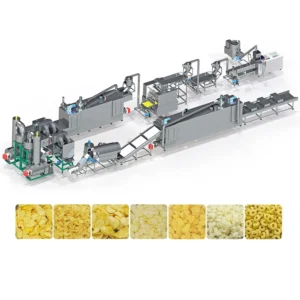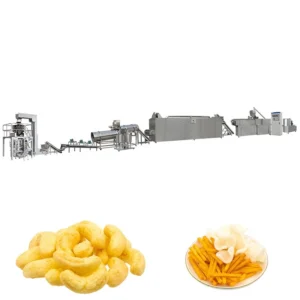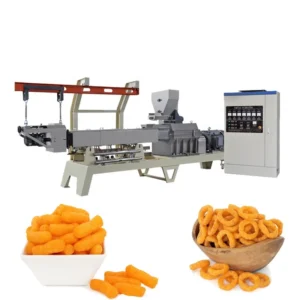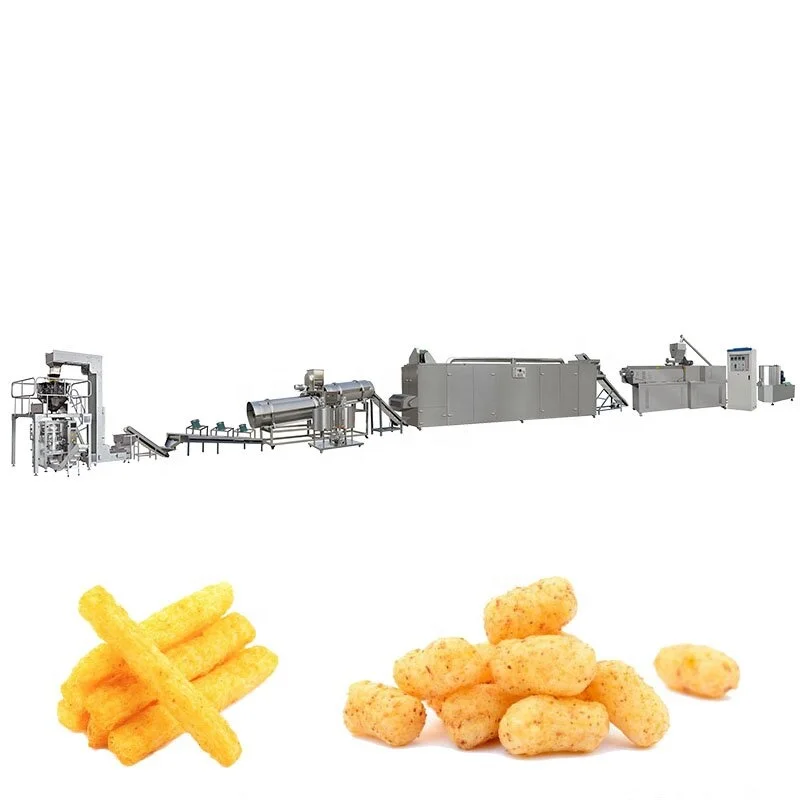
Screw Configuration Matched to Grain Formulation — We specify barrel profile and die geometry based on your exact corn, rice, or oat blend rather than defaulting to a generic extrusion setup, ensuring starch gelatinisation and flake density meet market expectations.
Technical Specifications
| Parameter | Value |
|---|---|
| Product Type | Corn Flakes Extruder Production Line |
| Models Available | MT70, MT85, MT75 |
| Extruder Type | Twin Screw |
| Installed Power (MT70 / MT85 / MT75) | 160 kW / 190 kW / 210 kW |
| Power Consumption (MT70 / MT85 / MT75) | 120 kW / 140 kW / 150 kW |
| Capacity (MT70) | 150-200 kg/hr (basis not stated in source — confirm raw material and moisture content) |
| Capacity (MT85) | 300-400 kg/hr (basis not stated in source — confirm raw material and moisture content) |
| Capacity (MT75) | 300-500 kg/hr (basis not stated in source — confirm raw material and moisture content) |
| Overall Dimensions (MT70 / MT85 / MT75) | 41×1.5×2.2 m / 43×1.5×3.2 m / 45×1.5×3.5 m |
| Screw Material | Special wear-resistant alloy |
| Control System | PLC for flaking machinery, MCC integrated line control |
| Flaking Machinery Drive | Double motors for separate roller driving |
| Flaking Machinery Hydraulic System | Hydraulic pressure control for double rollers |
| Flaking Machinery Temperature Control | Infrared sensor for even temperature pipe control |
| Dryer Heating Source | Gas or Electric |
| Roasting Oven | Hot air roasting with conciliation burner, dual circulating fans, cyclone dust removal |
| Coating System | Double tumble sugar melting, elevator, coating drum, spraying nozzle |
| Lubrication & Cooling | Automatic lubricating system with integrated cooling function |
| Voltage & Frequency | Configurable to local standard (source value — verify against manufacturer catalog) |
| Assembly State | Complete line, factory-tested before shipment |
| Basic Raw Materials | Powder of corn, rice, wheat, oat, barley, etc. |
| Standards | CE (source value — verify against manufacturer catalog for this specific line) |
Application Suitability
| Application | Material or Output |
|---|---|
| Natural corn flakes production | Corn, rice, wheat, oat, barley powder |
| Sugar-coated corn flakes production | Corn grits or multi-grain blend with sugar coating |
| Multi-grain breakfast cereal flakes | Oat, barley, wheat, and rice flour mixtures |
| Variety shape cereals (ball, tube, ring, star, wheel) | Grain flour formulations with adjustable extruder die |
Why "Standard Corn Flour" Trial Data Means Nothing for Your Grits
Your raw material composition determines the screw configuration, not the other way around.
Over years of walking trade floors across Europe and the Americas, I have watched buyers sign off on corn flakes extrusion production line technology based on trial runs performed with standard low-fat corn flour. Then the line arrives, they load their local degerminated corn grits with higher fat content, and the screw shear cannot keep up. Gelatinisation drops, the flakes come out of the roasting oven tough and chewy, and an entire batch goes to waste. The extruder was never wrong — the specification conversation skipped the most important question [NEED_CITE: raw material variability in grain extrusion processes].
Barrel Temperature Profile and Starch Gelatinisation Control
The twin-screw extruder on this line manages barrel temperature across multiple zones, each critical for the progressive gelatinisation of grain starch. Corn flakes extrusion production line technology depends on bringing the dough from initial hydration through full gelatinisation without over-shearing the matrix, and the integrated cooling function prevents hot spots that would otherwise cause premature expansion inside the barrel. Proper barrel profile is what separates a flake that toasts evenly in the oven from one that blisters and cracks.
Hydraulic Flaking and Uniform Sheet Thickness
Flake thickness directly governs roasting time and final crispness. The flaking station uses a hydraulic double-roller system with dual independent motors and an infrared temperature sensor to hold consistent gap pressure across the entire roller face. When dough temperature varies even slightly at the flaking roll entry point, the infrared feedback loop adjusts to prevent uneven compression that would produce mixed-density output on the conveyor [NEED_CITE: flaking roll pressure and cereal sheet uniformity].
Decoding the Power and Capacity Figures
The installed power range across MT70, MT85, and MT75 spans from 160 kW to 210 kW, reflecting different motor and barrel configurations for varying throughput targets. In twin-screw extrusion of cereal dough, the motor must deliver sufficient torque at the screw shaft to maintain shear under high-moisture, high-viscosity conditions. Power consumption values (120 kW to 150 kW) represent typical running load rather than peak draw. Capacity figures in the table carry a (basis to be confirmed) note because actual output in kg/hr depends entirely on raw material density, moisture content entering the extruder, and the target flake thickness at the roller station. A line processing high-fat corn grits will run at a different rate than one handling defatted oat flour, even on identical hardware. The PLC-controlled flaking machinery and MCC integrated line control ensure that throughput at the extruder is matched to downstream drying and roasting capacity, preventing material pile-up between stations.
What Happens When the Flaking Roll Pressure Is Undersized
A line where the flaking machinery cannot maintain uniform hydraulic pressure produces flakes of varying thickness across the belt. Thinner flakes over-roast and shatter during packing; thicker flakes retain internal moisture and go soft in the carton within days. The double-motor separate roller drive on this system addresses that failure mode directly, but only if the initial specification accounts for the actual dough viscosity the buyer will produce [NEED_CITE: flake thickness variance and shelf-life impact in breakfast cereals].
Why Procurement Should Start with a Raw Material Conversation
Every station on this line — from the batching mixer through the extruder, flaking rolls, dryer, and hot air roasting oven — is configured around the buyer’s specific grain formulation and target flake density. The screw configuration and die design are specified to the raw material rather than copied from a default template, which is the single most consequential decision in a corn flakes extrusion production line technology purchase. An in-house testing workshop allows trial runs on the buyer’s actual grain powder before the equipment leaves the factory, so product development begins before installation, not after. The roasting oven features a conciliation burner with dual circulating fans and cyclone dust removal, parameters that are tuned during commissioning to the flake geometry and coating type the buyer intends to run. Voltage, frequency, and control language are confirmed against the installation site before production begins, eliminating the commissioning delays that arise when a 50 Hz control panel arrives at a 60 Hz facility.
Documentation & Verification
- Screw and die configuration record matched to your grain blend and target flake density
- Trial run report on customer-supplied raw material verifying expansion and sheet thickness
- Electrical schematic with voltage, frequency, and control language confirmed for your site
- Line layout showing throughput matching across extruder, flaking, drying, and roasting stations
- Factory test record with operating parameters documented before dispatch
Installation, Commissioning & Support
- Foundation must accommodate line footprint up to 45×1.5×3.5 m with dedicated power circuits for the 210 kW installed load
- MCC panel and PLC flaking controls require confirmed voltage and frequency before wiring begins on site
- Twin-screw extruder ships with screw and die pre-configured; on-site verification against local raw material during commissioning
- Hydraulic flaking roller gap and infrared sensor calibrated to target flake thickness during initial production runs
- Hot air roasting oven burner tuned to buyer’s coating formulation and target surface bubble formation
- Automatic lubricating system and wear-resistant screw alloy reduce routine maintenance intervals; spare wear parts list provided at handover
What We Need to Specify Your Line Correctly
Send us your grain formulation — whether degerminated corn grits, oat flour, or a multi-grain blend — along with the fat and moisture content of your raw material. Provide your target flake thickness, final product density, and whether you plan to run natural or sugar-coated output. Confirm your facility voltage, frequency, and preferred control language, and share your available floor space so the layout can be drawn to match [NEED_CITE: pre-order raw material and site data requirements for cereal extrusion lines].
Frequently Asked Questions
Q: How are screw configuration and die design matched to our specific grain formulation?
A: We begin by analyzing your raw material composition — grain type, fat content, particle size, and native moisture. The screw element arrangement and compression ratio are then selected to deliver the shear and residence time needed for full starch gelatinisation at your target throughput, and the die geometry is set to produce the correct pellet shape for downstream flaking.
Q: What barrel temperature profile and moisture range support proper starch gelatinisation?
A: Barrel zones are set progressively from feed to die to bring the dough through hydration and gelatinisation without premature expansion. The required moisture range depends on your grain blend — higher-fat grits typically need different conditioning than defatted oat or rice flour — and is confirmed during the pre-shipment trial run on your actual material.
Q: Can a trial run be performed on our raw material before the line ships?
A: Yes. Our testing workshop runs your supplied grain powder through the configured extruder and flaking station to verify expansion ratio, flake thickness, and density against your product specification before dispatch, so adjustments are made at the factory rather than during on-site commissioning.
Q: How is throughput balanced between the extruder, flaking rolls, dryer, and roasting oven?
A: Each station is sized so that its maximum throughput exceeds the extruder output, preventing material bottlenecks. The MCC integrated line control coordinates start-stop sequencing and speed across the full production chain, and the line layout calculation confirms matched capacity before the order enters production.