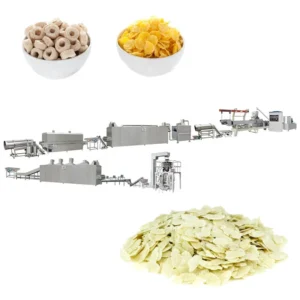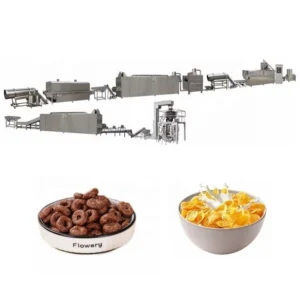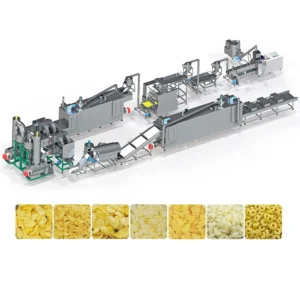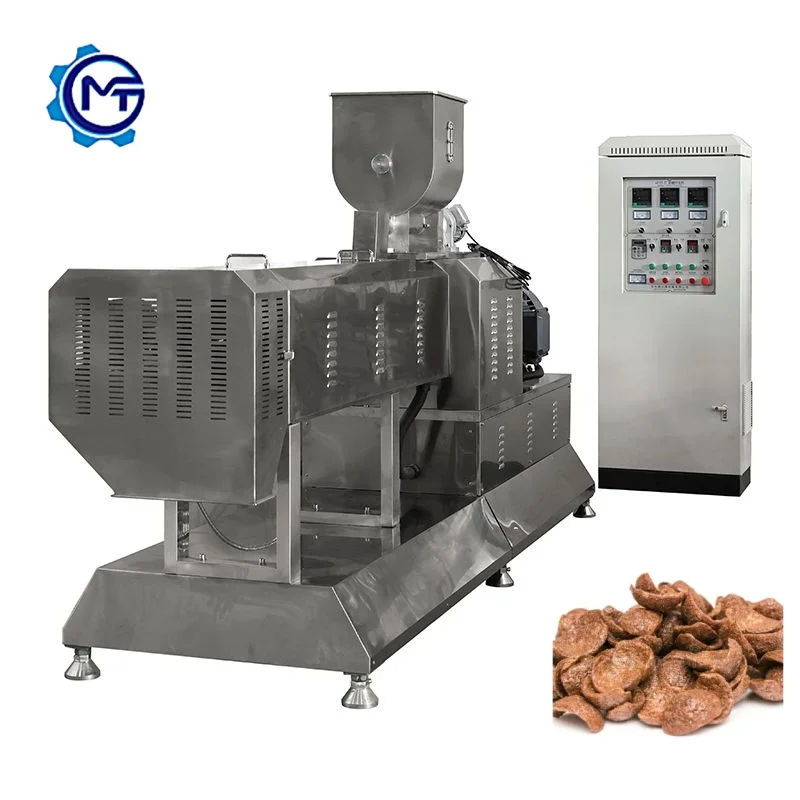
Precision-Matched Extrusion — Every MT70, MT85, and MT75 corn flakes line is configured with screw geometry and barrel zones mapped to the buyer’s actual flour blend, not assembled from a generic build sheet.
Technical Specifications
| Parameter | Value |
|---|---|
| Model | MT70 / MT85 / MT75 |
| Product Type | Corn Flakes Breakfast Cereal Production Line |
| Extruder Type | Twin Screw |
| Installed Power | 160 kW (MT70) / 190 kW (MT85) / 210 kW (MT75) |
| Power Consumption | 120 kW (MT70) / 140 kW (MT85) / 150 kW (MT75) |
| Capacity | 150–200 kg/h (MT70) / 300–400 kg/h (MT85) / 300–500 kg/h (MT75) (basis not stated in source — confirm raw material, moisture content, and product format) |
| Overall Dimensions | 41 × 1.5 × 2.2 m (MT70) / 43 × 1.5 × 3.2 m (MT85) / 45 × 1.5 × 3.5 m (MT75) |
| Raw Materials | Corn, rice, wheat, oat, barley powder |
| Final Products | Natural corn flakes, sugar-coated corn flakes, shaped puffed cereals (ball, tube, ring, fruit loop, star, wheel, flower, heart) |
| Line Stations | Mixing, Extruding, Flaking, Drying, Hot Air Roasting, Sugar Coating (optional), Cooling, Packing |
| Flaking Machine | PLC control, hydraulic double-roller system, double motors, infrared sensor temperature control |
| Dryer Heating Source | Gas / Electric (multi-fuel option) |
| Roasting Oven | Hot air roasting with vibrating pan, conciliation burner, dual circulating fans, cyclone dust removal |
| Coating System | Double tumble sugar melting, elevator, coating drum, spraying nozzle |
| Screw Material | Wear-resistant alloy (verify against manufacturer catalog) |
| Control System | PLC (confirmed for flaking station; full line PLC/MCC configuration to be confirmed) |
| Voltage & Frequency | To be confirmed before ordering |
| Standards | CE, ISO |
Application Suitability
| Application | Material or Output |
|---|---|
| Natural corn flakes manufacturing | Corn grits and corn flour blends |
| Sugar-coated breakfast cereals | Corn, rice, or multi-grain flakes with sugar or honey glaze |
| Multi-grain flake production | Blends of wheat, oat, barley, and rice flour |
| Shaped puffed cereal formats | Rings, balls, loops, stars, and wheels from cereal dough |
| Fortified breakfast cereal lines | Grain flour with added vitamin and mineral premix |
Why "Rated Capacity" Means Nothing Without the Flour Blend
A corn flakes production line extrusion technology rated at 400 kg/h on pure corn grits may drop significantly when the recipe shifts to a multi-grain blend with higher fiber content — yet many quotations never mention the test basis. The only capacity figure worth evaluating is the one measured on your exact raw material at your target moisture content.
I once set up a breakfast cereal line for a South Asian buyer who ran standard corn flour during our factory trial. When the machine arrived on-site, the buyer switched to a blend with cocoa powder and the expansion collapsed. The flakes came out dense, the blister pattern vanished during roasting, and the entire first batch was scrapped. That failure had nothing to do with motor power and everything to do with screw pitch and barrel temperature zones that were never tuned for that specific recipe. [NEED_CITE: effect of fiber and fat content on twin-screw extrusion expansion]
Selecting the correct corn flakes production line extrusion technology means confirming throughput on the actual flour blend — not trusting a catalog number derived from ideal laboratory conditions.
Screw Geometry and the Density Problem
The twin-screw configuration in the MT70, MT85, and MT75 series determines how cereal dough is sheared, mixed, and cooked inside the barrel. Screw pitch, flight depth, and kneading block arrangement all influence residence time and the degree of starch gelatinisation. A configuration that works for pure corn may over-shear a delicate oat blend, destroying the starch structure needed for proper flake expansion downstream.
Barrel Temperature Zones and Flake Blistering
Barrel temperature profiling works in stages: feed zone, compression zone, and metering zone each require distinct thermal settings. Corn flakes production line extrusion technology depends on these zones being matched to the flour’s gelatinisation window. Too much heat early on causes premature expansion inside the barrel; too little leaves raw starch that will never blister correctly in the roasting oven. [NEED_CITE: starch gelatinisation temperature ranges for corn and multi-grain flours]
Reading the Specs That Actually Matter
The installed power ratings — 160 kW, 190 kW, and 210 kW across the three models — indicate motor headroom, not energy efficiency. What matters more for daily operation is the power consumption figures of 120 kW, 140 kW, and 150 kW, which reflect realistic running load. The hydraulic double-roller flaking machine uses infrared sensor temperature control to maintain consistent roller surface temperature, which directly governs flake gauge uniformity across the full roller width. A flake that varies in thickness by even fractions of a millimetre will toast unevenly in the roasting oven, producing a mix of burnt and underdone pieces in the same batch. The hot air roasting oven uses a conciliation burner with dual circulating fans, ensuring that blister formation on the flake surface occurs evenly. Cyclone dust removal captures fines generated during roasting, keeping the production environment clean and reducing product loss.
The Hidden Cost of a Mismatched Line
When the dryer or roaster is sized smaller than the extruder output, the line bottlenecks at the thermal stages. Flakes pile up on the conveyor, cool below the required roasting entry temperature, and lose the moisture gradient needed for proper blistering. [NEED_CITE: throughput matching between extrusion and thermal processing stages] The result is a product that looks acceptable on the line but turns soggy within seconds of hitting milk in the bowl. Similarly, an undersized flaking station forces operators to widen the roller gap, producing flakes that are too thick to achieve the crunch profile the market expects. These mismatches do not appear in the quotation stage — they surface only during commissioning, when re-engineering the line is expensive and time-consuming.
Why Source This Line from Meiteng
Complete line throughput is calculated station-by-station so the extruder, flaker, dryer, and roaster all run at matched capacity rather than being assembled from separate vendor catalogs. Screw configuration and die design are specified to the buyer’s raw material and target flake thickness before production begins. An in-house testing workshop allows trial runs on the customer’s actual flour blend, generating a documented run report before the line ships. Twin-screw extrusion expertise spans corn flakes, multi-grain cereals, and shaped puffed formats on the same platform. Pre-sales engineering covers line layout and utility planning, followed by on-site installation, commissioning, and operator training at the buyer’s facility.
Documentation & Verification
- Line layout drawing with station-by-station capacity calculation for your target flake format
- Screw and die configuration record matched to your specific cereal flour blend
- Trial run report generated on your raw material in our testing workshop before dispatch
- Electrical schematic with voltage and frequency confirmed to your local grid standard
- CE declaration of conformity and ISO certificate for import clearance
- Operation and maintenance manual with wear parts list for screws, dies, and flaking rollers
Installation, Commissioning & Support
- Foundation plan based on line dimensions up to 45 m in length with utility connection points
- Dedicated electrical circuit sized to the model’s installed power of up to 210 kW
- Modular station delivery with on-site assembly and belt alignment across all conveyors
- First-run parameter tuning including barrel zones, roller gap, and roaster temperature profile
- Operator training covering screw configuration changes for different cereal recipes
- Wear parts inventory list with lead times for replacement screws, dies, and roller shells
- Scheduled maintenance intervals for hydraulic system, burner, and circulating fan assemblies
Before You Request a Quotation
To configure the right line, share your target cereal flour blend and any additives, your required flake thickness and bowl-life specification, and your local voltage and frequency standard. If you plan to run both traditional flakes and shaped puffed formats, let us know which die changes you anticipate so the extruder can be specified accordingly. Providing a sample of your raw material allows us to run a trial in the testing workshop and confirm screw configuration before the quotation is finalised.
Frequently Asked Questions
Q: How is screw configuration selected for different cereal flour blends and target flake densities?
A: The screw pitch, flight depth, and kneading block arrangement are chosen based on the flour’s starch content, fiber level, and the target expansion ratio. A trial run on the buyer’s actual raw material in our testing workshop confirms the configuration before the extruder is built, ensuring the correct flake density and blister pattern are achieved from the first production run.
Q: What barrel temperature profile produces the correct blister pattern during hot air roasting?
A: Each barrel zone — feed, compression, and metering — is set to match the flour’s gelatinisation temperature. Proper gelatinisation inside the extruder ensures the flake surface reacts correctly to the roasting oven’s hot air, producing uniform blisters. The conciliation burner and dual circulating fans in the roaster then distribute heat evenly across the flake bed.
Q: How does flaking roller gap and temperature affect final flake thickness and bowl life?
A: The hydraulic double-roller system on the flaking station sets precise gap spacing, while infrared sensors maintain consistent roller surface temperature. Thinner flakes achieve greater crunch but may break during packing; thicker flakes retain more moisture and turn soggy faster in milk. The gap is tuned during the trial run to match your market’s bowl-life expectation.
Q: Can the same extruder produce both traditional corn flakes and shaped puffed cereal formats?
A: Yes. The twin-screw extruder platform accommodates different die plates for flakes as well as shaped formats such as rings, balls, loops, and stars. Switching between formats requires a die change and adjustment of screw configuration and barrel temperature zones, which are documented in the configuration record provided with each line.