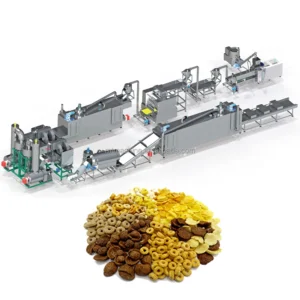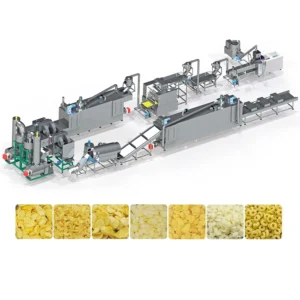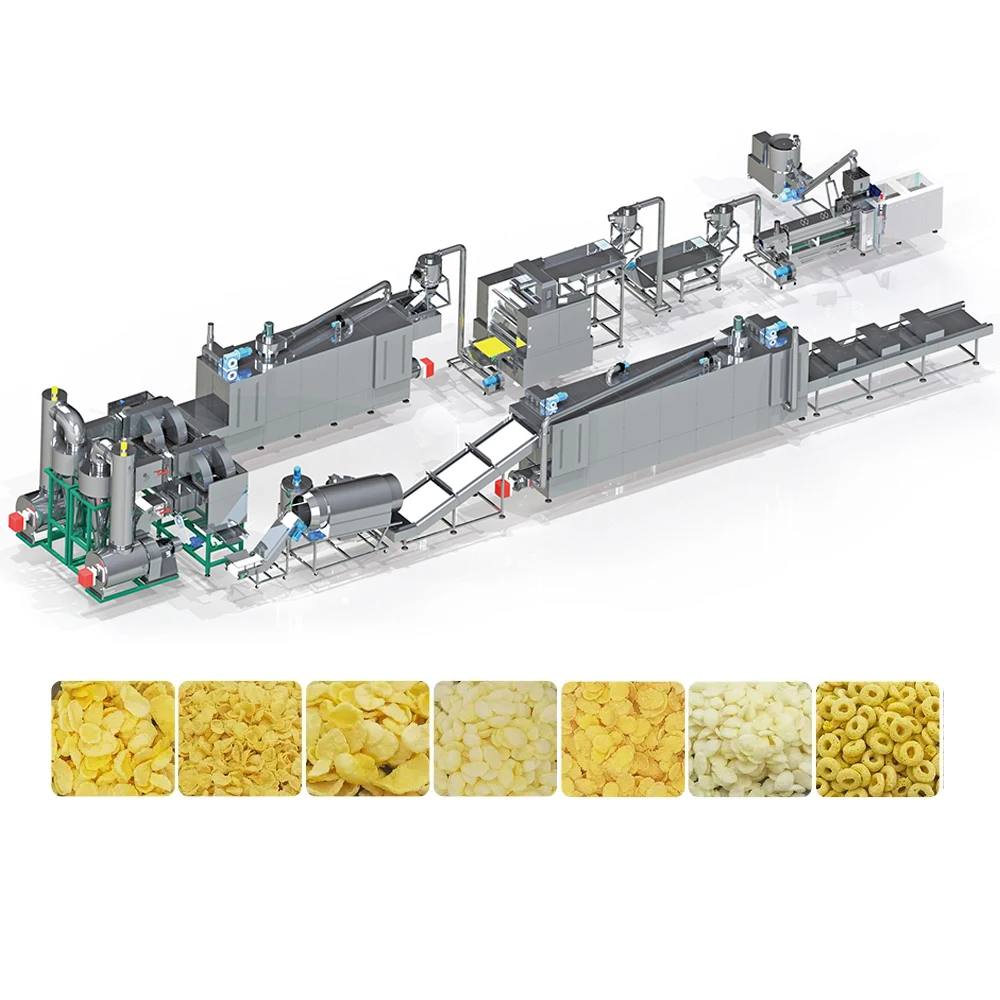
Custom Screw & Die Profiling — Every twin-screw extruder we dispatch ships with a screw configuration and die layout validated against the buyer’s own grain blend, ensuring consistent starch gelatinisation and flake density rather than generic output claims.
Technical Specifications
| Parameter | Value |
|---|---|
| Model | MT70, MT85, MT75 |
| Product Type | Corn Flakes Production Line |
| Screw Type | Twin-screw |
| Installed Power | 160 kW (MT70); 190 kW (MT85); 210 kW (MT75) |
| Power Consumption | 120 kW (MT70); 140 kW (MT85); 150 kW (MT75) |
| Capacity | 150–200 kg/h (MT70); 300–400 kg/h (MT85); 300–500 kg/h (MT75) (basis not stated in source) |
| Overall Dimensions (L×W×H) | 41 × 1.5 × 2.2 m (MT70); 43 × 1.5 × 3.2 m (MT85); 45 × 1.5 × 3.5 m (MT75) |
| Control System | PLC (flaking machinery); line-wide MCC/PLC implied |
| Basic Materials | Corn, rice, wheat, oat, barley powder |
| Production Procedure | Mixing → Extruding → Flaking → Drying → Hot Air Roasting → Cooling → Packing |
| Optional Sugar Coating Line | Sugar Spraying → Sugar Coating → Drying |
| Dryer Heating Source | Gas, Electric |
| Flaking Machinery | Hydraulic double rollers, infrared sensor temperature control |
| Key Features | Automatic lubrication, cooling function, wear-resistant screw |
| Standards | CE, ISO |
Application Suitability
| Application | Material or Output |
|---|---|
| Natural corn flakes | Corn grits or corn flour, roasted to crisp texture |
| Sugar-coated corn flakes | Sugar glaze applied post-extrusion and pre-roasting |
| Multi-grain breakfast cereal | Blends of rice, wheat, oat, and barley powders |
| Shaped cereal snacks | Ball, tube, ring, star, wheel, flower, heart via die change |
What "Rated Capacity" Leaves Out About Corn Flake Extrusion
A throughput figure means nothing until it is validated on your specific grain formulation.
I learned this the hard way when a Southeast Asian producer installed a line rated for a certain output, only to find that their locally sourced corn grits were coarser than the test medium. The dough never achieved full starch gelatinisation, the flakes came out thick and uneven, and actual output fell well below the nameplate. The extruder was not defective — the screw configuration and barrel temperature profile had simply been set for a different material. [NEED_CITE: starch gelatinisation requirements for cereal extrusion] This is why corn flakes extrusion line production technology demands a trial run on the buyer’s actual raw material before any capacity commitment is made.
Barrel Temperature Profiling and Starch Gelatinisation
Achieving the correct gelatinisation degree in the extruder barrel is the foundation of every downstream step. The twin-screw design allows precise control over moisture content, shear intensity, and residence time across multiple heating zones. Corn flakes extrusion line production technology depends on matching the barrel temperature profile to the grain blend — a pure corn recipe behaves very differently from a multi-grain mix containing oat and barley. Insufficient gelatinisation leaves the dough unable to hold shape during flaking, while excessive heat degrades the starch and produces a brittle flake that shatters in the roasting oven.
Die Design and Expansion Ratio Control
The die plate at the extruder outlet determines the cross-section of the extrudate and, critically, the expansion ratio as the dough exits into atmospheric pressure. A die opening that is too large produces a puff that the hydraulic flaking rollers cannot compress into a uniform sheet. A die that is too small generates excessive back-pressure, forcing the extruder motor to work harder and shortening screw life. [NEED_CITE: die geometry influence on extrudate expansion in food processing] The die configuration must therefore be specified alongside the screw profile and barrel settings, not selected from a generic catalogue.
How Installed Power, Flaking Pressure, and Roasting Temperature Interact
Looking at the spec sheet, the MT70 draws 120 kW during operation while the larger MT75 requires 150 kW — this power difference reflects both motor load and the thermal energy needed for barrel heating across a longer extruder. The hydraulic double-roller flaking station downstream uses an infrared sensor to monitor pipe temperature, keeping the sheet thickness uniform before the product enters the hot air roasting oven. The roasting oven itself uses a vibrating pan with high-temperature spraying tubes, two separate circulating fans, and a cyclone dust removal device. If the extruder delivers an extrudate with inconsistent density, no amount of roasting adjustment can correct the final crunch. Every station in the line must be throughput-matched so that the flaking rollers, dryer, and roasting oven handle the exact volume the extruder produces.
The Hidden Cost of Mismatched Extrusion Parameters
When screw configuration is copied from a generic build rather than specified to the buyer’s raw material, the problems do not appear until the first production run. Flakes may come out too dense to roast properly or too fragile to survive coating and packing. [NEED_CITE: post-installation commissioning issues in cereal extrusion lines] Producers then spend weeks adjusting barrel temperatures and swapping dies, losing raw material and missing delivery windows. The real cost is not the price of replacement screws — it is the lost production time and the batch rejections that follow.
Why Source the Extrusion Technology Here
The screw configuration and die design are specified to the buyer’s raw material blend and target flake density, not pulled from a standard shelf build. An in-house testing workshop runs trial batches on the customer’s actual grain formulation before shipment, confirming gelatinisation degree, expansion ratio, and flake uniformity. Complete line throughput is matched across extrusion, flaking, drying, and roasting so no single station becomes a bottleneck. Pre-sales engineering covers layout design, utility planning, and voltage confirmation — not just a quotation. CE and ISO documentation is provided as standard, not as an optional extra.
Documentation & Verification
- Line layout and capacity calculation matched to your grain blend and target output
- Screw and die configuration record specific to your raw material formulation
- Trial run report from in-house testing workshop on your grain before dispatch
- Electrical schematic with voltage and frequency confirmed to your facility
- CE declaration of conformity and ISO certificate included with shipment
- Operation and maintenance manual with wear parts list
Installation, Commissioning & Support
- Foundation plan accounts for the 41–45 m line length and vibrating roasting oven load
- Electrical supply matched to the 120–150 kW operating consumption and local voltage standard
- Extruder barrel segments and screw elements shipped disassembled for container loading
- Commissioning includes first-run barrel temperature calibration and die adjustment on your grain
- Operator training covers PLC interface navigation, screw wear inspection, and hydraulic roller pressure setting
- Wear parts list identifies replacement screws, dies, and roasting oven spray tubes for initial stocking
What We Need to Specify Your Line
To move past a generic quotation, we need your grain formulation and particle size distribution, the target flake density and crunch profile, and your facility voltage and frequency standard. If you are producing both natural and sugar-coated variants, let us know the split so we can size the coating drum and additional drying capacity accordingly. A raw material sample shipped to our testing workshop allows us to validate the corn flakes extrusion line production technology parameters before the order is finalised.
Frequently Asked Questions
Q: How is screw configuration selected for different grain blends?
A: Each grain — corn, wheat, oat, barley — has a distinct starch composition and particle behaviour under heat and shear. We adjust screw element arrangement, compression ratio, and barrel zone temperatures to match the blend. A trial run on the buyer’s actual formulation confirms the correct setup before the extruder ships.
Q: What moisture level is needed for full starch gelatinisation?
A: The required moisture depends on the grain blend and the residence time inside the barrel. Pure corn typically needs a different moisture target than a multi-grain mix. Our testing workshop determines the exact preconditioning moisture and barrel steam injection settings for your specific recipe.
Q: How does die design affect the flaking process?
A: The die opening controls the expansion ratio of the extrudate as it exits the barrel. If expansion is too high, the flaking rollers cannot produce a uniform sheet. We specify die geometry together with screw configuration so the extrudate arrives at the rollers at the correct density and thickness.
Q: How is extrusion capacity verified on the buyer’s raw material?
A: We run the buyer’s grain through the extruder in our testing workshop and document actual throughput, gelatinisation degree, and flake density. This trial run report accompanies the shipment, replacing generic nameplate claims with data from the specific formulation the line will process.
Q: How do extrusion shear and roasting temperature interact?
A: Extrusion shear and barrel heat determine how completely the starch gelatinises inside the dough. The roasting oven then drives off residual moisture and develops the final crunch. If the extruder delivers inconsistent gelatinisation, the roasting oven cannot compensate, resulting in flakes that are either too soft or too brittle.