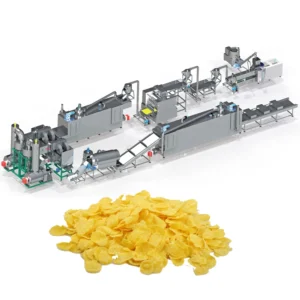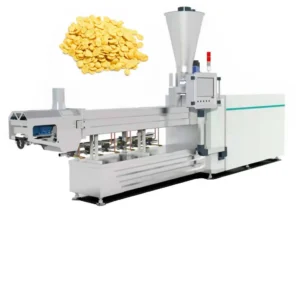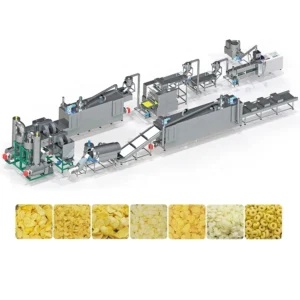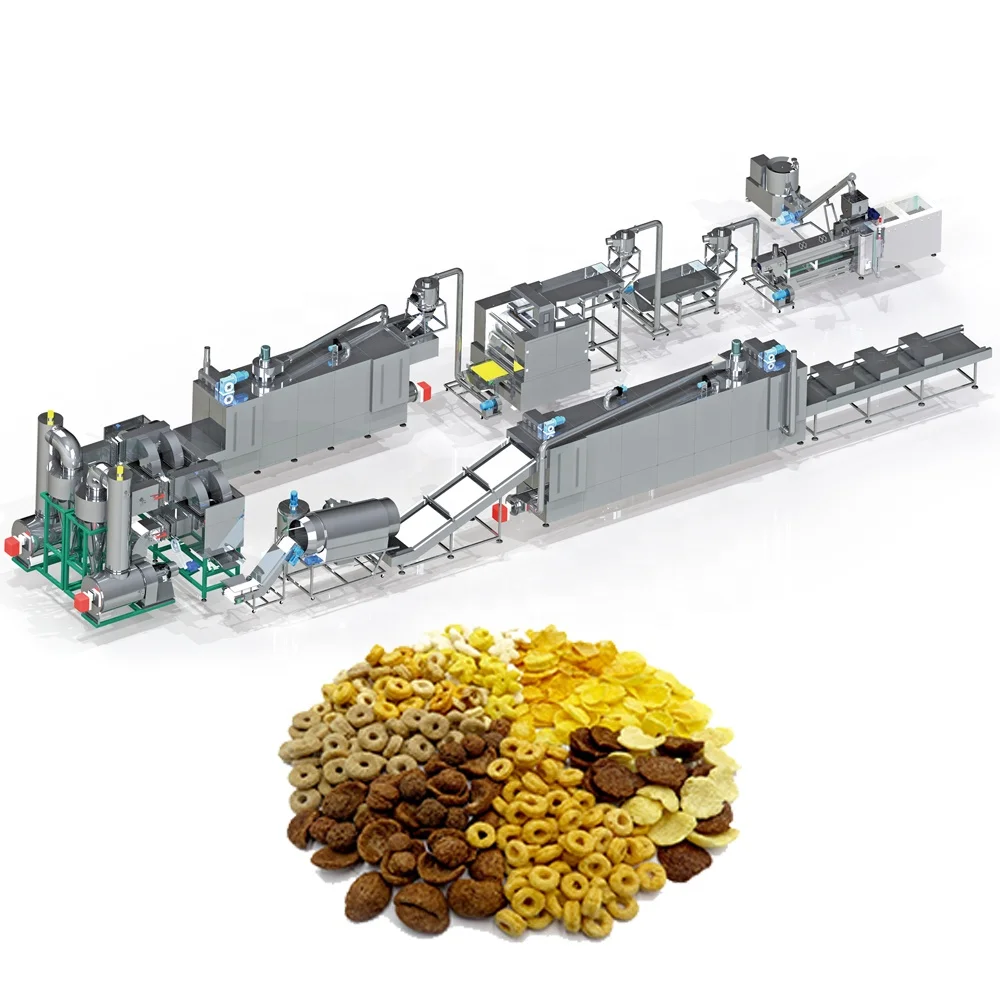
Screw Configuration Matched to Grain — MT70, MT85, and MT75 extruders ship with die sets and barrel profiles specified to the buyer’s actual corn, rice, or wheat formulation after in-house trial runs.
Technical Specifications
| Parameter | Value |
|---|---|
| Product Type | Corn Flakes Production Line |
| Models Available | MT70, MT85, MT75 |
| MT70 Installed Power | 160 kW |
| MT70 Power Consumption | 120 kW |
| MT70 Output Capacity | 150-200 kg/hr (basis not stated in source — confirm raw material formulation and moisture content) |
| MT70 Overall Dimensions | 41 × 1.5 × 2.2 m |
| MT85 Installed Power | 190 kW |
| MT85 Power Consumption | 140 kW |
| MT85 Output Capacity | 300-400 kg/hr (basis not stated in source — confirm raw material formulation and moisture content) |
| MT85 Overall Dimensions | 43 × 1.5 × 3.2 m |
| MT75 Installed Power | 210 kW |
| MT75 Power Consumption | 150 kW |
| MT75 Output Capacity | 300-500 kg/hr (basis not stated in source — confirm raw material formulation and moisture content) |
| MT75 Overall Dimensions | 45 × 1.5 × 3.5 m |
| Extruder Type | Twin Screw |
| Flaking Machine | Hydraulic double-roller, PLC controlled, infrared sensor temperature control |
| Dryer Heating Source | Gas or Electric |
| Roasting Oven | Hot air roasting, vibrating pan, two circulating fans, cyclone dust removal |
| Coating System | Double tumble sugar melting, elevator, coating drum, spraying nozzle |
| Control System | PLC |
| Screw Feature | Automatic lubricating and cooling function |
Application Suitability
| Application | Material or Output |
|---|---|
| Natural corn flakes | Degermed maize grits with controlled residual fat |
| Sugar-coated corn flakes | Corn base with double tumble sugar coating |
| Multi-grain breakfast cereal | Blends of corn, rice, wheat, oat, barley powder |
| Shaped cereal formats | Ball, tube, stick, ring, fruit loop, star, wheel, flower, heart shapes via die adjustment |
Why the Corn Flakes Extrusion Line Specifications Must Start with the Grain
A twin screw corn flakes extruder configuration built without testing the buyer’s grain will produce flakes with the wrong density and texture.
When process engineers copy a screw profile from a generic build, the barrel temperature zones and shear forces rarely match the starch gelatinisation window of the actual raw material. I have watched lines produce rock-hard flakes because the maize had higher residual fat than the lab sample used for the original setup. The starch never fully gelatinised, and the result was unsellable [NEED_CITE: starch gelatinisation temperature ranges for different maize varieties]. Getting the corn flakes extrusion line specifications right means matching every barrel zone to how your specific grain behaves under heat and moisture.
Barrel Temperature Profiling and Starch Gelatinisation
The degree of starch gelatinisation determines whether a corn flake fractures cleanly or crumbles during roasting. A twin screw corn flakes extruder configuration divides the barrel into multiple heating zones, each set to a different temperature to control how the grain transitions from raw powder to a fully cooked dough. The moisture content entering the extruder and the residence time in each zone together define the gelatinisation window. When a buyer switches from one maize supplier to another, even a small change in fat or protein content can shift this window enough to require a new barrel profile.
Screw Geometry and Shear Force Control
The screw elements inside a twin-screw extruder are modular, and their arrangement determines the shear force applied to the grain matrix. High-shear kneading blocks break down cell walls and promote starch release, while conveying elements move the material forward with minimal mechanical energy input. The right corn flakes extrusion line specifications balance these elements so the dough reaches the die at the correct viscosity. Too much shear generates excessive heat and over-gelatinises the surface; too little leaves raw pockets that expand unevenly during flaking [NEED_CITE: twin screw element geometry and shear rate relationships in food extrusion].
Die Design and Expansion Behaviour
The die plate at the extruder discharge controls the shape and initial expansion of the extrudate before it enters the flaking rollers. For corn flakes, the die orifice is typically a narrow slot that produces a thin ribbon, which the hydraulic double-roller flaking machine then presses to final thickness. The die geometry must account for the swell ratio of the specific grain blend — a high-oat formulation will expand differently from pure maize. Die options also allow the same extruder to produce ball, tube, ring, fruit loop, star, and other breakfast cereal shapes by swapping the die insert.
How Motor Power and Capacity Interact Across the Range
The MT70 draws 120 kW and targets lower-throughput production, while the MT85 and MT75 pull 140 kW and 150 kW respectively for higher volume. Installed power exceeds consumption because the motor must handle peak torque during start-up and when dough viscosity spikes from a moisture fluctuation. Output capacity figures are always tied to the raw material formulation and moisture content entering the barrel — a denser grain blend or a higher moisture recipe will change the throughput. The MT75 twin-screw extruder itself is rated at 200-300 kg/hr on standard formulations, and the full line throughput depends on matching the dryer and roasting oven capacity to this extruder output.
The Hidden Cost of Skipping a Trial Run
When an extruder ships without a trial run on the buyer’s actual grain, the first production week often becomes an expensive experiment. Screw profiles need adjusting, barrel temperatures need recalibrating, and the flaking pressure may need tuning — all while the line is installed on-site and every hour of downtime costs money. I have seen this play out in West Africa and South Asia where local maize varieties behave nothing like the reference grain used at the factory [NEED_CITE: grain variability in tropical export markets and its effect on extrusion]. Without pre-shipment testing, the buyer absorbs all the commissioning risk.
Why Procurement Should Focus on Extrusion Parameters
Every station on this line is sized so throughput matches across the extruder, flaking machine, dryer, and roasting oven, eliminating the bottleneck problem that plagues lines assembled from separate vendors. The screw and die configuration record is specified to the buyer’s raw material and target flake density before production begins. An in-house testing workshop runs the buyer’s actual grain to confirm texture, expansion, and gelatinisation degree before the machine ships. Electrical schematics include voltage and frequency confirmation for the destination market, preventing the commissioning delays that happen when a control panel is wired for the wrong supply. The PLC control system allows operators to store and recall barrel temperature profiles for different grain formulations, maintaining batch-to-batch consistency.
Documentation & Verification
- Screw and die configuration record matched to your grain formulation and target flake density
- Trial run report on your raw material confirming expansion, texture, and gelatinisation before dispatch
- Machine specification sheet with full electrical schematic and destination voltage confirmation
- Line layout drawing with capacity calculation across extruder, flaking, drying, and roasting stations
- CE declaration of conformity and ISO certificate for import and compliance documentation
- Wear parts list covering screw elements, die inserts, and flaking roller surfaces
Installation, Commissioning & Support
- Foundation plan accounts for the 41-45 m line length and 150-210 kW total power draw across three phases
- Dedicated electrical circuit sized for MT75 peak start-up torque at 210 kW installed power
- Extruder barrel sections arrive modular and are assembled on-site to match the confirmed screw profile
- First-run commissioning includes barrel temperature calibration on your grain through all heating zones
- PLC interface language and control labels configured to your operator’s preferred language before shipment
- Spare screw elements and die inserts ship with the line so first replacement does not interrupt production
What to Include in Your Inquiry
To configure the right extrusion setup, share your grain type and supplier specifications including moisture and fat content, the target flake density and format you need for your market, and the daily output volume you plan to run. Include your workshop’s available floor space and ceiling height, the local voltage and frequency standard, and your preferred PLC operating language. If you have an existing upstream mixer or downstream packing system, let us know so the line interfaces correctly.
Frequently Asked Questions
Q: How is screw configuration determined for my specific grain formulation and target flake density?
A: We start with your raw material data sheet — moisture, fat, protein, and particle size. A screw element arrangement is then designed to deliver the right shear and residence time for your grain’s gelatinisation window. A trial run in our testing workshop on your actual grain confirms the configuration before the extruder ships, and the final screw and die record is documented for your reference.
Q: What barrel temperature profile and moisture range produce natural versus sugar-coated corn flakes?
A: Natural flakes typically need a higher gelatinisation degree and tighter moisture control so the flake roasts evenly without blistering. Sugar-coated formats tolerate a slightly wider moisture band because the coating step adds surface moisture and heat. The PLC stores separate barrel zone profiles for each format so operators can switch between them without manual recalibration.
Q: How do I verify the stated output capacity against my actual raw material?
A: Capacity figures depend on grain density, moisture content, and the target flake thickness. We run a measured trial on your raw material in the testing workshop and record the actual throughput at steady state. This verified output forms the basis for sizing the downstream dryer, roasting oven, and packing station so every part of the line matches.
Q: What die options are available for producing different breakfast cereal shapes on the same extruder?
A: The extruder accepts interchangeable die inserts for shapes including ball, tube, stick, ring, fruit loop, star, wheel, flower, and heart formats. Each die geometry is matched to the grain blend’s expansion behaviour so the extrudate holds its shape through the flaking or cutting stage. Switching shapes requires only a die change and a PLC profile adjustment.