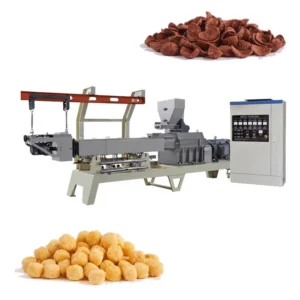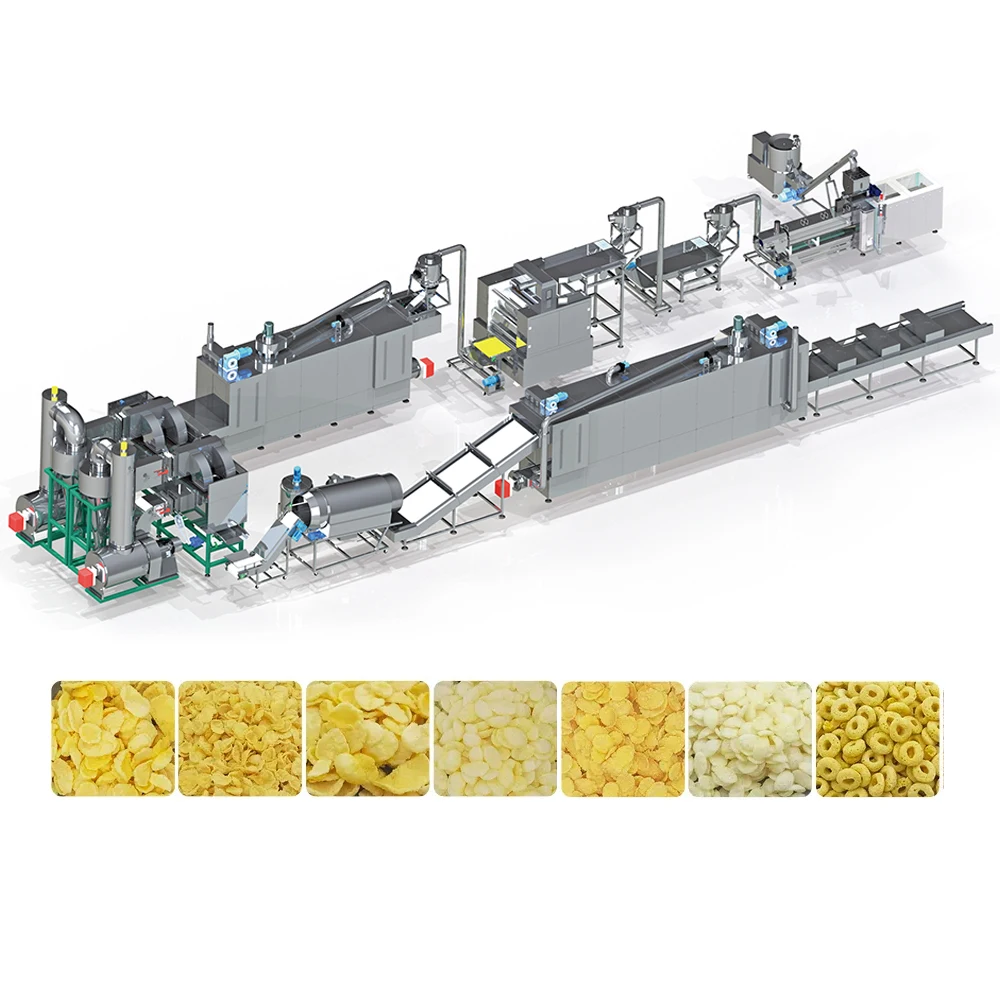
Screw configuration matched to raw material — Every MT75 corn flakes line ships with a screw geometry and die setup calculated from the buyer’s actual formulation, not copied from a generic build.
Technical Specifications
| Parameter | Value |
|---|---|
| Product Type | Corn Flakes Production Line |
| Model | MT75 (also available: MT70, MT85 variants) |
| Screw Type | Twin Screw |
| Installed Power | 210 kW (MT75); 160 kW (MT70); 190 kW (MT85) |
| Power Consumption | 150 kW (MT75); 120 kW (MT70); 140 kW (MT85) |
| Output Capacity | 300–500 kg/h (MT75); 150–200 kg/h (MT70); 300–400 kg/h (MT85) (basis not stated in source — confirm raw material / moisture / flake thickness) |
| Overall Dimensions | 45 × 1.5 × 3.5 m (MT75); 41 × 1.5 × 2.2 m (MT70); 43 × 1.5 × 3.2 m (MT85) |
| Control System | PLC automated line control |
| Flaking Machine Drive | Double motors for separate roller driving; hydraulic system for double rollers |
| Flaking Temperature Control | Infrared sensor for even temperature pipe control |
| Dryer Heating Source | Gas or Electric |
| Roasting Oven | Hot air roasting with conciliation burner, two circulating fans, cyclone dust removal |
| Coating System | Double tumble for sugar melting, elevator, coating drum, spraying nozzle |
| Basic Raw Materials | Corn, rice, wheat, oat, barley powder |
| Standards | CE, ISO |
Application Suitability
| Application | Material or Output |
|---|---|
| Natural corn flakes production | Corn grits and corn flour at controlled moisture |
| Sugar-coated breakfast cereals | Corn, rice, or wheat base with sugar or honey coating |
| Shaped cereal formats (loops, stars, balls, rings) | Oat, barley, and mixed grain blends via die adjustment |
| Fortified breakfast cereal lines | Vitamin and mineral premix blended into grain flour |
| Scale-up from pilot to continuous output | Matching extrusion throughput to flaking and roasting capacity |
Why Starch Gelatinisation Decides Whether Your Flakes Survive the Bowl
Flakes that collapse in milk usually trace back to undercooked starch inside the extruder barrel.
I spent years debugging lines across Africa and South Asia, and the most common failure I see on corn flakes extrusion technology lines is not mechanical — it is biochemical. When the barrel temperature profile does not match the corn grit’s actual moisture and fat content, gelatinisation stays incomplete. The pellet looks fine coming out of the die. It even flakes well. But once it hits the roasting oven, the internal structure lacks the rigidity to hold shape, and the flake disintegrates within seconds of contacting liquid. Process engineers often blame the roaster or the flaking rollers, when the root cause sits upstream in the screw configuration [NEED_CITE: starch gelatinisation degree measurement methods for extruded cereal products].
How Screw Geometry Controls Pellet Integrity Before Flaking
The twin-screw configuration on this corn flakes production line extrusion technology setup allows operators to adjust pitch, kneading block angle, and reverse-flight sections to control residence time and shear intensity. Corn grits at higher moisture need gentler shear and longer barrel dwell to reach full gelatinisation without over-expanding at the die face. The screw combination is rebuilt around the buyer’s specific corn variety and formulation before the machine ships.
Die Design and Its Direct Effect on Flake Thickness
The die determines pellet cross-section and wall density, which the flaking rollers then compress into the final flake. A pellet that exits too dense will resist compression and crack rather than flatten. One that exits too expanded will shatter under roller pressure. Die hole diameter, land length, and face geometry are specified together with the screw profile to target the exact pellet characteristics the flaking station requires [NEED_CITE: die land length effects on extrudate density in food extrusion].
Reading the Specifications That Actually Matter
The 210 kW installed power on the MT75 reflects the torque demand of pushing a high-moisture corn dough through restrictive die plates at continuous throughput. Power consumption at 150 kW indicates typical running load under matched raw material conditions. The hydraulic double-roller flaking system provides adjustable nip pressure, which directly controls flake thickness — thinner flakes roast faster and crisp more completely, but become fragile during coating and packing if pushed beyond their structural limit. The infrared sensor on the flaking station maintains consistent roller surface temperature, preventing the pellet from sticking or cooling unevenly before compression. Hot air roasting with two separate circulating fans and a conciliation burner gives operators independent control over top and bottom heat zones, which is critical for triggering the surface bubble formation that creates the characteristic corn flake texture.
What Happens When Extrusion Parameters Are Set by Default
A screw and die configuration lifted from a generic template produces pellets that may look acceptable on a test bench but fail at continuous production speed. I have walked into plants where flakes sank in milk because the expansion ratio was too low — the barrel profile had been set for a different corn variety entirely. In other cases, over-expanded pellets shattered during sugar coating, generating dust that contaminated the packing line and caused reject rates that made the entire run uneconomical. These problems do not show up in a factory test run on standard corn flour [NEED_CITE: common extrusion defects in breakfast cereal manufacturing].
Why Engineers Specify This Line for Extrusion-Sensitive Cereals
The screw configuration and die design are calculated against the buyer’s raw material and target product before production begins, rather than assembled from a catalogue of standard builds. The in-house testing workshop runs trial batches on the buyer’s actual corn or grain blend, generating a trial run report that documents barrel temperatures, screw RPM, moisture readings, and pellet density before the line ships. Throughput is matched across every station — extrusion, flaking, drying, roasting, and coating — under one supplier, eliminating the bottleneck that occurs when stations are sourced separately. The PLC control system logs process parameters continuously, giving operators a traceable record of every batch. CE and ISO certification is held for the complete line assembly, not just individual components.
Documentation & Verification
- Screw and die configuration record matched to your corn variety and formulation
- Trial run report on your actual raw material before shipment
- Line layout with throughput calculation across extrusion, flaking, and roasting
- Electrical schematic with voltage and frequency confirmation for your facility
- Barrel temperature profile and gelatinisation data from factory test
- CE declaration of conformity and ISO certificate for the full line
Installation, Commissioning & Support
- Foundation planning accounts for the 45 m line length and 3.5 m height clearance of the MT75
- Power supply requires dedicated circuit for 210 kW installed load with PLC panel isolation
- Line arrives in sectional modules with flaking and roasting stations pre-assembled
- First-run commissioning includes barrel temperature calibration to your corn formulation
- Operator training covers screw combination changes for different cereal formats
- Wear parts list with lead times for screw elements, die plates, and roller sleeves
What We Need to Configure Your Line
To specify the correct screw geometry and barrel profile, share your raw material type, moisture content at the mixer, and target flake thickness. We also need your facility voltage and frequency, available floor space with ceiling height, and whether your market requires natural flakes, sugar-coated output, or both. If you have an existing dryer or packing system that the line must integrate with, provide the equipment specifications so throughput matching can be confirmed before quotation.
Frequently Asked Questions
Q: How is screw configuration selected for different corn varieties and moisture levels?
A: The screw combination is built around your specific corn type — dent, flint, or flour corn each behave differently under shear. We take your raw material sample, measure moisture and fat content, then select kneading block angles, pitch sequence, and reverse-flight sections to reach the target gelatinisation degree without over-expansion at the die.
Q: What barrel temperature profile achieves proper gelatinisation without over-expansion?
A: The profile depends on your corn grit moisture and the die restriction. Typically, zones ramp from conditioning temperature through a peak cooking zone, then drop slightly before the die to control expansion. During the trial run, we map temperatures against your material and lock the profile into the PLC before shipment.
Q: How does die design affect flake thickness and final product density?
A: Die hole diameter and land length determine pellet density and cross-section. The flaking rollers then compress that pellet to final thickness. If the pellet exits the die too dense or too expanded, the rollers cannot produce a consistent flake. We match die geometry to your target flake specification during line configuration.
Q: Can the line run a trial on my raw material before shipment?
A: Yes. Our testing workshop runs your actual corn or grain blend through the configured extruder, flaking station, and roaster. The trial run report documents screw RPM, barrel temperatures, pellet density, flake thickness, and crunch duration, so extrusion parameters are confirmed before the line leaves the factory.
Q: How is expansion ratio and flake crunch verified during factory testing?
A: We measure pellet diameter against die hole size to calculate expansion ratio, then run flakes through the roaster and measure bowl life — the time the flake maintains structural integrity in liquid. Results are recorded in the trial report and compared against your target specification before acceptance.