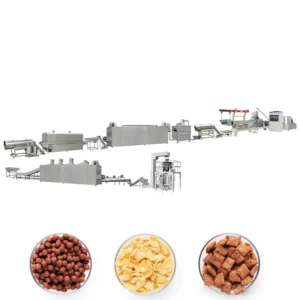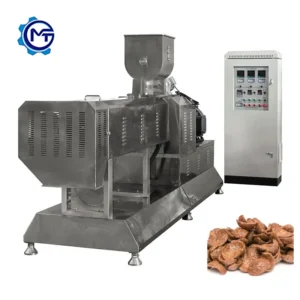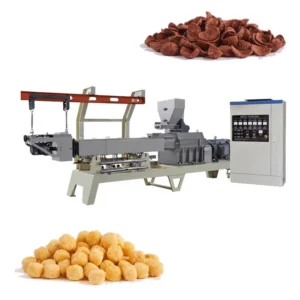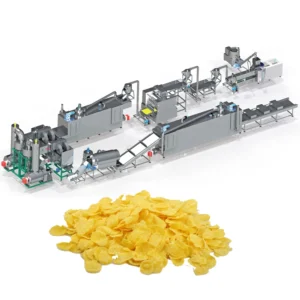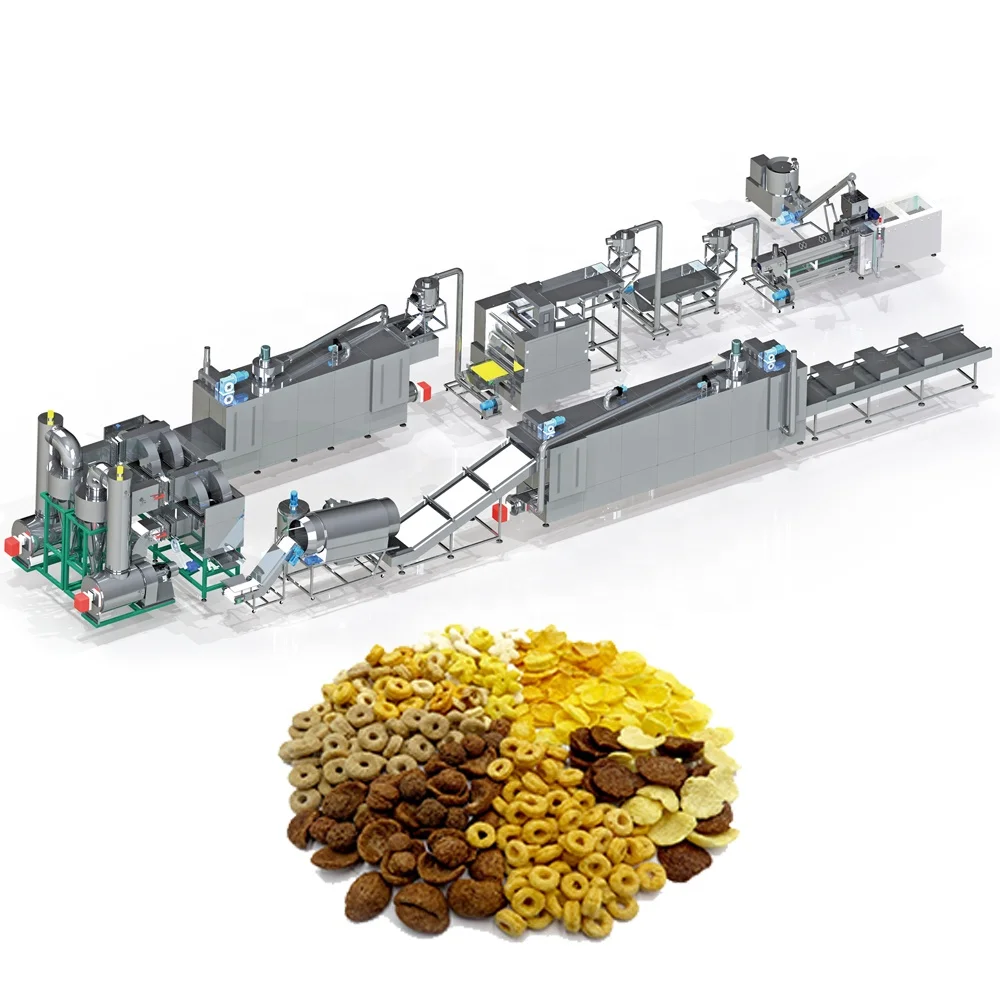
Screw Configuration Matched to Your Grain — Every extruder build starts with the buyer’s actual cereal formulation, not a generic template copied from another project.
Technical Specifications
| Parameter | Value |
|---|---|
| Product Type | Corn Flakes Breakfast Cereal Production Line |
| Models Available | MT70, MT75, MT85 |
| Extruder Type | Twin Screw Extruder |
| MT70 Installed Power | 160 kW |
| MT70 Power Consumption | 120 kW |
| MT70 Output Capacity | 150–200 kg/hr (basis to be confirmed) |
| MT70 Overall Dimensions | 41 × 1.5 × 2.2 m |
| MT75 Installed Power | 210 kW |
| MT75 Power Consumption | 150 kW |
| MT75 Output Capacity | 300–500 kg/hr (basis to be confirmed) |
| MT75 Overall Dimensions | 45 × 1.5 × 3.5 m |
| MT85 Installed Power | 190 kW |
| MT85 Power Consumption | 140 kW |
| MT85 Output Capacity | 300–400 kg/hr (basis to be confirmed) |
| Control System | PLC control (MCC and PLC available) |
| Flaking Drive | Double motors with independent roller drive |
| Flaking Pressure | Hydraulic system for double rollers |
| Flaking Temperature Control | Infrared sensor for even pipe temperature |
| Dryer Heating Source | Gas or Electric |
| Roasting Oven | Vibrating pan, reconciliation burner, dual circulating fans, cyclone dust removal |
| Coating System | Double tumble sugar melter, elevator, coating drum, spray nozzle |
| Basic Raw Materials | Corn, rice, wheat, oat, barley powder |
| Final Product Shapes | Natural and coated corn flakes; ball, tube, stick, ring, fruit loop, star, wheel, flower, heart |
| Standards | CE, ISO |
Application Suitability
| Application | Material or Output |
|---|---|
| Natural corn flakes production | De-germed corn grits with controlled moisture |
| Sugar-coated corn flakes | Corn flakes with sugar syrup coating and secondary drying |
| Multi-grain breakfast cereal | Blends of rice, wheat, oat, and barley powder |
| Extruded cereal shapes | Rings, balls, stars, fruit loops via die change on the same extrusion platform |
| Fortified breakfast cereal | Grain base with added vitamin and mineral premix |
What "300 kg/hr" Hides When Your Corn Grits Are Different
Capacity only holds when the screw, die, and barrel profile are tuned to your specific grain formulation.
A nominal throughput figure quoted on standard corn grits can collapse the moment the line meets your local raw material. I once watched a corn flakes line lose a significant share of its flake yield because the buyer’s de-germed corn had a higher residual fat content than the trial sample. The material turned sticky inside the barrel, expansion dropped, and the rollers produced uneven flakes that crumbled at the roasting stage. Two days of on-site barrel temperature and moisture adjustment followed. A corn flakes extrusion production line that has not been tested against your exact grain is a line whose real output remains unknown. [NEED_CITE: grain composition variability in global maize supply chains]
Barrel Profile and Starch Gelatinisation Control
The corn flakes extrusion production line relies on precise barrel temperature zones to achieve full starch gelatinisation without over-cooking the dough. Each zone along the barrel is independently heated and monitored, allowing the operator to set a gradient that matches the specific gelatinisation window of the grain blend in use. Corn requires a different thermal path than oat-heavy formulations, where the higher lipid content shifts the onset temperature. Getting this profile right is what separates a flake that toasts evenly in the roasting oven from one that scorches on the surface while staying dense inside.
Die Geometry and Flake Density Targeting
Die design directly governs the cross-section and expansion behaviour of the extrudate before it reaches the flaking rollers. A wider die opening with a specific land length produces a ribbon that compresses into a thicker, denser flake suited to the conventional corn flakes market. Switching to a narrower die with a shorter land creates a lighter expansion that suits multi-grain or fruit-loop-style cereal formats. The die is matched to the target product specification, not left as a default. [NEED_CITE: die land length influence on extrudate expansion in cereal processing]
Reading the Specs That Actually Matter on the Floor
The MT75 at 210 kW installed power and the MT85 at 190 kW illustrate that a higher installed power does not always correspond to a larger model number — the difference reflects screw geometry and torque requirements rather than simple size scaling. Power consumption figures (150 kW for the MT75, 140 kW for the MT85) show what the line draws under typical operating load, which is the number that determines your transformer sizing and cable specification. Overall line lengths from 41 m to 45 m mean you need a workshop with clear longitudinal space plus room for maintenance access on both sides. The hydraulic flaking system with independent dual-motor drive keeps each roller’s speed adjustable, which is critical when you need to fine-tune flake thickness without stopping the extruder. PLC control with MCC integration gives operators recipe storage so a change from natural corn flakes to sugar-coated variants can happen through parameter recall rather than manual recalibration of every heater zone.
The Cost of Skipping the Raw Material Test
When a line ships without a trial run on the buyer’s actual grain, every assumption about expansion ratio, flake integrity, and roasting time is a guess. On-site commissioning then becomes product development, burning raw material and production days while the screw configuration and barrel temperatures are adjusted from scratch. Flakes that sink in milk, shatter during packing, or emerge from the roaster with inconsistent colour are symptoms that trace back to an extruder that was set up for someone else’s corn. [NEED_CITE: commissioning delays caused by untested raw material in food extrusion]
Why Sourcing the Full Line from One Supplier Changes the Equation
Throughput matching across every station is engineered here rather than assembled from separate vendors, so the extruder output aligns with flaker capacity, dryer residence time, and roasting oven throughput without one station bottlenecking the rest. Screw configuration and die design are specified to the buyer’s raw material report and target flake density before the build begins. An in-house testing workshop runs the buyer’s actual grain through the extruder before shipment, generating a trial run report that confirms expansion, texture, and flake density against specification. The hot air roasting oven is equipped with a reconciliation burner and dual circulating fans to maintain even surface temperature across the full pan width. Electrical schematics, voltage confirmation, and PLC control language options are locked in before production starts, not discovered at commissioning.
Documentation & Verification
- Line layout drawing with throughput calculation across extruder, flaker, dryer, and roaster
- Screw and die configuration record matched to your grain formulation
- Trial run report on your raw material confirming flake density and expansion
- Electrical schematic with confirmed voltage, frequency, and control language
- Operation and maintenance manual with wear parts list for screws and dies
Installation, Commissioning & Support
- Foundation plan based on the 45 m line length with load-bearing points for the MT75 extruder and hydraulic flaker
- Dedicated power circuit sized to the 210 kW installed power of the MT75 with transformer specifications
- Sequential commissioning from mixing through packing with barrel profile tuning on your grain
- Operator training covering PLC recipe storage and die changeover procedures
- Wear parts inventory covering screws, dies, and flaker roller surfaces for the first replacement cycle
What to Send with Your Inquiry
Share your raw material specification including moisture content and fat percentage, your target flake density and crunch texture, and the daily output you need to meet. Include your workshop dimensions and ceiling height, local voltage and frequency, and the PLC control language your operators require. If you have existing upstream or downstream equipment that the new line must integrate with, provide those details so the layout accounts for connection points.
Frequently Asked Questions
Q: How is the extruder screw configuration matched to my specific cereal grain blend?
A: The screw elements and die are selected after reviewing your raw material report — including grain type, moisture, fat, and starch content. A trial run in the testing workshop then confirms that expansion ratio and extrudate texture meet your flake density target before the configuration is finalised for production.
Q: Can I verify line capacity on my actual raw material before shipment?
A: Yes. Your grain is run through the extruder in the in-house testing workshop, and a trial run report documents flake density, expansion, and texture against your specification. This report is shared with you before the line is crated for dispatch.
Q: How is throughput balanced between the extruder, flaker, and roasting oven?
A: Each station’s capacity is calculated to match the extruder output so that no single machine creates a bottleneck. The hydraulic flaker speed, dryer residence time, and roasting oven pan feed rate are all coordinated in the line layout proposal.
Q: What barrel temperature profile is used for corn versus oat-based flakes?
A: Corn typically requires a higher peak barrel temperature to achieve full starch gelatinisation, while oat blends with higher lipid content need a lower gradient to prevent oil separation. The PLC stores separate thermal profiles for each formulation, recalled when switching products.
Q: What electrical and control details are confirmed before production begins?
A: Voltage, frequency, and PLC control language are confirmed and documented in the electrical schematic before manufacturing starts. This ensures the line connects to your facility’s power supply and is operable in the language your team uses, avoiding delays at commissioning.