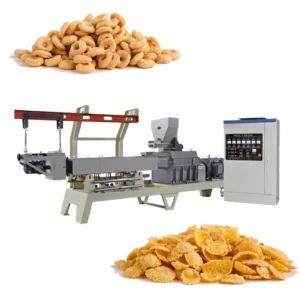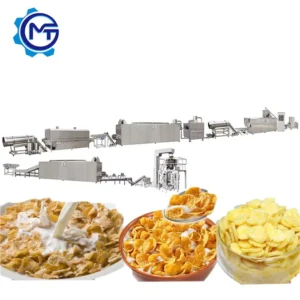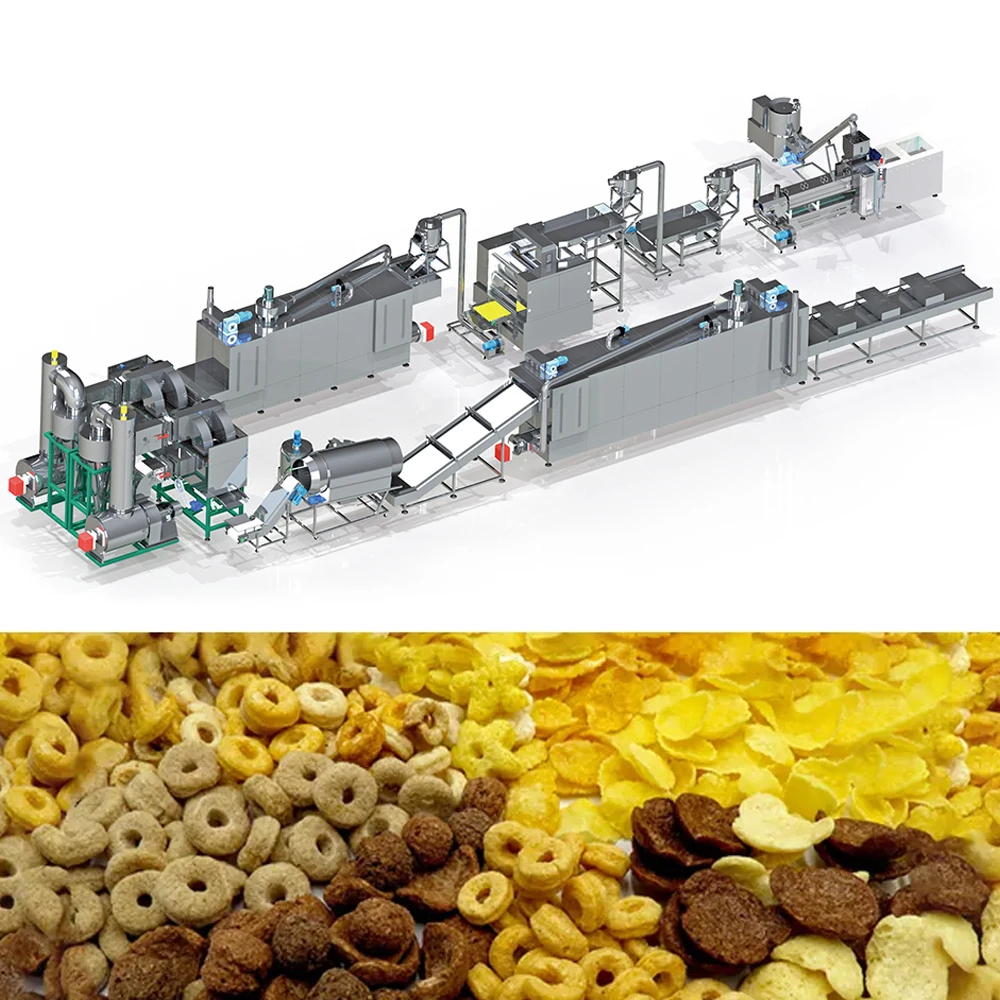
Screw Configuration Matched to Your Grain Blend — every MT75 barrel zone and die orifice is specified after trial runs on the buyer’s actual corn, wheat, or oat formula, so starch gelatinisation and flake density hit the target before the line ships.
Technical Specifications
| Parameter | Value |
|---|---|
| Product Type | Twin Screw Extrusion Corn Flakes Production Line |
| Model | MT70 / MT75 / MT85 |
| Screw Type | Twin Screw with automatic lubricating and cooling |
| Installed Power | MT70: 160 kW; MT75: 210 kW; MT85: 190 kW |
| Power Consumption | MT70: 120 kW; MT75: 150 kW; MT85: 140 kW |
| Output Capacity | MT70: 150–200 kg/hr; MT75: 300–500 kg/hr; MT85: 300–400 kg/hr (basis not stated in source) |
| Overall Dimensions | MT70: 41 × 1.5 × 2.2 m; MT75: 45 × 1.5 × 3.5 m; MT85: 43 × 1.5 × 3.2 m |
| Control System | PLC with MCC available per line configuration |
| Flaking Machinery | Hydraulic double rollers, separate motor drives, infrared temperature sensor |
| Dryer Heating Source | Gas or electric, configurable to facility supply |
| Roasting Oven | Hot air with conciliation burner, dual circulating fans, cyclone dust removal |
| Coating System | Double tumble sugar melter, elevator, coating drum, spraying nozzle |
| Voltage & Frequency | Customizable (commonly 415V 50/60Hz, 440V 50/60Hz, 220V 60Hz) |
| Line Assembly | Complete sequence: mixing → extruding → flaking → drying → roasting → coating → cooling → packing |
| Certification | CE, ISO |
Application Suitability
| Application | Material or Output |
|---|---|
| Natural corn flakes | Corn grits and corn flour at controlled moisture |
| Sugar-coated breakfast flakes | Corn base with syrup coating in the tumble drum |
| Multi-grain flakes | Wheat, oat, and barley blends requiring adjusted barrel temperature profiles |
| Shaped cereal pieces | Ball, tube, ring, star, and fruit loop forms via interchangeable die plates |
| Fortified cereal | Vitamin and mineral premix incorporated at the batching and mixing stage |
Why Generic Screw Builds Fail on Your Grain Formula
A corn flakes extrusion machine screw configuration die design copied from a standard build will produce the wrong expansion ratio and flake density when the buyer switches to a multi-grain or high-fibre blend. The screw profile and die orifice must be specified to the exact raw material formula, moisture content, and target flake thickness before production begins.
I spent two weeks in a breakfast cereal plant adjusting barrel zones and screw elements after the client replaced standard corn flour with their own whole-wheat premix. The expansion collapsed, flake density dropped below the market specification, and every downstream parameter — dryer retention time, roller gap on the flaker, roasting temperature — had to be recalculated. That kind of on-site rework is avoidable if the extrusion parameters are locked down during a pre-shipment trial on the buyer’s actual material [NEED_CITE: starch gelatinisation behaviour across cereal grain types].
Barrel Temperature Zones and Starch Gelatinisation Control
The twin-screw extruder uses a multi-zone heating system along the barrel to manage starch gelatinisation in stages. Early zones bring the grain blend to the gelatinisation threshold while later zones control the degree of cook and melt viscosity. Each zone is monitored and adjusted through the PLC, allowing the operator to dial in the exact thermal profile that a particular corn, wheat, or oat blend requires. Consistent zone control prevents under-cooked centres that produce brittle flakes and over-cooked surfaces that scorch during roasting.
Shear, Moisture, and Expansion Ratio
The intermeshing twin-screw geometry generates the shear energy needed to fully gelatinise starch at relatively low moisture levels compared to single-screw designs. Moisture injection points along the barrel let the operator fine-tune water activity inside the extruder, directly influencing the expansion ratio as the product exits the die. A corn flakes extrusion machine screw configuration die design that matches the grain blend ensures that the extrudate emerges with the correct density to survive flaking without shattering, and to develop the expected crunch after roasting [NEED_CITE: moisture-shear interaction in twin-screw cereal extrusion].
Die Orifice Geometry and Pellet Shape
The die plate at the extruder discharge determines the cross-section of the extrudate pellet that enters the flaking rollers. Round, slotted, or shaped orifices change how the pellet flattens and how evenly heat penetrates during drying. For shaped cereals such as rings, stars, or fruit loops, the die is paired with a face cutter that slices the extrudate at the die face. The screw elements immediately upstream of the die must generate sufficient pressure to fill every orifice evenly; otherwise, pellets emerge with uneven wall thickness and the flakes crack during the roller stage.
Reading the Specification Sheet for Production Impact
Installed power and power consumption figures across the MT70, MT75, and MT85 models reflect different motor sizes and throughput ranges, but the more telling parameter for process engineers is the relationship between screw speed, barrel length, and residence time. A longer barrel with more heating zones gives the operator greater control over the gelatinisation curve, which matters when switching between a simple corn grits formula and a multi-grain blend with varying starch and fibre content. The hydraulic flaking station with separate motor drives for each roller allows independent speed adjustment, so roller surface speed can be matched to the extrudate feed rate — a detail that directly affects flake thickness uniformity across the full roller width. The hot air roasting oven uses a conciliation burner and two circulating fans to create an even temperature field, which is essential for developing the characteristic surface bubbling and crispness that define a quality corn flake [NEED_CITE: hot air circulation uniformity in cereal roasting ovens].
The Hidden Cost of Mismatched Line Stations
An extruder that runs well in isolation can still bottleneck the entire line if the dryer, flaker, or roaster downstream cannot handle its output. When the flaking rollers cannot keep pace, extrudate backs up, cools below the plastic range, and shatters instead of flattening. When the roaster is undersized, flakes exit with residual moisture that shortens shelf life and dulls the crunch. These problems rarely surface during a short factory test with a single material; they appear weeks into production when the buyer runs a different formula or pushes for higher output [NEED_CITE: line throughput balancing in breakfast cereal processing].
Why Source the Extrusion Line Here
Screw configuration and die design are specified to the buyer’s raw material and target flake specification, not pulled from a generic template — the screw element record and die drawing are included in the documentation package. An in-house testing workshop allows trial runs on customer-supplied grain blends before the machine ships, so gelatinisation behaviour and expansion ratio are confirmed early. The complete line from batching through extrusion, flaking, drying, roasting, coating, and packing comes under one supplier, which means throughput is calculated across every station rather than left to the buyer to reconcile. PLC and MCC control systems are configurable with the operator language and alarm text the buyer’s team actually reads. Pre-sales consultation extends through on-site installation, commissioning, and operator training, with a wear parts list covering screws, dies, and roller surfaces for planned maintenance scheduling.
Documentation & Verification
- Line layout and capacity calculation matched across extruder, flaker, dryer, and roaster stations
- Screw and die configuration record tied to your grain formula and target flake density
- Trial run report on your raw material from the in-house testing workshop
- Electrical schematic with voltage and frequency confirmed to your facility supply
- Operation and maintenance manual with PLC screen descriptions in your language
- CE declaration of conformity and ISO certificate included with shipment documents
Installation, Commissioning & Support
- Foundation plan provided for the 45-metre line footprint including flaker and roaster load points
- Dedicated electrical circuit sized for the MT75 at 210 kW installed power with confirmed voltage
- Line arrives in modular sections with lifting points marked for workshop crane placement
- First-run commissioning includes barrel zone calibration and screw speed ramp-up on your material
- Operator training covers PLC parameter adjustment, die changeover, and roller gap setting
- Wear parts list covers screw elements, die plates, and flaking roller sleeves for first reorder
What to Include in Your Inquiry
Send your grain formula or raw material data sheet, target flake thickness and density specification, and daily output requirement so the line capacity can be calculated station by station. Include your facility voltage, frequency, and preferred control language so the electrical schematic and PLC screens are prepared before production. If you are running a new blend that has not been extruded before, request a trial run in the testing workshop to confirm the corn flakes extrusion machine screw configuration die design before the line is finalised.
Frequently Asked Questions
Q: How is screw configuration selected for different grain blends?
A: Each grain — corn, wheat, oat, barley — has a different starch gelatinisation temperature and fibre content. Screw element arrangement, compression ratio, and barrel zone temperatures are adjusted to match the specific blend. A configuration record is created for your formula and included in the documentation, so the setup is repeatable across production runs and future reorders use the same baseline.
Q: What barrel temperature and moisture levels are needed for proper gelatinisation?
A: Target temperatures and moisture injection rates depend on the grain blend and desired expansion ratio. The PLC allows zone-by-zone adjustment, and the in-house testing workshop can establish the correct profile on your material before shipment. This avoids on-site trial and error that delays commissioning and risks producing off-spec flakes during the learning period.
Q: How is line capacity verified before the equipment ships?
A: A trial run is conducted in the testing workshop using your raw material at the intended moisture level. Extruder output, flake thickness from the hydraulic rollers, and roaster throughput are measured together so that every station is confirmed to handle the target rate without creating a bottleneck upstream or downstream.
Q: How does the flaking station maintain uniform thickness?
A: The hydraulic double-roller system uses separate motors for each roller, allowing independent speed adjustment. An infrared sensor monitors roller surface temperature, and the PLC adjusts the gap and speed to keep flake thickness consistent across the full roller width, preventing thin edges that over-roast and thick centres that retain moisture.
Q: How is downstream capacity matched to the extruder?
A: Dryer residence time, roaster belt speed, and coating drum volume are calculated against the extruder output for your specific product. The line layout document shows each station’s capacity so you can see the throughput balance before the order is confirmed, reducing the risk of one station limiting the entire line.