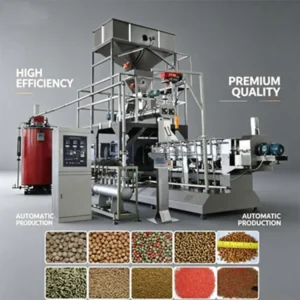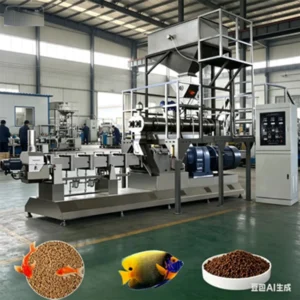
Screw Configuration Matched to Formulation — Every barrel segment and die land length is calculated against the buyer’s specific fish meal ratio, starch content, and target buoyancy, not copied from a generic build.
Technical Specifications
| Parameter | Value |
|---|---|
| Product Type | Twin Screw Fish Feed Extruder Production Line |
| Extruder Type | Twin screw |
| Control System | Intelligent PLC automatic control |
| Material Contact Parts | Food-grade 304 stainless steel |
| Screw Configuration | Matched to raw material and target pellet specification (basis not stated in source — confirm screw diameter / L:D ratio / die configuration) |
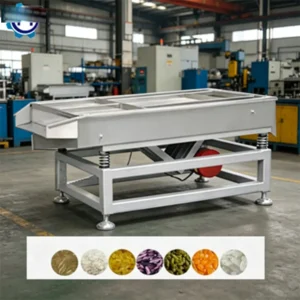
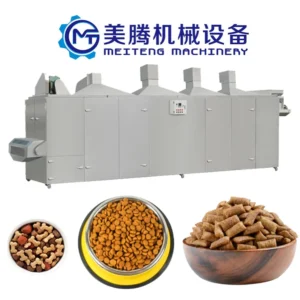
| Line Stations | Raw material mixer, extruder, dryer, seasoning coating machine, vibrating sieve, conveyor equipment |
| Output Capacity | Medium to large scale continuous production (basis not stated in source — confirm kg/h based on raw material formulation and moisture content) |
| Pellet Size and Hardness | Adjustable according to breeding requirements (basis not stated in source — confirm die format and range) |
| Pellet Buoyancy | Supports both floating and sinking pellets |
| Automation Level | Full continuous automatic production from mixing through extrusion, drying, seasoning, screening to finished product discharging |
| Energy Design | Optimized energy saving transmission structure and heating system (rated power not specified in source) |
| Voltage & Frequency | Configurable to target market (basis not stated in source — confirm voltage, frequency and phase) |
| Overall Dimensions | Dependent on line configuration (basis not stated in source — confirm L×W×H) |
| Assembly State | Complete matched production configuration |
| Standards | CE, ISO, food-grade 304 stainless steel compliant with international food hygiene standards |
Application Suitability
| Application | Material or Output |
|---|---|
| Floating aquatic feed pellets | Koi, goldfish, tropical fish, and freshwater fish formulations based on fish meal, soybean meal, corn powder |
| Sinking aquatic feed pellets | Bottom-feeding species requiring controlled density without compromising starch gelatinisation |
| Dry pet food kibble | Corn, meat meal, and compound additive blends at varying moisture ratios |
| Compound additive processing | Vitamin premix and functional ingredient incorporation into base starch matrix |
What Happens When the Screw Profile Ignores Your Formula
The twin screw fish feed extruder extrusion technology fails the moment the screw configuration is copied from a previous customer’s build rather than matched to your actual raw material blend.
Density and buoyancy are determined inside the barrel, not at the die face.
I have watched aquaculture producers run high-fishmeal formulations through generic screw sets and end up with floating pellets that sink within minutes — an entire production batch written off because the shear profile and compression ratio were never calculated for that specific protein-to-starch ratio. The barrel temperature zones were set to a default profile that undercooked the starch, leaving the pellet core ungelatinised and structurally weak. These are not edge cases; they represent a recurring pattern when extrusion line suppliers treat screw configuration as a catalogue selection rather than an engineering exercise tied to the buyer’s formulation [NEED_CITE: starch gelatinisation requirements for aquatic feed extrusion].
Shear, Residence Time, and the Starch Gelatinisation Window
The twin screw fish feed extruder extrusion technology relies on mechanical shear and thermal input working together to push starch granules past their gelatinisation threshold. Twin-screw geometry allows independent adjustment of screw speed and barrel temperature across multiple heating zones, giving the operator control over how aggressively the material is worked. A high-fishmeal blend requires a different compression sequence than a corn-dominant formula, and the modular screw elements make that adjustment possible without replacing the entire shaft assembly.
Barrel Temperature Profiling Across Heating Zones
Each barrel segment carries its own heating and cooling circuit, creating a temperature gradient that moves the material through preconditioning, melting, and metering stages. The PLC system monitors these zones continuously, adjusting power delivery to hold the setpoint despite fluctuations in feed rate or ambient workshop temperature. Maintaining this profile is what separates a pellet that holds its structure in water from one that disintegrates or sinks prematurely [NEED_CITE: barrel temperature control in twin-screw food extrusion].
Reading the Specs That Actually Matter for Pellet Density
The L:D ratio of the screw assembly determines how long the material stays under pressure and heat — a longer barrel gives more residence time for complete starch cooking, which is critical when processing high-protein aquatic formulations that resist gelatinisation. Die land length controls back-pressure at the exit point, directly influencing expansion ratio and final pellet density. Food-grade 304 stainless steel contact surfaces prevent corrosion from the chloride content common in fish meal blends, extending service intervals between screw and barrel replacements. The intelligent PLC control ties mixer feed rate, extruder screw speed, and dryer temperature into one coordinated loop, so a change in one parameter triggers compensating adjustments downstream rather than letting the line drift out of specification.
The Cost of Skipping the Trial Run
Producers who accept shipment without a factory trial on their own raw material frequently discover during commissioning that the pellet density falls outside market specification. Reworking the screw configuration on-site means halted production, wasted raw material, and missed delivery windows while the supplier ships replacement elements. I have seen floating feed lines produce only sinking output for the first several days of operation because the die geometry was never validated against the buyer’s actual corn-to-soybean ratio [NEED_CITE: extrusion line commissioning delays from untested configurations].
Why This Line Is Configured Before It Is Quoted
The testing workshop runs your raw material through the proposed screw and die set before any commercial commitment is finalised, generating a trial report that documents expansion ratio, density, and surface finish. Screw configuration and die design are recorded against your specific formulation, so reorders use the same build parameters rather than starting from scratch. Line throughput is calculated station by station — mixer output matched to extruder intake, dryer capacity matched to extruder discharge — so no single station bottlenecks the sequence. Voltage, frequency, and HMI language are confirmed against the destination facility before electrical panels are wired. CE and ISO compliance is documented with certificates that align to the machinery directive requirements for your export market.
Documentation & Verification
- Line layout and capacity calculation showing throughput balance across all stations from mixer to screening
- Screw and die configuration record tied to your raw material formulation and target pellet buoyancy
- Trial run report on customer raw material documenting density, expansion ratio, and surface quality
- Electrical schematic with confirmed voltage, frequency, phase, and control language for destination market
- CE declaration of conformity and ISO certificate matching the exported machinery classification
- Wear parts list specifying screw elements, die inserts, and barrel liners with replacement intervals
Installation, Commissioning & Support
- Foundation plan accounts for extruder vibration isolation and dryer thermal expansion clearances
- Dedicated electrical circuit sized for combined heater and main drive motor load
- Modular line stations arrive in sequence for staged assembly matching workshop access constraints
- First-run parameter setting covers screw speed, barrel zone temperatures, and dryer dwell time
- Operator training addresses PLC interface navigation, alarm response, and recipe storage
- Spare screw elements and die inserts ship with initial order to cover first replacement cycle
Before You Send the Inquiry
Share your raw material formulation with the protein, starch, and moisture percentages, along with whether the target market expects floating or sinking pellets. Specify the local voltage, frequency, and whether the HMI needs to display in a language other than English. If you are integrating this line with existing upstream mixing or downstream packing equipment, provide the interface dimensions and throughput rates so the conveyor transitions can be designed before fabrication [NEED_CITE: industrial voltage and frequency standards by region].
Frequently Asked Questions
Q: How is screw configuration and die design matched to my raw material formulation and target pellet buoyancy?
A: The engineering team reviews your ingredient ratios — fish meal, soybean meal, corn powder, and additives — then selects screw element profiles, compression ratios, and die land lengths that produce the required expansion and density. This configuration is tested in the workshop on your actual material before the build is finalised.
Q: Can a trial run on my actual raw material be performed before shipment to verify pellet density and expansion?
A: Yes. The in-house testing workshop processes a sample of your formulation through the proposed screw and die set, generating a report that records pellet density, surface finish, and expansion ratio. You receive this report before approving shipment.
Q: How is the barrel temperature profile controlled across heating zones during extrusion?
A: The PLC system manages individual heating and cooling circuits on each barrel segment, holding setpoints within a narrow band. Operators can adjust zone temperatures independently from the control panel to fine-tune starch gelatinisation without stopping the line.
Q: How does the PLC control system coordinate the full line from mixing to screening for continuous throughput?
A: The intelligent PLC links mixer discharge rate, extruder screw speed, dryer belt speed, and seasoning drum rotation into one automated loop. A change at any station triggers proportional adjustments downstream, maintaining steady material flow without manual intervention.
Q: What documentation is provided for starch gelatinisation degree, moisture range, and expansion ratio?
A: The trial run report records measured expansion ratio, pellet density, and moisture content at the dryer exit. The screw and die configuration record documents the build parameters that produced those results, allowing consistent replication on future production runs.