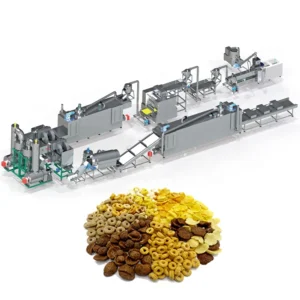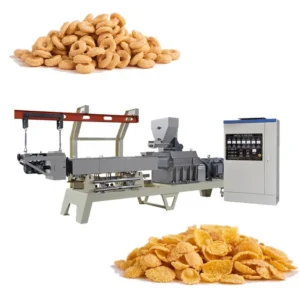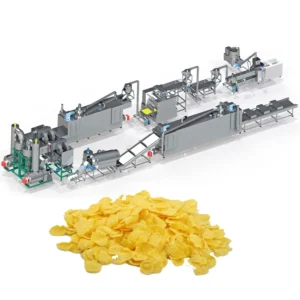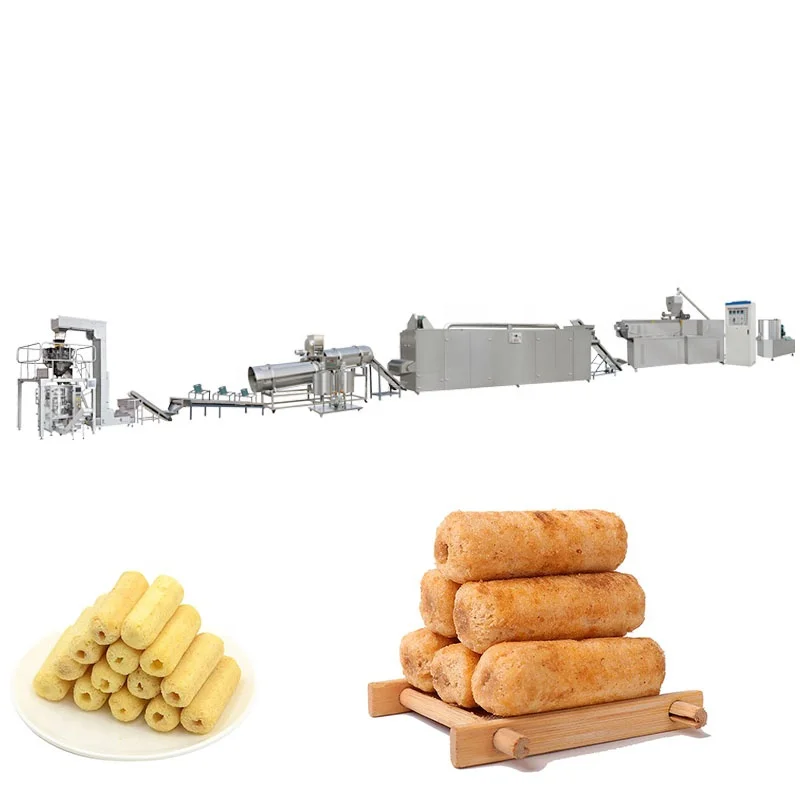
Screw Geometry Dictates Flake Quality — MT75 twin-screw configuration and die profiles are specified to the buyer’s grain base and target bowl-life density, not copied from generic builds.
Technical Specifications
| Parameter | Value |
|---|---|
| Model | MT75 |
| Product Type | Twin Screw Extruder Corn Flakes Production Line |
| Screw Type | Twin-screw with automatic lubricating and cooling |
| Installed Power | 210 kW |
| Power Consumption | 150 kW |
| Output Capacity | 200–300 kg/h (basis not stated in source — confirm raw material / moisture) |
| Overall Dimensions | 45 × 1.5 × 3.5 m |
| Control System | PLC and MCC integrated control |
| Dryer Heating Source | Gas or Electric (configurable) |
| Flaking Machinery | Hydraulic double-roller system with separate motors and infrared temperature control |
| Hot Air Roasting Oven | Vibrating pan, conciliation burner, dual circulating fans, cyclone dust removal |
| Coating System | Double tumble sugar melting, elevator, coating drum, spraying nozzle |
| Raw Materials | Corn, rice, wheat, oat, barley powder |
| Assembly State | Complete turnkey line from batching to packing |
| Voltage & Frequency | Customized to local supply (to be confirmed) |
| Standards | CE, ISO |
Application Suitability
| Application | Material or Output |
|---|---|
| Natural corn flake production | De-germed corn grits with controlled fat content |
| Sugar-coated breakfast cereal | Corn or wheat base with syrup enrobing |
| Multi-shape cereal snacks | Rice, oat, and barley blends using interchangeable dies |
| Fortified cereal processing | Grain powder mixed with vitamin and mineral premix |
Why Generic Screw Builds Sink Corn Flakes in Milk
The corn flakes extruder screw configuration die design must match your actual raw material, not a catalog default.
A screw setup optimized for standard corn flour behaves differently when faced with de-germed corn grits that carry higher residual fat. The fat interferes with starch gelatinisation inside the barrel, reducing expansion at the die face. When those under-expanded pellets pass through the flaking rollers and enter the hot air roasting oven, they lack the internal bubble structure needed to produce a crisp, buoyant flake. The result is a dense flake that sinks in the bowl and shatters under sugar coating [NEED_CITE: starch gelatinisation interference by lipid content in extrusion].
I have watched entire trial batches disintegrate because the screw elements were arranged for a generic corn powder profile while the buyer was running a coarser grit with different moisture absorption. The extruder ran fine mechanically — the problem only appeared after roasting and packing, when the product failed the bowl-life test.
How Twin-Screw Geometry Shapes Starch Gelatinisation
The twin-screw extruder processes grain through distinct functional zones: conveying, preconditioning, melting, and metering. Each zone uses specific screw element types — forward-pitch flights, kneading blocks, and reverse elements — to control residence time and shear intensity. For corn flakes, the goal is partial gelatinisation: enough to make the pellet pliable for flaking, but not so much that the starch structure collapses during roasting.
The barrel temperature profile works in tandem with screw geometry. Independent heating zones allow operators to set a gradient that matches the corn flakes extruder screw configuration die design sequence, keeping moisture migration predictable from feed inlet to die face [NEED_CITE: barrel zone temperature profiling in twin-screw cereal extrusion].
Die Geometry and the Bubble Structure That Defines Crunch
The die orifice diameter and land length determine the pressure drop at exit, which directly governs how many steam bubbles nucleate inside each pellet. Too few bubbles produce a glassy pellet that flakes into a hard chip. Too many create a fragile foam that disintegrates in the coating drum.
For corn flakes destined for hot air roasting, the die must produce a pellet with uniform micro-bubble distribution. This internal architecture expands further when exposed to the roasting oven’s high-temperature air, giving the final flake its characteristic crunch. Adjusting die geometry is how the same MT75 platform switches between natural flakes, sugar-coated variants, and multi-shape formats like rings or fruit loops by changing the mould insert.
Reading the Specs That Matter for Cereal Extrusion
The 210 kW installed power on the MT75 indicates the mechanical and thermal energy available for processing high-viscosity grain doughs. Corn and oat blends require more torque than rice-based formulations, and undersized motors lead to screw stall during production ramp-up.
The PLC and MCC control system allows operators to save and recall recipes — specific combinations of screw speed, barrel temperatures, feeder rates, and moisture injection levels. This matters when a plant runs natural corn flakes on Monday and switches to a wheat-oat blend on Wednesday.
The hydraulic double-roller flaking machinery with infrared temperature sensing maintains consistent gap pressure and roll surface condition. Uneven roller temperature causes differential flake thickness, which then roasts unevenly — some flakes burn while others remain doughy.
The vibrating pan hot air roasting oven with cyclone dust removal keeps fines from recirculating and contaminating the product stream, a common source of burnt particle defects in cereal lines.
What Happens When Line Stations Are Mismatched
An extruder producing pellets faster than the flaking rollers can process them creates a bottleneck where pellets cool and harden in the buffer conveyor. Hardened pellets resist flattening, producing cracked flakes that fail visual inspection.
Conversely, a roasting oven with insufficient residence time cannot develop the bubble structure the die geometry was designed to initiate. The flakes exit chewy rather than crisp, and sugar coating slides off the surface instead of adhering. These mismatches are not visible on individual machine spec sheets — they emerge only when throughput is calculated across every station from mixing to packing [NEED_CITE: throughput balancing in cereal extrusion line design].
Why Buyers Specify This Extrusion Platform
Screw configuration and die design are documented against your specific raw material formulation, not pulled from a standard template. Every element arrangement is recorded and reproducible.
The in-house testing workshop runs your actual grain base — whether de-germed corn grits, oat flour, or barley blend — before shipment, so gelatinisation behavior and expansion rate are validated on your material.
The line integrates every station from batching through extrusion, flaking, drying, hot air roasting, coating, cooling, and packing under one supply contract, so throughput is matched across all stages.
CE and ISO certification covers the complete line assembly, which simplifies import documentation and machinery directive compliance in regulated markets [NEED_CITE: CE machinery directive requirements for food processing equipment].
Documentation & Verification
- Screw and die configuration record specifying element arrangement for your grain formulation
- Trial run report on your raw material documenting expansion rate and pellet density
- Line layout with capacity calculation matching throughput from mixer to packer
- Electrical schematic with voltage and frequency confirmation for your facility
- Machine specification sheet covering all stations and utility requirements
- Operation and maintenance manual with wear parts list and replacement intervals
Installation, Commissioning & Support
- Foundation plan accommodating the 45-meter line footprint and flaking machinery hydraulic load
- Dedicated electrical circuit sized for 210 kW extruder plus dryer and roasting oven heating elements
- PLC and MCC panel setup with operator interface language matching your production team
- First-run parameter logging across all barrel zones and flaking roller gap settings
- Operator training covering recipe recall, screw speed adjustment, and die changeover procedure
- Wear parts inventory including replacement screw elements, die inserts, and flaking roller surfaces
What We Need to Configure Your Line
Provide the specific grain base you intend to process — corn grits, oat flour, rice blend — along with typical moisture content and fat percentage from your supplier certificate of analysis.
Share your target flake format, whether natural corn flakes, sugar-coated, or multi-shape cereal, and the daily production volume your market requires.
Confirm your facility voltage and frequency, available ceiling height for the drying and roasting stations, and whether you need the line to integrate with existing upstream mixing or downstream packing equipment.
Frequently Asked Questions
Q: How is screw configuration determined for different grain bases like corn versus oat?
A: Each grain has distinct starch composition, protein content, and lipid levels that affect gelatinisation temperature and melt viscosity. We run your actual raw material in the testing workshop, adjusting kneading block arrangement, reverse element placement, and barrel zone temperatures until pellet expansion and density match your flake specification. The final screw configuration is documented and supplied with the machine.
Q: What barrel temperature profile produces optimal starch gelatinisation for corn flakes?
A: Corn flakes require partial gelatinisation — enough to make pellets pliable for flaking without collapsing the starch matrix. The profile typically starts moderate at the feed zone and increases through the melting section, with the metering zone held at a level that controls moisture migration. Exact setpoints depend on your corn grit particle size and moisture content, validated during the pre-shipment trial run.
Q: How does die design affect flake expansion during hot air roasting?
A: Die orifice diameter and land length control the pressure drop at exit, determining how many steam bubbles nucleate inside each pellet. The corn flakes extruder screw configuration die design sequence produces a micro-bubble structure that expands further in the roasting oven, creating the characteristic crisp texture. Die geometry is selected based on your target flake density and bowl-life requirements.
Q: Can the same extruder run multiple cereal shapes from one platform?
A: Yes. The MT75 platform supports natural flakes, sugar-coated variants, and shapes like rings, balls, tubes, and fruit loops by changing the die insert and adjusting the cutting system. Screw configuration may also be modified if the new shape requires different expansion behavior. Mould changeover is documented in the operation manual with the corresponding recipe parameters.
Q: What trial run data is provided on my raw material before shipment?
A: The testing workshop trial produces a documented report covering screw speed, barrel temperatures at each zone, moisture addition rate, pellet expansion ratio, and bulk density. Flaking and roasting parameters are also recorded if the full line is being tested. This report travels with the machine so your production team has validated starting parameters for commissioning.