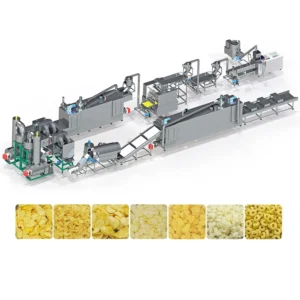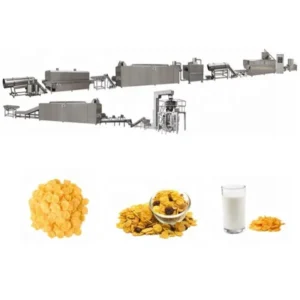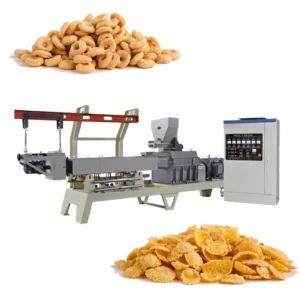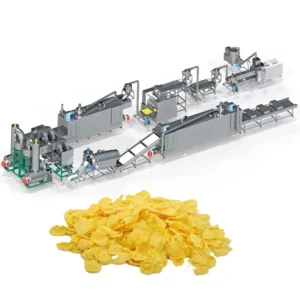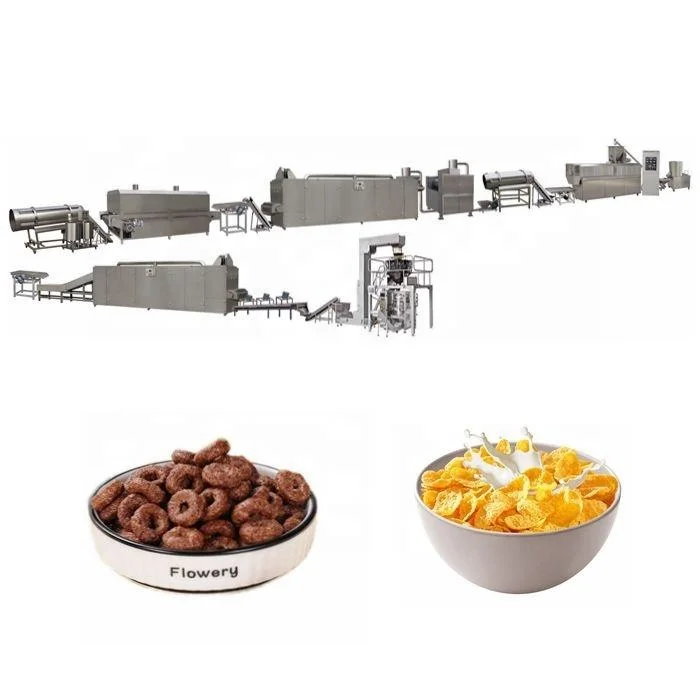
Screw Configuration Matched to Material — every die profile and screw element is selected after reviewing your cereal powder blend and target flake density, not copied from a generic build.
Technical Specifications
| Parameter | Value |
|---|---|
| Product Type | Twin-Screw Extruded Corn Flakes Breakfast Cereal Production Line |
| Models Available | MT70 / MT85 / MT75 |
| Installed Power | MT70: 160 kW / MT85: 190 kW / MT75: 210 kW |
| Power Consumption | MT70: 120 kW / MT85: 140 kW / MT75: 150 kW |
| Output Capacity | MT70: 150–200 kg/h, MT85: 300–400 kg/h, MT75: 300–500 kg/h (basis not stated in source — confirm raw material, moisture, product format) |
| Overall Dimensions | MT70: 41 × 1.5 × 2.2 m / MT85: 43 × 1.5 × 3.2 m / MT75: 45 × 1.5 × 3.5 m |
| Extruder Screw Type | Twin-screw |
| Flaker Control | PLC with hydraulic double-roller system, separate roller motors, infrared temperature monitoring |
| Dryer Heating Source | Gas or electric, configurable |
| Roasting Oven | Hot air roasting with vibrating pan, dual circulating fans, cyclone dust removal |
| Coating System | Double tumble drum for sugar melting, elevator, coating drum, spraying nozzle |
| Line Stations (Natural) | Mixing → Extruding → Flaking → Drying → Hot Air Roasting → Cooling → Packing |
| Line Stations (Sugar-Coated) | Adds sugar spraying and secondary drying stage after roasting |
| Extruder Working Principle | Feeding, extruding, cutting, heating, gearing, and controlling systems integrated |
| Certifications | CE, ISO |
Application Suitability
| Application | Material or Output |
|---|---|
| Natural corn flakes | Corn grits and corn flour blends |
| Sugar-coated corn flakes | Corn base with sugar syrup coating |
| Shaped breakfast cereals | Rice, wheat, oat, and barley powders formed into loops, rings, stars, balls, tubes, sticks |
| Expanded snack variants | Same extrusion platform with adjusted screw configuration and die |
What "300 kg/h" Actually Means on Your Material
A quoted capacity is only as reliable as the raw material behind it.
I remember a line we shipped to Southeast Asia last year — the screw configuration was dialed in for a standard corn grit recipe from our testing workshop. The customer switched to a high-fat corn flour locally, and the expansion collapsed. Flakes came off the rollers shattered, and it took two weeks of on-site adjustment to stabilize the texture. When evaluating a corn flakes extrusion production line turnkey proposal, the number on the spec sheet means very little if it was never tested against your specific powder blend, fat content, and moisture level [NEED_CITE: raw material variability in extrusion processing]. Fat above a certain threshold suppresses starch gelatinisation, which directly reduces expansion and compromises the flake integrity that downstream rollers depend on. That is why every configuration we ship now starts with a sample of your actual material running through our testing workshop before the extruder leaves the floor.
How Screw Geometry Controls Flake Density
The twin-screw extruder in this line handles cereal dough under controlled shear, moisture, and temperature profiles. The screw element arrangement — conveying, kneading, and reverse elements — determines residence time and the degree of starch gelatinisation inside the barrel. A corn flakes extrusion production line turnkey setup depends on getting this balance right: too little gelatinisation and the pellet will not flatten cleanly through the flaker; too much and the dough becomes overly plastic, producing flakes that are dense and tough rather than crisp. The die opening diameter and face-cutting speed further control pellet length, which directly translates to final flake size after rolling.
Barrel Temperature Profile and Moisture Management
Each barrel section carries independent heating zones that maintain a specific temperature gradient from the feed inlet to the die plate. For corn-based cereals, the profile typically ramps from moderate heat at the feed zone to higher temperatures near the die, ensuring that moisture is driven into the starch granules progressively rather than flashing off too early. The moisture content at the barrel inlet — usually adjusted at the mixer — interacts with this thermal profile to set the expansion ratio [NEED_CITE: starch gelatinisation temperature ranges for cereal extrusion]. If your local corn variety absorbs water differently, the entire temperature ladder may need recalibration, which is exactly the kind of variable that only a pre-shipment trial run can expose.
Reading the Power and Dimension Data
The installed power across the three models — ranging from 160 kW on the MT70 to 210 kW on the MT75 — reflects the motor capacity available at the extruder main drive, not continuous draw. Power consumption figures are lower because heaters, cutters, and auxiliary drives cycle on and off during steady-state operation. The overall line length spans 41 to 45 meters depending on model, which includes every station from the mixer through to the cooling conveyor. The flaker uses a hydraulic double-roller system with separate motors for each roller, allowing independent speed control to maintain uniform flake thickness across the full roller width. Infrared sensors monitor pipe temperature in the flaking zone to prevent the pellet from cooling too much before it passes through the nip, which would cause cracking rather than clean compression.
The Downstream Bottleneck That Spec Sheets Hide
A common failure mode on assembled lines is an extruder that produces faster than the dryer or roaster can handle. The corn sits on the drying belt with residual moisture still locked in the core, and by the time it reaches the roasting oven, the surface has already set into a hard shell that prevents proper blistering. On a properly engineered corn flakes extrusion production line turnkey project, the dryer belt length and roasting oven volume are calculated against the extruder output at your specific moisture reduction target, not against a generic throughput figure [NEED_CITE: throughput matching across extrusion line stations]. When stations are sourced from separate vendors, this matching rarely happens at the design stage, and the bottleneck only becomes visible during commissioning — when you are already paying for downtime.
Why Sourcing from One Supplier Matters Here
Every station on this line — mixing, extruding, flaking, drying, roasting, cooling, and packing — is sized and specified under a single engineering scope. The screw configuration and die design are documented against your raw material sample, not pulled from a standard library. The flaker, dryer, and roasting oven capacities are calculated to match the extruder output at your target moisture and flake thickness, preventing the downstream bottlenecks that plague multi-vendor assemblies. Before shipment, the complete configuration runs in the in-house testing workshop using your actual material, and a trial run report is generated. Pre-sales consultation, on-site installation, commissioning, operator training, and ongoing wear parts support all come from one accountable source rather than fragmented across several equipment vendors.
Documentation & Verification
- Line layout showing throughput calculations matched across every station from mixer to packer
- Screw and die configuration record specifying element arrangement for your cereal blend
- Trial run report from testing workshop using your raw material before dispatch
- Electrical schematic with voltage and frequency confirmed for your facility
- Operation and maintenance manual with wear parts list for screws, dies, and roller surfaces
- CE declaration of conformity and ISO certificate included with shipping documents
Installation, Commissioning & Support
- Foundation plan accounts for the 41–45 m line length and flaker hydraulic load points
- Dedicated power circuit sized to the MT70/MT85/MT75 installed power rating at your local voltage
- Extruder barrel sections and flaker rollers ship disassembled for container loading and on-site reassembly
- First-run parameter setting includes screw speed, barrel temperatures, and flaker nip gap adjustment
- Operator training covers PLC interface navigation, recipe storage, and emergency stop sequences
- Wear parts inventory includes replacement screw elements, die plates, and flaker roller shells
What to Include in Your Inquiry
Send a representative sample of your cereal powder blend along with the target flake format — natural, sugar-coated, or shaped — and the daily output you need to sustain. Include your facility voltage, frequency, and available floor length so the layout can be drafted to match your building constraints. If you have existing upstream milling or downstream packing equipment, note the interface specifications so the line can be designed to connect without modification.
Frequently Asked Questions
Q: How is line capacity verified against my specific raw material and moisture content?
A: We request a sample of your actual cereal blend and run it through the extruder in our testing workshop before production begins. The trial documents expansion ratio, pellet density, and flake integrity at your target moisture level, and the screw configuration is adjusted if the results fall outside specification.
Q: How do you match dryer and flaker throughput to the extruder to prevent bottlenecks?
A: Each station is calculated against the extruder output at your specific moisture reduction target. Dryer belt length, roasting oven volume, and flaker roller speed are all set during the line design phase so that no single station restricts the flow from the extruder die to the cooling conveyor.
Q: Can I run a trial on my raw material before shipment, and what does the report include?
A: Yes. The trial run uses your supplied material and produces a report covering screw speed, barrel temperature profile, die configuration, pellet dimensions, and final flake thickness. This document ships with the line and serves as the baseline recipe for commissioning at your facility.
Q: What does phased installation and commissioning look like for a complete cereal line?
A: The line arrives in sections aligned to the layout drawing. Mechanical assembly proceeds station by station from the mixer forward, followed by electrical connection, PLC programming verification, and a production run using your material to confirm that throughput and product quality match the trial run report.
Q: How are voltage, control language, and utility requirements confirmed before production?
A: During the specification review stage, we confirm your local voltage, frequency, and preferred PLC language. The electrical schematic is drawn to match these parameters, and the control panel is wired and labeled accordingly before the factory test, so no rewiring is needed at your site.